Architecture Audio Tour for Travelers on Foot
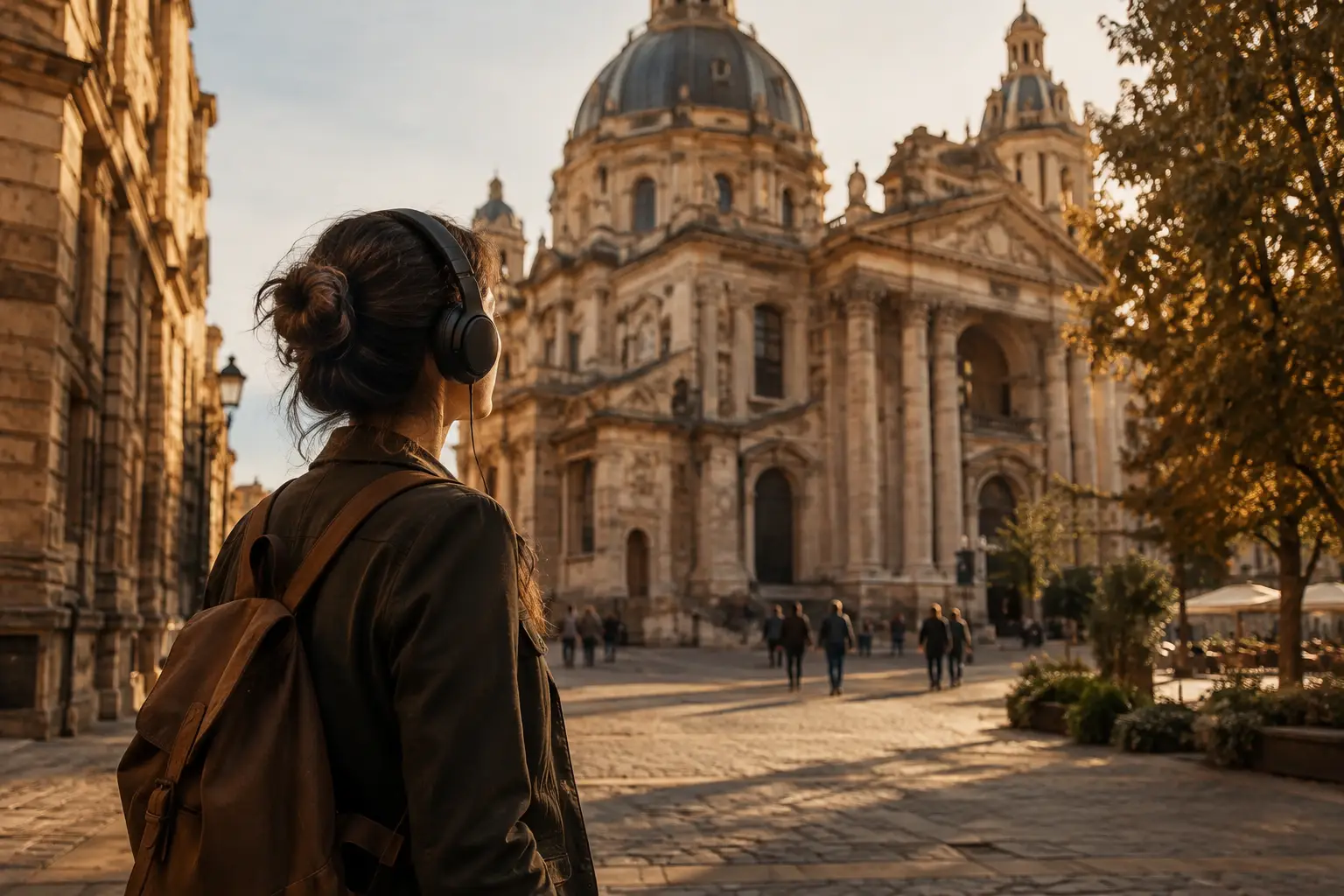
An architecture audio tour for travelers turns a city walk into a clear story of stone, steel, streets, and daily life, at your own pace for a better walk.
A façade gives you only half the story. You can stand under the carved lions of Florence’s Palazzo Vecchio, look up at the ironwork along Barcelona’s Passeig de Gràcia, or cross the glassy lobby of a New York tower and still miss what changed there. An architecture audio tour for travelers gives the building a voice while your eyes remain on the street.
That matters because architecture is not only about famous names and dramatic skylines. It explains why one neighborhood has narrow shaded lanes and another has wide boulevards, why apartment balconies face an inner courtyard, and why a train station is built to make you feel small before you board. A good tour turns a walk into a sequence of choices made by rulers, merchants, engineers, tenants, and families.
What an architecture audio tour should do
The useful kind does not recite dates beside every doorway. It helps you notice the evidence in front of you. You hear why the lower floors are heavy stone while the upper floors use lighter brick, then you can see the change with your own eyes. You learn how a public square once worked as a market, parade ground, water source, or meeting place.
It also gives you a route. This is more valuable than it sounds when you arrive in an unfamiliar city with two hours before dinner. Architecture is spread across streets, bridges, civic buildings, housing blocks, parks, and industrial edges. Without a sequence, you may spend the afternoon crossing town for one landmark and pass the more revealing streets without knowing it.
The strongest tours move between the grand and the ordinary. In Paris, that may mean reading the broad lines of a nineteenth-century boulevard, then noticing the service entrances, shopfronts, and uniform balconies that make the avenue work. In Tokyo, it may mean leaving a polished commercial tower to look at the tight plots and small lanes behind it. The contrast is often the point.
Choose the right architecture audio tour for travelers
Start with the question you actually have. If this is your first morning in a city, choose a walk that gives you orientation: a river, central square, main avenue, older district, and a few turning points in the city’s growth. You need the map in your head before you need a long account of a single architect.
If you already know the center, choose a focused route. A walk through Berlin’s postwar streets, the Art Nouveau blocks of Riga, or the warehouses around a former port can reveal more than another lap around the postcard monuments. Look for a guide that says where it begins, how far it goes, and what kind of buildings it follows. “City architecture” is too broad to be useful on a rainy afternoon.
Language matters as much as subject. Architecture has its own vocabulary, and you should not have to translate every other sentence while trying to cross a busy road. Clear narration in a language you understand lets you concentrate on proportion, material, sound, and movement. Lokali provides free narrated and written guides in 45 languages across more than 190 cities, which is particularly useful when the official site guide exists only in a few languages.
Offline access is practical rather than glamorous. Stone walls, underground passages, crowded squares, and foreign data plans are poor conditions for depending on a signal. Download the guide and map before you leave your lodging, then keep your phone in your pocket between stops. You are there to look up, not to watch a loading symbol.
Build the walk around light, distance, and attention
Architecture changes with the hour. A white limestone façade at noon can look flat; later, a low sun may bring out window frames, cornices, and old repairs. If your route includes a waterfront or a civic square, begin when you have enough daylight to see how the buildings meet the open space. Save an interior-heavy museum or station for the part of the day when heat, cold, or rain makes the street less pleasant.
Do not try to cover an entire style in one day. A six-kilometer walk with six meaningful stops is usually richer than a frantic route through twenty buildings. Leave time to stand across the street, walk around a corner, and look back. The view from fifty meters away often explains the building better than the view at its front door.
Use the audio as a prompt, not a command. If a courtyard is full of children leaving school, pause the narration. If a market street pulls you away from the marked route, follow it for a block and return later. A self-guided tour works because it gives you context without asking you to keep pace with a raised umbrella.
There is one useful rule: listen before you photograph. A photograph taken after you understand the purpose of an arch, stair, or tower is more likely to show what caught your attention. It also prevents the familiar travel habit of collecting façades you cannot identify the next week.
Learn to read more than the landmark
At each stop, look for three things: material, use, and surrounding space. Material tells you what was available, affordable, fashionable, or technically possible. Brick, timber, concrete, glazed tile, and cast iron each leave different marks as they age.
Use tells you who the building serves. A city hall announces authority differently from a bathhouse, apartment block, mosque, library, factory, or railway station. Look at doors, stairs, loading bays, waiting areas, and windows at street level. They often reveal the daily life that a grand front façade tries to hide.
Surrounding space tells you whether the building stands apart or belongs to a larger plan. In a medieval lane, a projection over the street can create shade and make the passage feel intimate. Along a planned boulevard, repeated heights and regular windows create a shared rhythm. Neither is accidental, even where later renovations have blurred the original pattern.
You do not need to memorize terms such as pilaster, clerestory, or cantilever unless they help you see. Plain questions are enough. Why is the entrance so high? Why do the windows get smaller above the first floor? Why is this public building facing the water rather than the street? The answers connect design to money, climate, power, and everyday movement.
When audio is not enough
An audio guide is not always worth using. Skip it when you are exhausted, traveling with someone who wants an unplanned wander, or visiting a building where silence is part of the experience. In a small chapel, a memorial, or a busy food market, a screen and earbuds can put a layer between you and the place.
It also has limits inside complex museums. If you are standing before a model, drawing, or fragile object and need to ask why it matters, a written label may be clearer than walking narration. Read the guide text when you want to slow down, compare details, or check a name without rewinding audio beside other visitors.
A human guide is often the better choice for a dense historic district, a building with restricted areas, or a subject you already know well. A knowledgeable person can answer the question that occurs to you at that exact doorway and can adjust the route when a street is closed or an interior is inaccessible. Scheduled walking tours also add conversation, which some people want. The trade-off is cost, fixed timing, and moving at the group’s speed.
Let the city continue after the route ends
The point of an architecture walk is not to finish every stop. It is to make the next street more legible. After hearing why a square was reshaped or how a neighborhood expanded beyond its old walls, you begin to notice similar decisions on your way to lunch, the station, or your hotel.
Leave one unscripted block at the end. Sit where you can watch people use the space: bicycles cutting across a plaza, office workers gathering beneath an arcade, residents carrying groceries through a courtyard gate. Buildings become easier to understand when you see what they ask people to do, minute by minute.