Historic District Self Guided Walks That Work
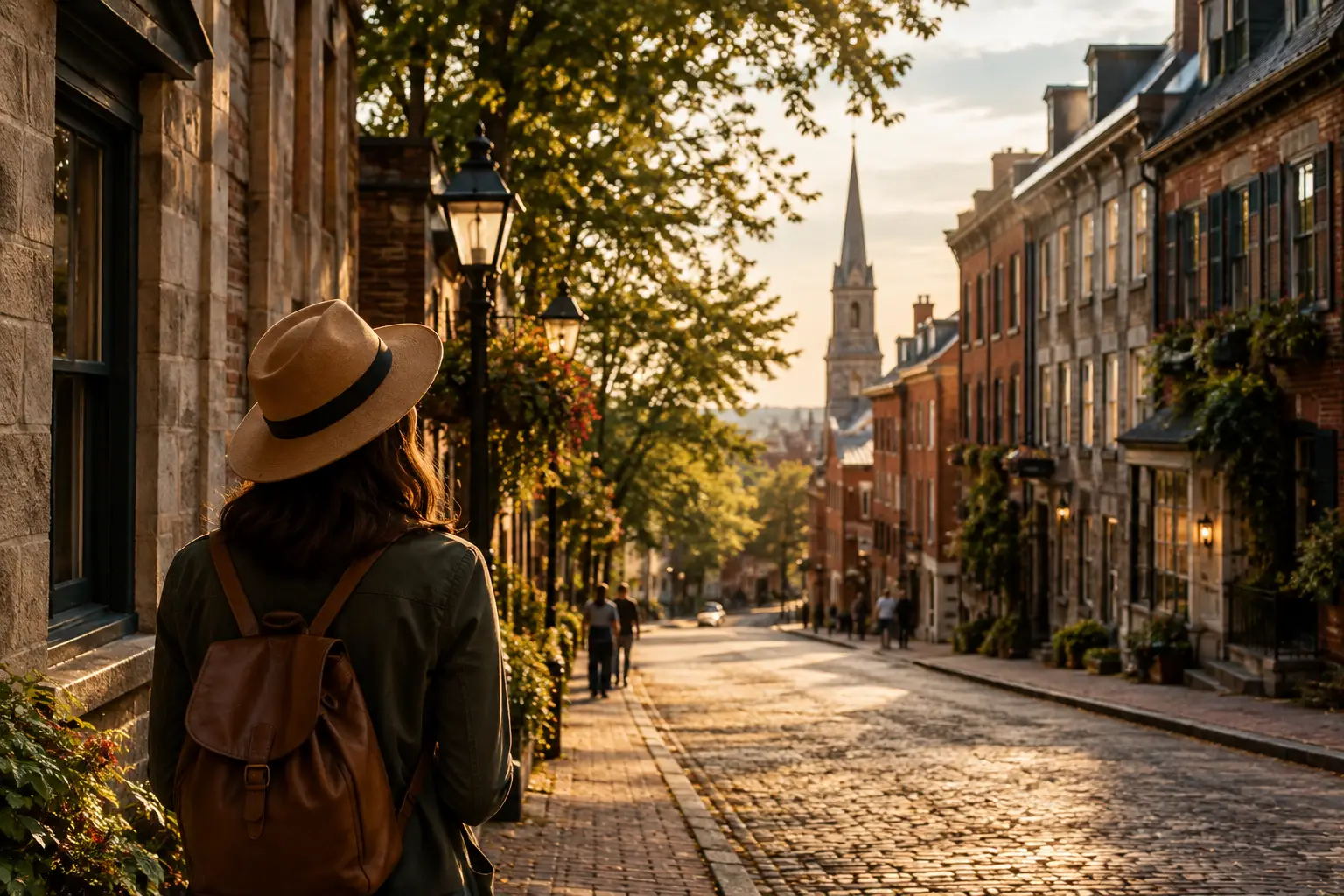
Plan historic district self guided walks with a clear route, useful context, offline maps, and time to notice the streets between nearby landmarks.
A historic district is rarely difficult to find. The problem is knowing where to begin once you are standing beneath a clock tower, facing six streets, with a map full of pins. Historic district self guided walks work when they give you a thread to follow: a port becoming a market, a fortress growing into a city, a working neighborhood changing with each generation.
You do not need to march from landmark to landmark. In fact, that is often the quickest way to miss the place. Build a walk around one clear route, leave room for a side street or a quiet square, and use the major sites as anchors rather than targets to collect.
Start with the shape of the district
Before choosing individual stops, look at the historic district as a piece of geography. Is it set on a hill, beside a river, inside former walls, or spread along an old trading road? The shape explains more than a date on a plaque. A steep lane may have led to a citadel. Warehouses by the water may explain the wealth of the central square. A broad avenue may have replaced crowded medieval streets.
Choose a route that moves in one direction. Walking from a high point downhill is usually easier than reversing it, but it depends on what you want to see first. In a walled town, starting at a gate can make the old boundary visible from the beginning. In a former industrial district, begin at the station, dock, or market where goods and people once arrived.
Avoid planning a zigzag route simply because every famous building appears close together on the map. A block can take twenty minutes when you stop to look at carved doorframes, shop signs, courtyards, and the line of the roofs. A shorter route with a clear story is more satisfying than a long one that turns into a race.
Give the walk a time period
A district often contains several cities at once. There may be Roman stones in a cellar, a medieval church, nineteenth-century apartments, and a twentieth-century cinema on the same street. If you try to absorb all of it equally, the place can become a blur.
Pick one period as your main lens. You might follow the years when merchants funded civic buildings, when factories drew workers to the neighborhood, or when a royal court reshaped the street plan. This does not mean ignoring everything else. It means you have a way to recognize why one building is important and another is simply attractive.
At each stop, ask two practical questions: what happened here, and what can you still see because of it? A former guild hall matters not only because a guild met there, but because its tall ground floor once stored goods, its upper rooms hosted meetings, and its position near the market showed who controlled trade.
This approach also helps with buildings that are closed. You can understand a site from the street if you know what its façade, location, and neighbors are telling you. Do not spend half an hour waiting outside every locked door unless entering is the point of your day.
Let ordinary buildings do some of the work
The memorable detail is often not the cathedral or city hall. It may be a row of narrow houses with different window heights, a faded painted advertisement, a public fountain worn smooth at the edge, or a courtyard that turns an apparently grand avenue into a dense residential block.
Pause where the district changes character. Notice when stone gives way to brick, when streets widen, or when workshops become cafés and galleries. These shifts show how people earned money, moved through the city, and made room for new fashions. They are the material of local history, not decoration between famous stops.
Build in a beginning, middle, and finish
A good self-guided walk has a rhythm. Start with orientation in an open place where you can see the main streets or skyline. Then enter narrower streets, where the scale becomes more intimate and details are easier to read. Finish somewhere that lets you look back across what you have walked: a riverbank, a hill, a public garden, or a square at the edge of the district.
The middle is where you slow down. This is the point to include a market lane, an old residential street, or a small place of worship that gives the district a human scale. If your route contains only monuments, it can feel like a sequence of exterior walls.
Keep the walk flexible. A street repair, a festival setup, or rain can change the route without ruining it. Save two or three stops rather than treating every pin as compulsory. You are not failing to see the district if you skip a museum whose subject does not interest you.
Use audio carefully, not constantly
Audio can make a street more legible, especially when there is little signage or when the visible remains need explanation. But listening without pause can turn a walk into a podcast with cobblestones. Stop before you press play. Look around first. Then let the narration add names, dates, and scenes to the buildings in front of you.
A free guide is useful when it keeps the route independent. Lokali provides narrated and written walks, maps, and offline downloads across more than 190 cities in 45 languages, so you can listen or read at your own pace without renting a device at each entrance. Download what you need while you have a connection, then keep your phone available for the moments when context matters.
Still, audio is not always the right answer. In a small district with excellent street panels, you may prefer to walk quietly and read only at the sites that interest you. If you are visiting a complex palace, archaeological site, or museum with difficult access and a dense political history, an on-site guide or a scheduled human tour can be worth the fixed time and cost. A knowledgeable person can answer the question that occurs to you on the spot. A self-guided walk cannot.
Know when to go inside
Historic districts invite a common mistake: trying to enter every historic building. Most interiors will not add much to your understanding, and some are more interesting from outside. Choose one or two interiors that reveal something you cannot see from the street.
That might be a market hall, a house museum, a church with surviving wall paintings, or a civic building whose interior shows how the city governed itself. Give those places proper time. Rushing through five interiors can leave you with less memory than sitting for ten minutes in one square after visiting a single well-chosen site.
If a landmark has an audio guide of its own, decide whether it adds a different layer. At the Louvre, for example, the museum’s own guide is priced at €6 and offered in nine languages. That may be useful if you want object-by-object interpretation indoors. It does not replace a neighborhood walk, which explains how a building sits within the city beyond its doors.
Keep the practical details quiet but ready
A phone map is useful, but it should not be the main thing you look at. Set your next stop before leaving the current one, then put the phone away for a block or two. Historic districts are full of short visual connections: an arch framing a tower, a street name that preserves an old trade, a glimpse of water at the end of a lane. You only notice them when your eyes are up.
Carry a route that works offline, especially in thick stone streets or areas where mobile service is inconsistent. Mark a natural pause point roughly halfway through. It might be a bench, a square, or a covered arcade. The break is not wasted time. It gives you a chance to see whether your route has become too ambitious and whether one detour is worth taking.
End before you are tired of looking. Leave one street unexplored, one courtyard unseen, or one museum for another day. A historic district is not a checklist. It is a part of the city where the past still shapes the ordinary route home, the sound from a window, and the corner where you choose to turn.