Can You Use a Museum Audio Guide Without Tickets?
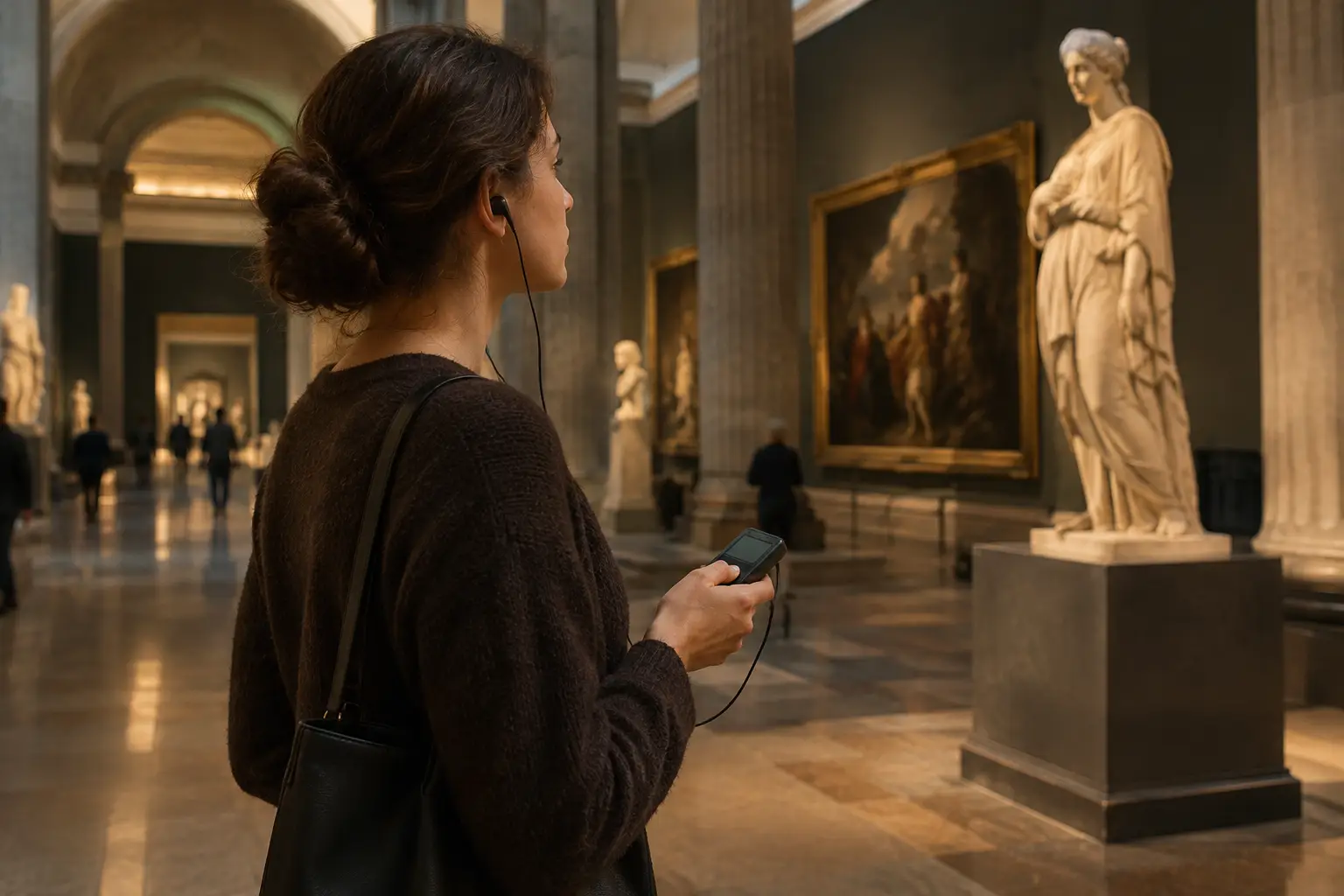
Need a museum audio guide without tickets? Learn what works outside the gallery, how to prepare offline, and when an official guide is worth paying for.
A museum audio guide without tickets is useful, but it does not open the doors for you. It gives you the story before you enter, helps you decide whether the collection is worth your time, and can continue after you leave. For places such as the Louvre, the Prado, or Prague Castle, that preparation can be more valuable than pressing play beside a crowded painting.
The key is knowing what kind of guide you are getting. Some audio guides are built for a numbered route inside a specific building. Others explain the museum, its major works, and the neighborhood around it. The second kind works well without admission. The first may leave you listening to directions for Room 12 while standing on a busy street.
What “without tickets” can actually mean
You may be looking for free audio before deciding whether to buy admission. Perhaps the museum is sold out, the line is too long, or you only have an hour between a train arrival and dinner. You may also want context for the building itself, which is often visible from outside without entering at all.
A useful guide without a ticket does three jobs. It tells you why the museum exists, points out what can be seen from public space, and gives you enough context to recognize the important objects if you enter later. It should not pretend that a recording can substitute for the collection itself.
At the Louvre, for example, the former royal palace, the long courtyards, and the glass pyramid tell part of the story before you see a single gallery. At the Prado, a guide can place Velázquez and Goya in the history of Madrid before you stand in front of their paintings. At Prague Castle, the courtyards and changing levels of the complex make more sense when you know that a castle is not one building but a layered seat of power, worship, and ceremony.
That is different from an official in-gallery device. The Louvre's own guide costs €6 and is available in nine languages. It may be worthwhile if you want a route tied precisely to the rooms and objects around you. A general guide cannot reliably replace those object-by-object prompts, especially in a large museum where galleries change and works travel on loan.
Choose the guide for the moment you have
Start with the time you actually have, not the famous name on the façade. If you have 20 minutes outside, look for a short orientation to the building, its founders, and the collection's central idea. Do not start a two-hour gallery tour that assumes you are moving from one numbered room to another.
If you are visiting tomorrow, use a museum audio guide without tickets as reconnaissance. Listen on the bus or at breakfast. Write down three works, rooms, or periods you care about. This small decision protects you from the usual museum fatigue: walking for an hour, seeing too much, and remembering only the gift shop and sore feet.
If you have already visited once, skip the introductory route. Choose a narrower story instead. A guide about the French Revolution changes how you see the Louvre's portraits and furniture. A guide about Spain's civil war changes the emotional weight of rooms at the Prado. The same collection can feel entirely different when you arrive with one clear question.
For the street outside, treat the audio as a pause rather than background noise. Stand where you can see the entrance, the roofline, or the procession of people arriving. Look up between sections. A museum's architecture often announces its original purpose: a palace built to display authority, a former station built for movement, or a purpose-built gallery designed to make culture feel public.
Check whether it works offline before you leave Wi-Fi
Museum walls, underground entrances, and thick stone corridors are poor places to depend on a signal. If a guide allows offline use, save it before leaving your hotel or a café. Open it once while connected, confirm that the audio and map load, and keep your phone charged.
This is not only about convenience. An audio guide that stops halfway through a historical scene breaks the rhythm of a visit. You are left holding a phone in a room full of people, trying to reconnect instead of looking at the painting or sculpture in front of you.
Bring headphones, but keep one ear free when moving through crowded galleries or crossing streets. Museums are not silent places. You hear school groups gathering, shoes on parquet floors, a guard asking visitors to step back. Those sounds are part of the visit, and they also help you stay aware of the space around you.
Lokali offers free museum, landmark, and city audio guides in 45 languages, with written text and offline downloads. Its value is strongest when you want the wider setting as well as the collection: the street outside, the historic district, and the events that shaped what you are about to see. It is less useful when you need a current room-by-room commentary for a temporary exhibition.
Build a visit around fewer objects
The mistake is not using an audio guide. The mistake is trying to hear everything it contains. A museum is not a podcast queue to clear.
Choose one route through the collection. It might be portraits of rulers, ancient burial objects, Dutch interiors, or the paintings made in one turbulent decade. Then give yourself permission to pass rooms that do not belong to that route. A focused 45 minutes can stay with you longer than three restless hours.
Before you enter, read the guide's descriptions if you prefer words to narration. Written text is easier to scan when you are deciding where to go, and it avoids the awkward stop-start rhythm of removing headphones whenever you need to check a room sign. Audio is better when you are standing still with an object and want your eyes free.
Once inside, use the guide as an invitation to look longer. If it explains a portrait, find the hands, fabric, expression, and symbols of rank before moving on. If it describes an archaeological object, imagine the person who carried, wore, repaired, or buried it. The detail is often more memorable than the headline name of the artist or dynasty.
When free audio is not enough
There are moments when paying for an official guide makes sense. A complex palace with several entrances and timed routes may require accurate navigation. A special exhibition may depend on a carefully ordered argument that a general guide cannot anticipate. If you are deeply interested in one collection, the museum's own commentary can provide curatorial detail that broader guides leave out.
A human guide is also worth considering when you want to ask questions, travel with children who need a changing pace, or are studying a subject in depth. A good person can notice when you are tired, curious, or confused. Recorded audio cannot do that.
But a scheduled group walk is not automatically better. It fixes your pace, often spends time on introductions and logistics, and may keep you in front of objects after your attention has moved elsewhere. If you want to sit in a courtyard for ten minutes, return to one painting, or leave after half an hour, your own phone gives you more freedom.
Let the museum continue outside
Do not judge a guide only by whether it speaks inside the galleries. Some of the strongest museum stories begin at the exit. Look at the square, the riverbank, the former palace grounds, or the avenue that leads back toward the city. Ask why this institution was placed here and who was meant to enter it when it first opened.
Then carry one image into the rest of your day. A painted royal face can make the nearby palace feel less decorative. A Roman coin can change a walk through an old market street. A map from a museum case can make the next neighborhood easier to read.
You do not need a ticket to begin that process. You only need a guide that gives you a reason to look, and enough space to follow your own attention.