Offline audio guides for travel that work anywhere
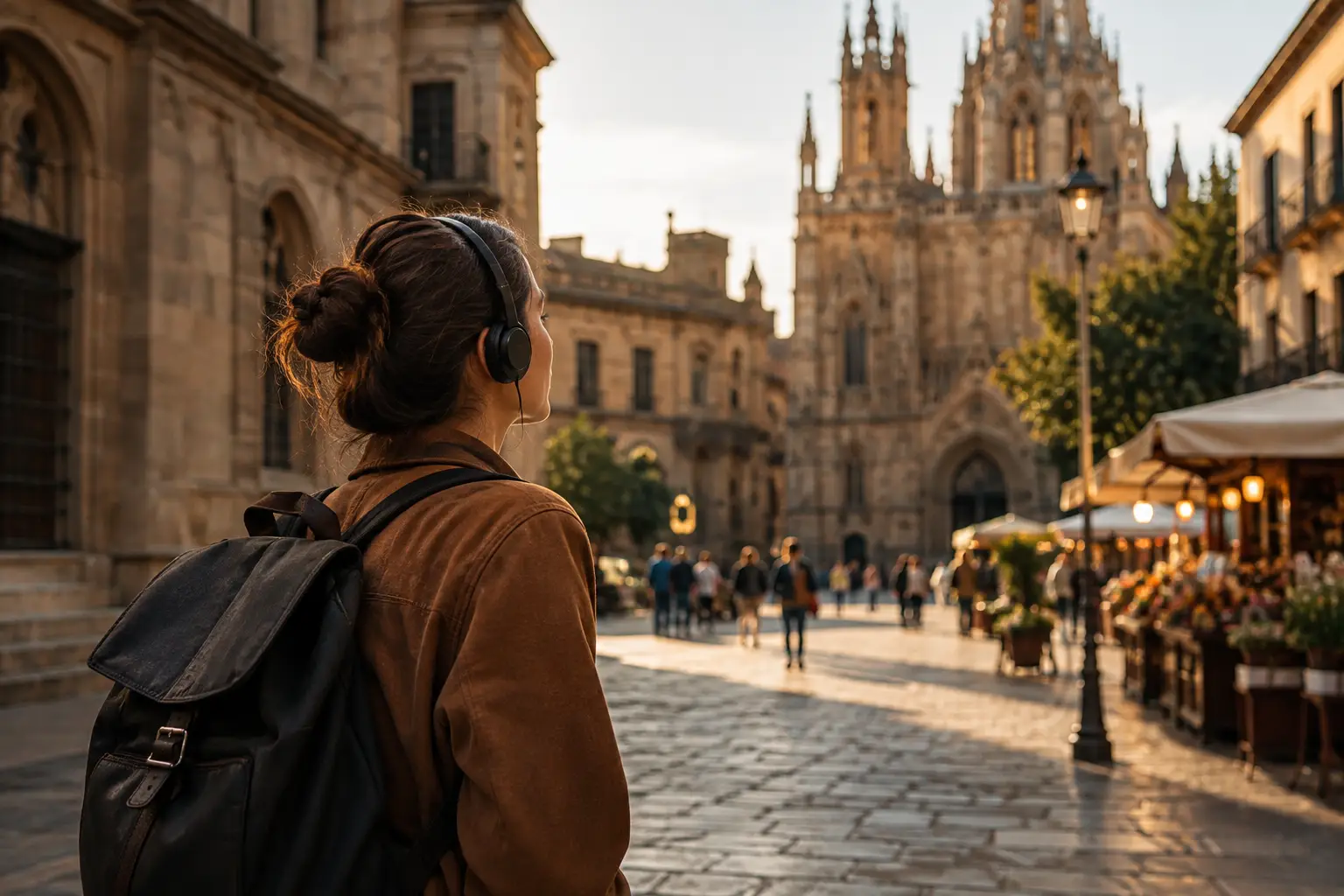
Offline audio guides for travel keep history, maps and practical context in your pocket when signal vanishes between streets, stations and stone walls.
At the gate of Prague Castle, the phone signal can be crowded out by stone walls and hundreds of other phones. In the long galleries of the Prado, a connection can fade just when you stop in front of a painting. Offline audio guides for travel solve a small but frustrating problem: the story is already on your phone, ready when you are.
That changes the shape of a day. You do not stand under a museum sign trying to load a page, use up roaming data, or pay again for a plastic device and wired headphones. You walk, pause, listen, read, and move on when you choose.
Why offline changes a day on foot
A city is not experienced in a straight line. You take the wrong exit from a station. Rain begins over a square. You see a church door open and step inside for ten minutes. A scheduled walking tour has a fixed route and a fixed pace. An offline guide lets the day bend around what is actually happening.
This matters most in places where the setting is part of the story. At the Terracotta Army, the scale arrives before the facts do: ranks of clay figures in a vast excavated hall, each face slightly different. At the Acropolis, wind, heat, and the steep walk shape your attention as much as the marble. A good recording gives you enough context to see what is in front of you, then leaves room for the place itself.
Offline access is also useful in ordinary travel moments. Underground platforms, airport arrivals, mountain roads, and thick old walls are unreliable places to depend on a live connection. Downloading a guide before leaving your accommodation means your route, narration, and written notes remain available even when the network does not.
It is not only about data. Constant loading breaks concentration. If each stop requires a search, a spinning screen, and a new page, history becomes a sequence of admin tasks. An audio guide works better when the next story is waiting while you cross the street.
How to use offline audio guides for travel well
Download before you are outside. This sounds obvious, but a guide is most useful when you prepare it during a quiet ten minutes on Wi-Fi, not at the entrance when a queue is moving behind you. Open the guide once after downloading it. Check that the audio, map, and written text are visible, and make sure your phone has enough battery for the route.
Choose a route that fits the time you actually have. A walk of two or three hours can easily become half a day if you stop for a market, a view, or a long lunch. If you have only an hour before a train, use a short neighbourhood walk or a guide for one landmark rather than trying to complete a whole district.
Listen in short sections. There is no prize for finishing every track. At a museum, one or two well-chosen objects can give an exhibition its shape. In a city centre, a story at the main square and another at the old city wall may be enough to make the streets between them feel connected.
Headphones are useful, especially near traffic, but they are not compulsory. Keep one ear free when you are walking near bicycles, cars, or busy crossings. In a quiet church or gallery, low volume or reading the guide text can be more considerate than speaking sound from your phone.
Maps deserve the same attention as narration. A pin tells you where a story begins, but it does not always show the pleasant way to reach it. Look ahead for parks, riverside paths, hills, and large roads. The shortest route can lead through a tunnel, a fenced construction site, or a dull shopping street while a slightly longer street gives you arcades, bakeries, and a clearer sense of the neighbourhood.
Let the guide answer one question at a time
The strongest guides are not collections of facts. They answer a question you can see. Why does this palace have a defensive tower? Why is one square broad and ceremonial while the next is narrow and dark? Why does a painting made for a royal court look so intimate from two metres away?
If a recording gives dates without a reason to remember them, skip ahead. You are not preparing for an exam. You are using history to notice details: soot on a façade, a carved coat of arms above a door, the direction a procession once took through a square.
Written text is valuable here. On a noisy tram, you may prefer to read. In a museum, you may want to return to one sentence after looking at an object for longer. Audio and text should be two ways into the same place, not a choice between culture and convenience.
What to download before a museum or city walk
A useful offline guide has more than a voice track. Before setting out, look for practical orientation: where the walk begins, how long it is likely to take, what kind of ground lies ahead, and whether its stops form a sensible order. A map matters because a fine story is less helpful if you cannot find the doorway or viewpoint it describes.
For a first visit, begin with a city walk that explains the main streets and landmarks. This gives you a framework. On your second day, or on a return visit, choose a museum, a smaller district, or a historical episode. The two experiences are different. One helps you get your bearings; the other gives you a reason to linger.
Some guides use a historical scene to place you inside a particular moment. This can work well when it stays close to the site. At a former palace, you can picture the sound of horses in the courtyard or the tension before a public announcement. It works less well when the drama is so broad that you could be anywhere. The stone, street, room, or landscape should remain at the centre.
Lokali is one option for this kind of independent travel. Its free, ad-free guides cover more than 190 cities in 45 languages, with downloadable walks, landmark and museum guides, maps, and written versions of the narration. Language choice matters more than it first appears. A guide in the language you think in lets you spend less effort translating and more time looking.
When offline audio is not enough
An offline guide cannot look at your face and notice that you are confused, tired, or fascinated by an unexpected detail. It cannot answer a question about the restoration happening behind a barrier. It also cannot change a route because a small exhibition is temporarily closed or because you want to spend an hour discussing one artist.
That is where a human guide can be worth the cost. Choose one for a specialist subject, such as architecture, archaeology, food, or family history, when conversation is the point. A small scheduled tour can also help when you want company or when a place makes more sense through personal stories and questions.
An on-site guide rental can be worth using when a museum has made its collection-specific commentary unusually strong. It may include curators, conservators, or recordings tied to an exhibition that no general city guide can match. The trade-off is often price, limited language choice, a device to collect and return, and an experience that stops at the museum door.
For everything between those cases, offline audio gives you a rare kind of freedom. You can leave a grand avenue for a side street, stop at a bench, replay a story, or abandon the plan entirely because dusk has changed the light on the buildings.
Before you leave in the morning, download the guide, charge your phone, and choose only a few stops you genuinely want to understand. Then keep enough empty time for the part no recording can predict: the bell heard from an alley, the courtyard behind an open gate, or the painting that holds you still for longer than planned.