Travel Guides in Multiple Languages That Work
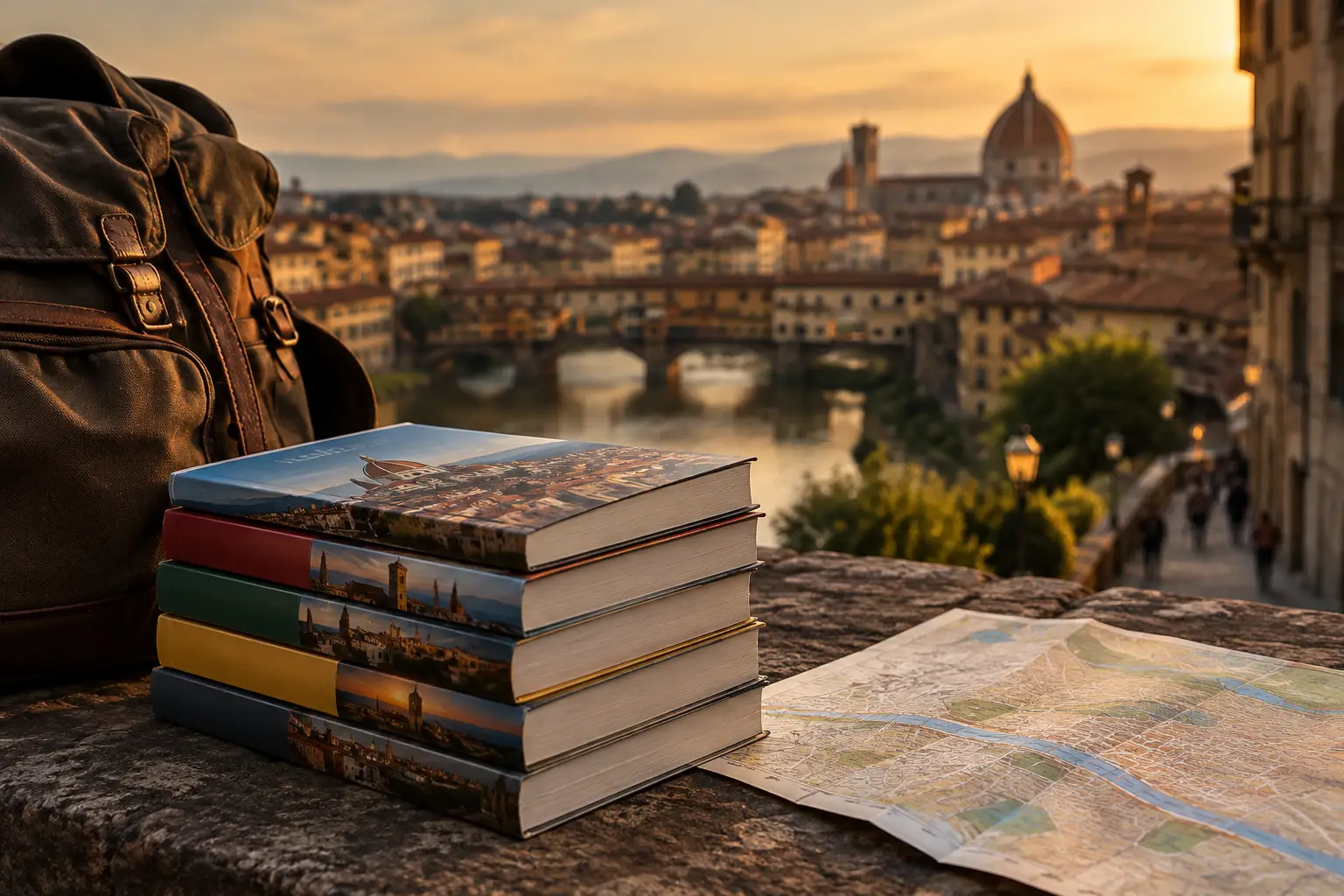
Travel guides in multiple languages help you hear a city in words that feel familiar, then keep moving at your own pace, online or offline, at each door.
At the Prado, a label can tell you the painter’s name while the important part stays out of reach: why a royal family is posed like actors on a stage, or why a dark room changes the force of a painting. Travel guides in multiple languages are not a convenience added after the facts. They decide whether a place becomes legible while you stand in it.
English may be useful for bookings and menus, yet it is not always the language in which you think quickly. In a museum corridor, on a noisy tram, or outside Prague Castle with a map open in one hand, you need clear words without the extra work of translating each sentence in your head.
What travel guides in multiple languages change
A guide in your own language gives you more than vocabulary. It gives you pace. You can understand a short explanation while crossing a square, notice the carved faces over a doorway, and decide whether to stay for another room or move on.
This matters most with history, because history often arrives as a crowd of names and dates. A good guide chooses one thread. At the Terracotta Army, that might mean beginning with the ruler who wanted protection after death, then letting the ranks of clay soldiers explain the scale of his ambition. At the Hagia Sophia, it might mean following one building through changing uses and centuries rather than asking you to memorize every ruler associated with it.
Literal translation is not enough. A sentence can be grammatically correct and still sound stiff, vague, or needlessly formal. The useful version tells you what you are looking at, why it was made, and where to look next. It avoids idioms that make sense only to a native speaker and keeps sentences short enough to follow while walking.
Language choice also changes who gets to travel independently. If the only detailed explanation is in English, French, or the local language, many visitors end up paying for a scheduled tour simply to get basic context. That can be worthwhile, but it should be a choice, not the entry fee for understanding a city.
Choose the language before you choose the route
Start with the place, not the platform. Search for the site you actually plan to visit: “Prado audio guide free,” “Prague Castle audio guide free,” or “Terracotta Army audio guide free.” You are looking for more than a language label. Check whether the guide covers the specific rooms, gates, streets, or viewpoints that matter to you.
Then test the format. Audio works well when your eyes are busy - on the steep lanes around Lisbon’s Alfama district, for example, or while moving through a large archaeological site. Written text is often better in a gallery where you want to pause, reread a date, or compare two objects without putting on headphones.
A guide should make its route clear. If it begins at one entrance and ends at another, you can plan lunch, a train, or the next neighborhood around it. If it simply offers dozens of disconnected stops, it may still be useful, but you will do more organizing yourself.
Offline access is not a technical luxury. It is practical independence. Download the material before leaving your accommodation, especially if you expect to use maps, narration, and written notes throughout the day. A guide that disappears when your connection weakens is a poor companion on a long walk.
Look for interpretation, not a translated label
The difference becomes clear at famous places. Most visitors can identify the Eiffel Tower, the Colosseum, or Barcelona’s Sagrada Família from a photograph. The question is what you understand once you are there.
Useful interpretation gives an object or building a physical presence. It might point out the soot-darkened stone on an old church facade, the narrow windows that kept a medieval room defensible, or the change in street width where a modern boulevard cut through older blocks. These details give your eyes a job.
It also gives you a sequence. In a palace, begin with the person who needed the palace, then the ceremonies that happened inside it, then the workers and servants who kept it running. In a city square, begin with the market or harbor that made the square necessary before moving to statues and facades.
Be cautious with guides that promise to explain everything. A two-hour visit does not need fifty facts per room. It needs a few clear moments that remain with you after you leave: the echo beneath a dome, the worn step at a gate, the painted ceiling above a crowded bedchamber.
When free guides are enough, and when they are not
Free audio and written guides are often enough when you want orientation, a self-guided walk, or a clear story at a major landmark. They are especially useful if you are visiting several places over a few days and do not want to pay again at every door.
Lokali is one option for this kind of trip. Its mobile web app and Android app cover more than 190 cities in 45 languages, with narrated walks, written guides, maps, offline downloads, and historical scenes. You can use it to walk through Tbilisi past sulfur baths, carved wooden balconies, and the bells near Sioni Cathedral without matching your afternoon to a group’s meeting point.
There are limits. A free guide cannot answer your question when a painting, inscription, or room catches you unexpectedly. It cannot adjust to your child’s attention span, show you an access route, or notice that you are fascinated by Roman engineering and should skip the portrait gallery. For that, a human guide can be worth the cost.
A paid on-site guide can also make sense when the collection is unusually complex or the building itself has restricted areas and timed movement. The Louvre’s own guide, for example, is a separate option offered in nine languages for €6. If you want commentary designed specifically for that museum, rather than a broader city context, it may be the more focused choice.
Scheduled walking tours have a different strength: conversation. You may meet someone who can respond to a question, explain an unfamiliar custom in plain terms, or change direction when weather interrupts the route. The trade-off is fixed timing, a shared pace, and the social commitment of staying with strangers for several hours.
Build a day around the words you understand
Do not save every guide for the evening. Use one in the first hour after arriving. A short introduction to the city’s layout can stop you from treating a river, old wall, market street, and station as unrelated points on a map.
For a museum, read or listen to the opening section before entering. You will arrive with a question already forming: what changed here, who paid for it, what did people fear, or what were they trying to display? Once inside, let the guide support your attention rather than control it.
For a neighborhood walk, leave room for detours. If a passage smells of coffee and warm bread, or a courtyard pulls you away from the marked route, stop. The value of a guide in your language is not that it dictates each step. It is that you can return to the story when you are ready.
A city does not become more meaningful because you consume every stop. It becomes clearer when one voice, in words you do not have to struggle to decode, helps you notice what is already in front of you.