Audio Walking Tour: See a City at Your Pace
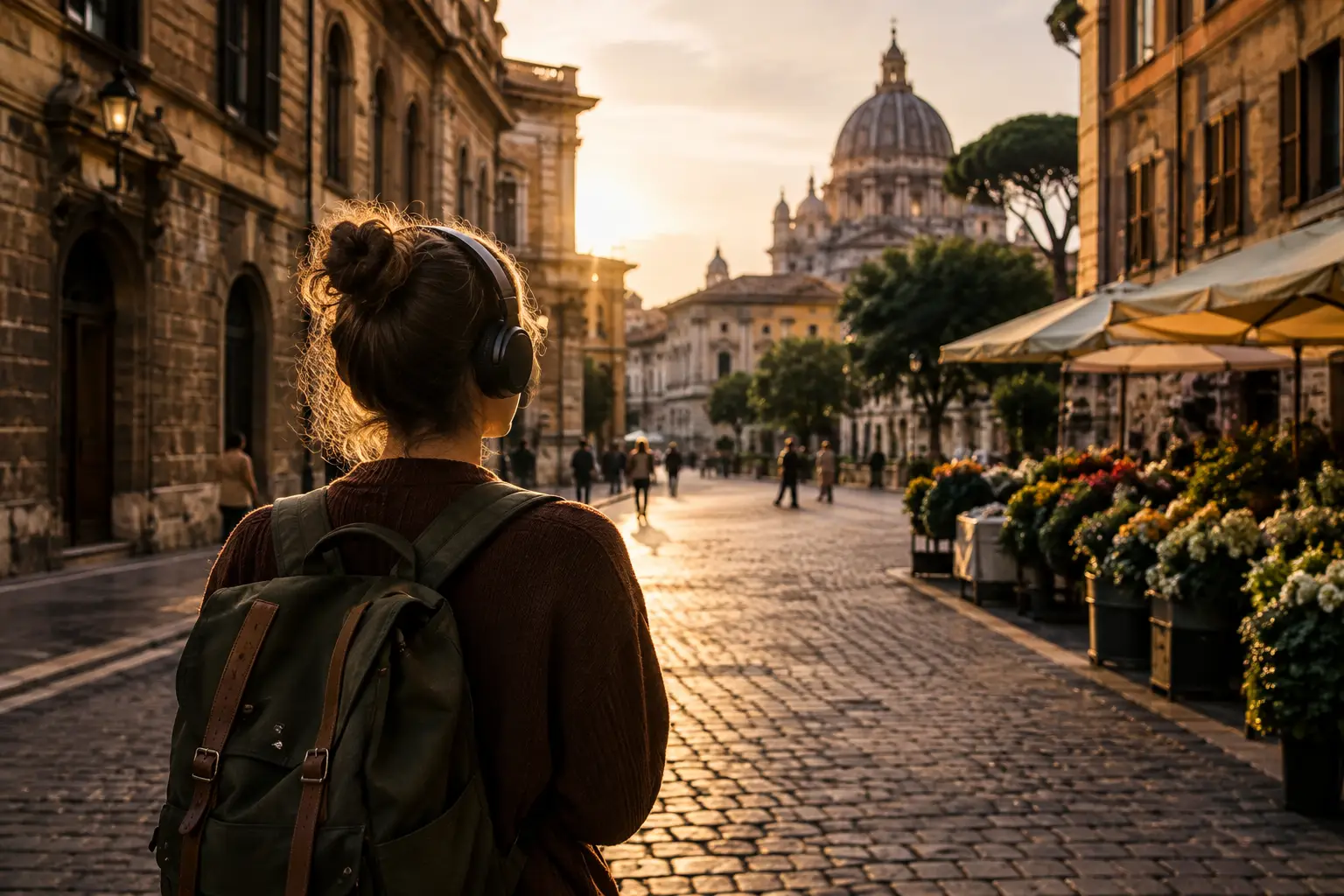
A free audio walking tour gives you history, directions, and room to wander. Learn what to choose, when to pause, and when a guide is worth it.
At 8:30 in the morning, a square can belong to delivery vans, café chairs, and the person washing a doorway. By noon, the same place is a crowd. An audio walking tour lets you hear why that square matters while moving through it on your own schedule. You can stop for coffee, take the wrong lane, or spend twenty minutes looking at one carved doorway without having to catch up with a guide carrying a flag.
That freedom is the point, but it is not the whole story. A useful tour also gives you a route, a sense of time, and enough context to make a street feel like more than a line between famous buildings. The right one turns a walk into a sequence: a market before a church, a ruined wall before the modern avenue built beside it, a palace room before the view from its terrace.
What an audio walking tour should do
A good audio walking tour does not narrate every meter. Constant commentary makes a city sound like a museum corridor. It should speak at the moments when the place changes: when you enter an old quarter, cross a river, reach a hill, or stand where an ordinary-looking facade holds an extraordinary past.
Look for a guide that tells you where to begin, how long the route may take, and what kind of walking it involves. A two-hour central route can become four hours if you enter every church, sit down for lunch, and follow every side street. That is not bad planning. It is often how a city becomes memorable.
The narration should also explain what you are seeing in plain language. “Baroque” means more when you can hear it while looking at a theatrical church front, twisted columns, and statues that seem to lean into the street. Dates matter when they place you in a sequence, not when they arrive as a test. You need to know whether a building stood before the railway, after a fire, or through a change of rulers. You do not need a long list of names with no visual anchor.
Maps matter too, especially where streets turn narrow and irregular. The point is not to follow a blue dot with your head down. It is to know which archway leads toward the next stop and when a small detour is worth taking.
Start with the place you actually have time to see
Searches for a free Prado audio guide, a Prague Castle audio guide, or a Terracotta Army audio guide all ask the same practical question: can you understand this place without paying again at the entrance? Often, yes. But a city walk and an indoor landmark guide solve different problems.
A walking route helps you decide what comes next. It gives shape to an afternoon when you have arrived in a new city and do not yet know which district connects to which. A museum or monument guide helps you slow down in one location, where labels may be brief, crowded, or available in only a few languages.
Choose one main experience for a morning or afternoon. Trying to complete a full city route, a major museum, and three landmarks before dinner creates a day of checking clocks. If you have only a few hours, pick the area you will enjoy walking even if one site is closed, busy, or less interesting than expected.
For a first visit, begin near the historic center or at a transport point you can recognize easily. For a return visit, skip the familiar main square and choose a neighborhood route. The difference can be as simple as hearing the story of former workshops, apartment courtyards, bathhouses, warehouses, or a station district rather than hearing the founding story again.
Listen in short stretches
Audio works well when it shares the street with the street itself. Start an episode before a landmark, then pause it when you arrive. Look up. Notice the scale of the windows, the sound under an arcade, the smell of bread from a side lane, or the abrupt quiet inside a courtyard. A guide gives you a frame; the city supplies the evidence.
You do not need headphones every minute. In a busy road, open traffic, or a place where you need to hear your surroundings, pause the narration. Read the accompanying text if that is easier. Written guide text is useful in a crowded gallery, on a windy bridge, or when you want to reread one detail rather than replay a two-minute section.
Offline access is more useful than it sounds before you travel. Downloading a guide and map while you have Wi-Fi means you are not rationing data at the moment you need directions. It also removes the small irritation of a page failing to load while you are standing between two streets with nearly identical names.
Lokali offers free narrated walks, landmark guides, maps, and written text across more than 190 cities in 45 languages. It is particularly useful when you want the same route in the language you understand most comfortably, or when you want to save a guide before leaving your accommodation. The value is not that a phone replaces attention. It is that your phone can carry the context without charging you for each new doorway.
Let the route bend when the city asks
A fixed route is a starting line, not a contract. If a market is active, a public garden is open, or a street pulls you toward an unfamiliar quarter, take the turn. Resume the guide later. You will still understand more than if you had walked with no context at all.
There are limits. A long route on a hot afternoon may be less enjoyable than one compact district and a museum. A hillside city can make a route that looks short on a map feel demanding. Cobblestones, steps, rain, and luggage change the calculation. Use a route for its ideas, not as proof that you have covered enough ground.
It also helps to leave empty space between stops. The most revealing moments are often not official attractions: the tiled entrance hall of an apartment building, a tailor opening shutters, a bus crossing a monumental bridge, or the contrast between a polished shopping street and the lane behind it. Audio gives you permission to look more closely because you are no longer wondering what you have missed.
When audio is not enough
An audio walking tour cannot answer the question you have right now. It cannot point out a detail obscured by scaffolding, adjust a route for a sudden closure, or read the mood of a small group. It is also less effective when a place depends on conversation, craft, or specialist knowledge that needs questions and demonstrations.
A human guide is worth considering when you want a focused architectural, food, art, or local-history discussion, especially if you are visiting with a group that has different interests and needs help making decisions together. A scheduled walk can also be good when you want company or find a new city difficult to enter alone. You trade independence for live judgment and shared energy.
An on-site guide rental may be worthwhile for a complex collection with little English signage, or for a temporary exhibition that an outside guide cannot cover. But it is not always worth paying for a device that repeats a basic timeline you can read or hear elsewhere. Before renting one, ask whether it covers the collection in depth, whether it is available in your language, and whether you will actually use it for long enough to justify the cost. The Louvre's own guide, for example, costs €6 and is offered in nine languages; for a short visit with a few chosen works, that may be reasonable, while a broader historical guide may serve you better outside the building.
Make room for one historical scene
Facts become easier to hold when they happen somewhere. Instead of memorizing that a fortification was rebuilt, imagine the labor of hauling stone up a slope. Instead of hearing only that a square hosted a ceremony, picture the packed windows, the horses, the bells, and the crowd trying to see over shoulders.
This is where an audio walk can do something a paper map cannot. A short historical scene, placed at the right spot, makes the present street feel layered without turning it into a lecture. Then pause the recording and walk on. The pavement is still warm, someone is setting out tables, and the city has returned to its ordinary business.
Choose a route that leaves you curious rather than exhausted. If you finish with one building, street, or story you want to understand better, the walk has done its job.