First Time Visitor Sightseeing Guide for Cities
A first time visitor sightseeing guide for choosing a walk, museum, and a neighbourhood meal without losing half the day to maps, queues
At 10.30 in the morning, the city is already making demands. A church tower appears at the end of one street, a museum banner hangs two blocks away, and your map shows thirty saved places. This first time visitor sightseeing guide gives you a way to choose without turning the day into a race between landmarks.
The useful aim is not to see everything. It is to understand the shape of a place well enough that, by evening, its streets, food, history, and ordinary rhythm begin to connect. You need one strong route, one place to stop, and enough empty time for a wrong turn that becomes interesting.
Start with the city’s physical logic
Before choosing attractions, look at the map as if it were a landscape rather than a list. Find the old core, the river or harbour if there is one, the main station, and the large park, hill, or public square. These features explain why streets run where they do. They also show where a day on foot will become tiring.
Most first visits go wrong through distance, not poor taste. A palace, market, modern art museum, and viewpoint can all look close on a phone screen while sitting on opposite sides of steep streets, bridges, or a busy ring road. Choose one compact area for the morning and a second for the afternoon. If the city has a historic centre, begin there before the lanes fill with groups and delivery vans.
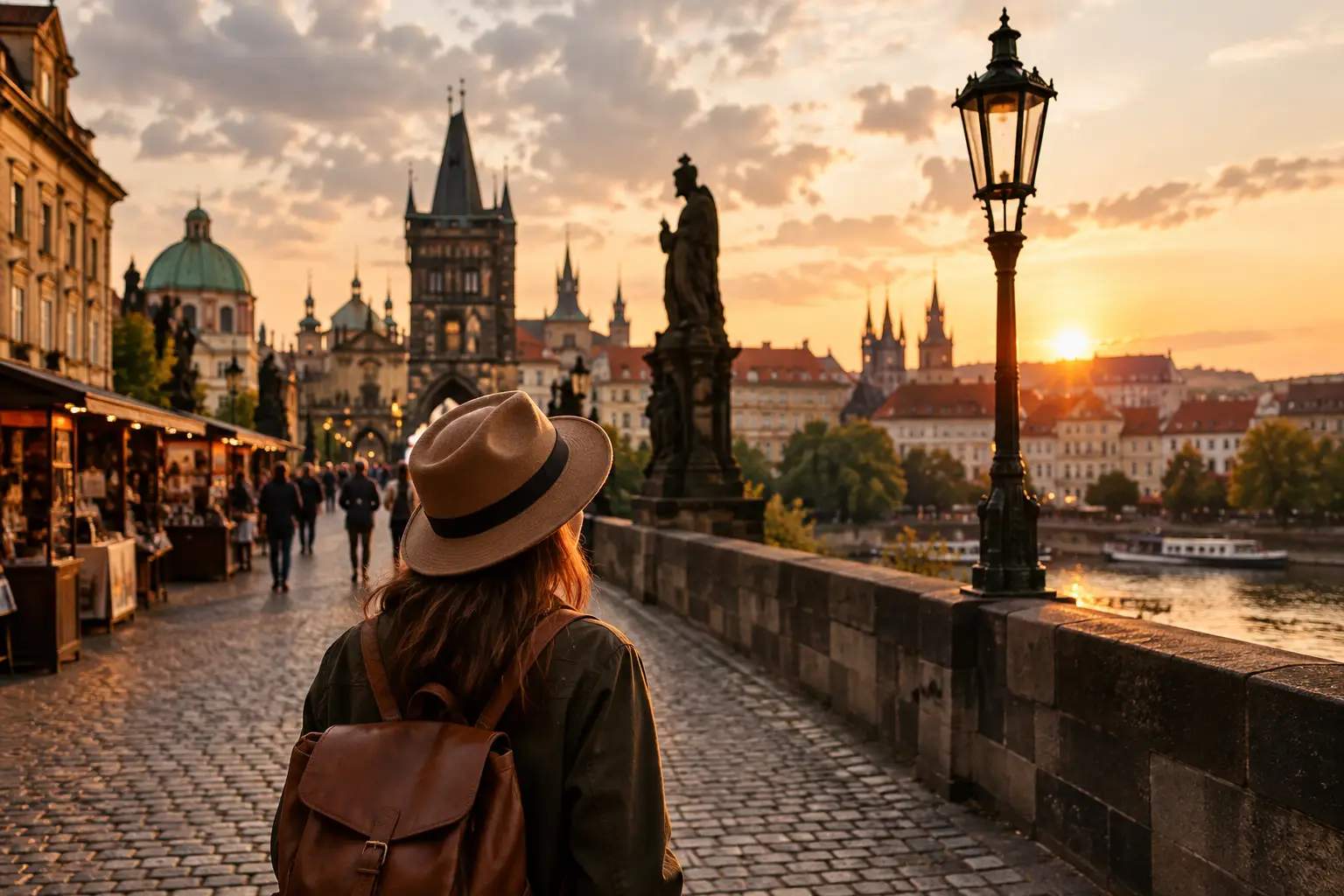
In Rome, that might mean following the line from the Colosseum through the Forum area towards the Capitoline Hill, rather than crossing repeatedly between the Vatican, Trastevere, and the Spanish Steps. In Prague, it might mean choosing either the Castle district or the Old Town and riverbanks for your first half-day. The principle travels well even when the street names change: build a route that moves forward.
Give the morning to one story
A first-time visitor sightseeing guide should begin with a question, not a checklist. What made this city matter? It may be a port, a royal court, an industrial river, a religious centre, a trade route, or a capital built to display power. Pick one site that answers the question clearly.
That site can be a museum, fortress, cathedral, archaeological area, or civic square. Spend long enough there for the place to become more than a photograph. Forty-five minutes can be enough for a small church; a major collection may need two unhurried hours. Do not enter a large museum merely to say you have entered it. If you only have energy for three rooms, choose three rooms and read or listen properly.
Audio can help when labels are thin or the building itself needs explanation. Lokali offers free narrated and written guides across more than 190 cities in 45 languages, including walks and landmark guides that can be downloaded for offline use. Use it as a layer of context while you walk, not as a voice that tells you to hurry to the next pin.
There are limits. A guide on your phone cannot answer a detailed question about a painting, notice that a temporary room is closed, or adjust to a child who has lost interest. For a specialised collection, a complicated archaeological site, or a building with restricted areas, a paid human guide can be worth the fixed time and cost. The point is to choose one when expertise genuinely changes what you see, not because standing alone in a lobby feels uncertain.
Plan a route with a middle, not just an end
The route between major sights is where a city becomes real. Leave room for the bakery window, the tram wires crossing a square, the produce market closing for the day, or the small plaque that explains why a wall has cannonball marks. These are not detours from sightseeing. They are the evidence that the place is lived in.
Choose a walk of roughly two to four kilometres between stops, depending on hills, weather, and how long you linger. A route can include one grand avenue and one quieter street. In Paris, the contrast between the broad perspective of the Champs-Élysées and the narrow passages near the Marais tells you more than two similar monuments. In Istanbul, the movement between a busy avenue and the lanes around a neighbourhood market changes the scale of the city in minutes.
Avoid the temptation to add a distant viewpoint simply because it appears on every map. A view is worth the journey when it helps you understand the terrain: a river bend, a harbour, a ridge, a wall, or the relationship between old districts and newer ones. It is less worth it when it consumes an hour of transport and leaves you staring at a line of phones held above the crowd.
Eat where the route pauses naturally
Lunch is not a task to fit between attractions. It is the reset that protects the afternoon. Choose it near the point where your morning area ends, rather than walking back towards the hotel or searching for a famous address across town.
A menu with photographs is not automatically bad, and a plain dining room is not automatically local. Look instead for a place that suits the hour and the street. Near a market, you may find short menus and quick turnover. In a business district, lunch may be faster and quieter before offices empty. In a historic square, the view can be pleasant, but the food and price may be shaped more by the location than the kitchen.
If you want a long meal, make it the activity. If you want to keep walking, eat simply and sit somewhere public afterwards. The ten minutes on a bench can help you remember what you have just seen better than another hurried room in a museum.
Save one major interior for the afternoon
Afternoons suit a second kind of sightseeing: a museum, palace, bathhouse, covered market, library, or other interior where light and weather matter less. Choose something that changes the story of your morning rather than repeating it.
After a royal palace, a neighbourhood museum may show how ordinary people lived. After a military fortress, a riverside walk can reveal the commercial city that supported it. After a cathedral, an art collection may make more sense because you can recognise saints, patrons, and symbols you have just encountered in stone and glass.
This is also the point to be realistic about fatigue. If your feet hurt and your concentration has narrowed to locating a toilet or a chair, skip the second major attraction. Walk through a residential street, take public transport for a few stops, or sit with a drink and watch the city change its shift. Sightseeing does not improve because you force one more ticketed room into the schedule.
Make the evening smaller than the day
A first day often ends badly when you try to recreate a perfect evening from someone else’s itinerary. You do not need a rooftop, a reservation across town, and a final landmark lit after dark. Pick one area that feels safe to navigate in your own way, return to a street you passed earlier, and see what changes after work and school hours.
Night is useful for noticing pace. A square that felt ceremonial at noon may become social. A market street may turn quiet. A waterfront may fill with people walking slowly for no obvious reason. These scenes give context to the monuments because they show who uses the city now.
What to leave for another day
Leave one good thing unseen on purpose. It may be the celebrated museum, the distant district, or the day trip that looked possible on paper. Keeping one clear reason to return is better than ending your first day with a camera full of places you barely remember.
Tomorrow, choose a different lens: food, twentieth-century history, architecture, waterfronts, or one particular neighbourhood. Tonight, let the route settle in your mind. The city will be easier to read because you have not tried to consume it all at once.