A Locally Narrated Walking Tours App That Fits
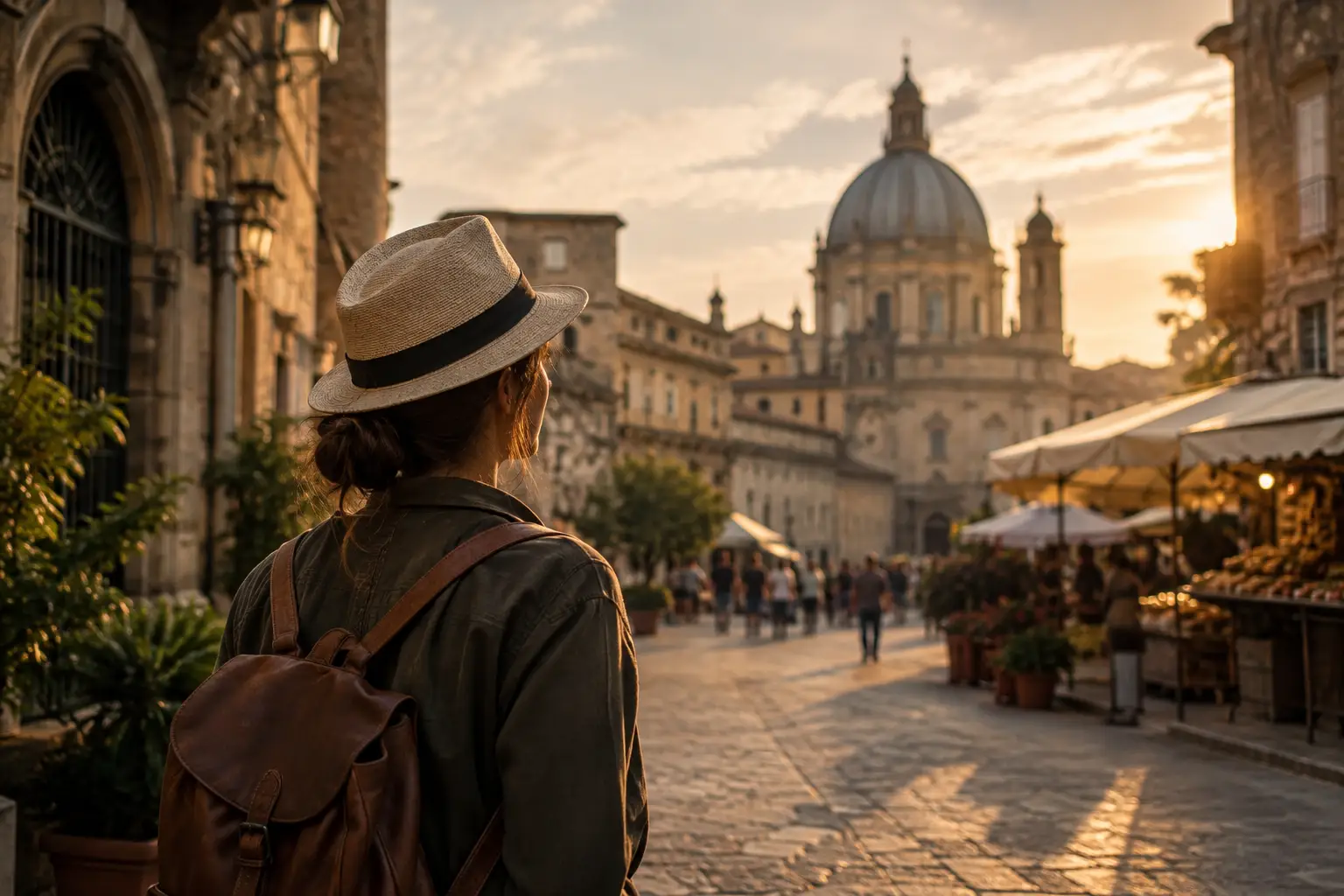
A locally narrated walking tours app gives you history, direction, and room to pause, read
You are standing outside Prague Castle, looking at a line of stone facades and a map full of tiny labels. Or you are at the Prado, trying to decide whether to spend ten minutes or an hour with a painting. A locally narrated walking tours app gives you a voice, a route, and enough context to make the next turn mean something, without joining a group or renting another device.
That matters most when you have already paid for transport, accommodation, and entry. You do not need a guide speaking through a headset while you hurry after an umbrella. You may want to stop for coffee, sit on a low wall, return to a chapel, or skip a square that does not interest you. A good self-guided walk leaves room for all of that.
What local narration should actually give you
“Locally narrated” can mean many things. Sometimes it means a guide records a script written by a historian. Sometimes it means a local writer notices the small details that a broad city overview misses: the old shop signs on a side street, the courtyard behind an arch, the reason a riverbank became a trading district.
The useful part is not the accent of the narrator. It is the point of view. At a landmark, you need more than dates and architectural labels. You need to know what people saw there, what changed, and where to look before you walk on.
Picture a street in Tbilisi with sulfur baths below, carved wooden balconies above, and the bells of Sioni Cathedral carrying across the roofs. A narration becomes valuable when it connects those details to the shape of the city. It tells you why the bath district is there, how trade moved through the valley, and why the old town rises so sharply from the river.
That kind of explanation works just as well in a museum. In a large collection, a short audio guide can turn a room of paintings into a sequence: who commissioned them, what the artist was arguing with, and why one canvas stopped viewers in their tracks. You still choose your pace. You simply have a better reason to pause.
A locally narrated walking tours app is not a group tour
A scheduled walking tour solves a different problem. It can be the right choice when you want conversation, questions answered in real time, or a person who changes the route because a street is blocked or the weather turns. A human guide can read a room, adjust the level of detail, and point out something happening right now.
But group tours ask for fixed time and social energy. You meet at a set place, follow the group’s pace, and often stay longer at stops that interest someone else. If you are jet-lagged, traveling alone, or only have a free morning between trains, that structure can feel like work.
An app is quieter. You can begin at 8 a.m. before the central streets fill, or at 5 p.m. when the light changes on the buildings. You can replay one section and ignore another. If you have a child, a sore foot, or a sudden rain shower, you can stop without losing the entire experience.
There is a trade-off. An app cannot answer an unusual question. It cannot notice that a temporary exhibition has changed or respond to your interest in 19th-century engineering rather than royal portraits. Use it for independence and steady context. Choose a live guide when conversation itself is the point.
The route matters as much as the story
A walking guide fails when it treats a city as a pile of pins. You need a sensible order: begin where transport leaves you, walk through a district without crossing the same street three times, and end near somewhere useful for the rest of your day.
The strongest routes use distance carefully. They do not send you uphill only to bring you down again for a single plaque. They explain the view before you reach it. They allow you to see how a market square connects to a civic building, a church, a port, or an old defensive wall.
Maps are essential, but they should not dominate the walk. You should be looking at cobbles, doorways, traffic, and faces more than a blue dot. The phone is there to orient you when alleys split or when a broad avenue erases the older street pattern.
Offline access is especially useful in underground passages, thick-walled museums, and cities where you do not want to depend on a mobile signal. Download the guide before leaving your accommodation, bring headphones if you prefer them, and keep some battery for navigation. These small preparations make the walk feel less managed by the phone, not more.
Read when listening does not fit
Audio is not always the right format. In a crowded gallery, you may not want earbuds in. On a noisy avenue, you may miss half the narration. At a memorial or religious site, reading quietly can feel more appropriate than pressing play.
Written guide text gives you control over speed and attention. You can scan the practical information first, read the history while waiting in line, then listen later on a calm street. For many people, the ideal guide offers both rather than insisting that every story arrives through headphones.
This also helps when you travel in a language that is not your first. A clear written paragraph lets you reread a name or a date. It can make a complicated sequence of dynasties, artists, or rebuilding campaigns easier to follow than a fast spoken explanation.
Choose language before you choose a route
A tour in a language you understand well is not a small luxury. It changes what you retain. You notice the details when you are not translating every sentence in your head.
That is why language coverage matters more than a polished voice sample. If you are searching for a free Prague Castle audio guide, a free Terracotta Army audio guide, or a free Prado audio guide, start by checking whether the guide exists in the language you actually use with ease. Then check whether it includes a map, written text, and offline access.
Lokali is one option built for this kind of independent visit. It provides free narrated and written guides across more than 190 cities in 45 languages, through its mobile web app and Android app. The useful feature is not a badge or a price comparison. It is the ability to save a walk, download it, and use your own phone while moving at your own pace.
A guide should also help with orientation before the historical detail begins. In a city you have never seen, it is useful to know which neighborhood you are entering, what kind of place it was built to be, and how its major sights relate to one another. In a museum, it helps to understand whether you are in chronological order, moving through national schools, or following a particular collection.
Let history happen at the place where it happened
The most memorable narration does not recite a timeline from a distance. It places an event in front of you. You stand by a gate, a bridge, a palace wall, or a public square, and the past gains scale because you can see the physical setting.
This is where historical scenes can be especially effective. A brief reconstruction of a defining moment can show what the crowd heard, where officials stood, or how a fire, procession, arrival, or protest altered the space. It should remain grounded in the site, not turn every stop into theater.
The same restraint applies to famous landmarks. You do not need twenty minutes of praise outside every monument. Sometimes the valuable sentence is the one that tells you to look at a cracked column, an altered window, or a line in the paving stones. The object is not to make every stop grand. It is to make the city legible.
Before you press play, decide what kind of day you want. If you need a broad first introduction, choose a route that connects the main districts. If you have seen the center before, choose one neighborhood, one museum wing, or one historical period. Leave one stop unplanned. The street between two narrated points is often where a city starts speaking in its own voice.