Prado Audio Guide Free for Your Museum Visit
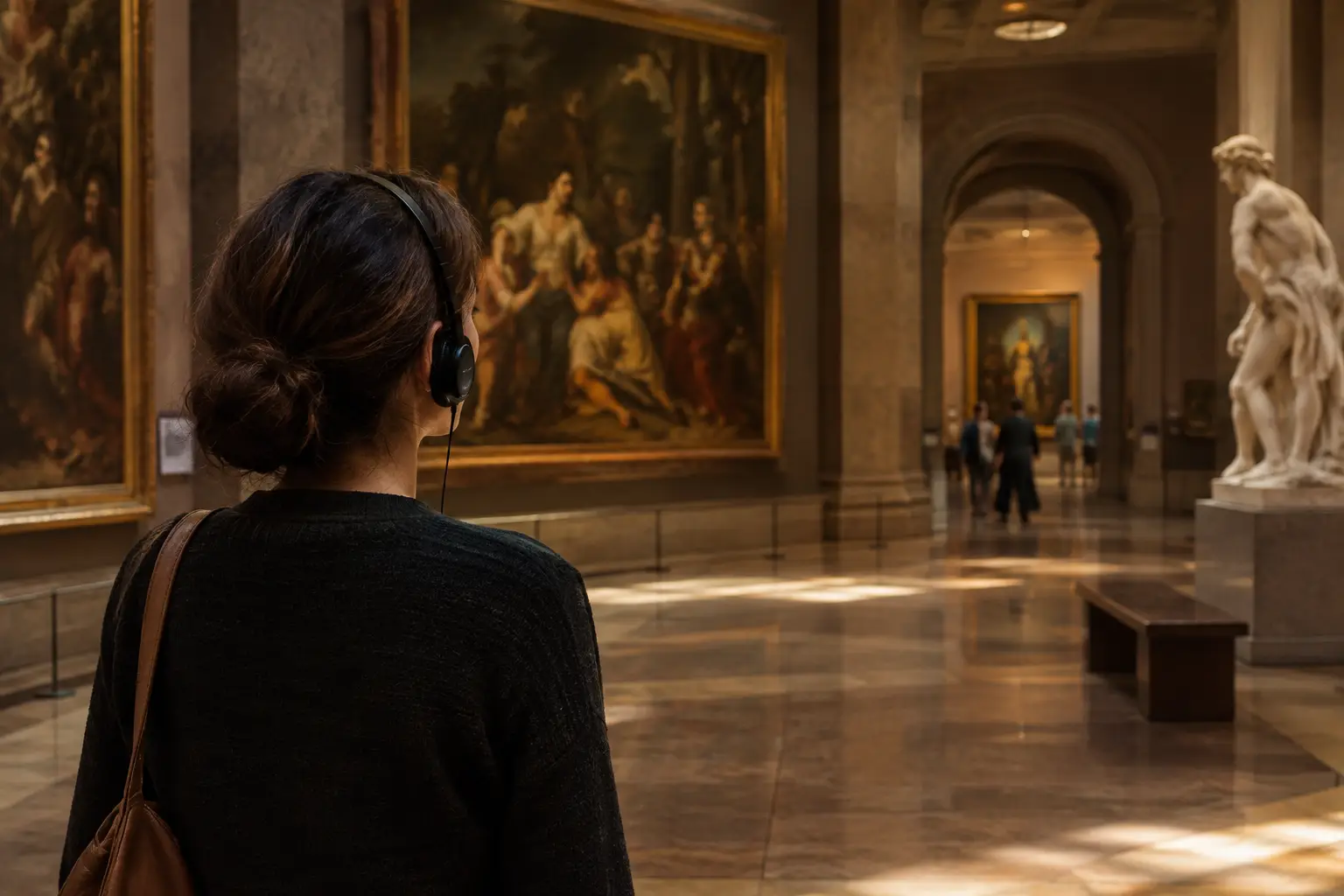
Looking for a Prado audio guide free of charge? Plan a focused route through Velázquez, Goya, and Bosch, then listen offline at your own pace.
You stand before Las Meninas and the room is crowded, quiet, and moving in several directions at once. A Prado audio guide free of charge gives you a way to stop following the crowd and start looking with purpose. You do not need to cover every gallery. You need enough context to notice why a painter places a mirror at the back of a room, or why one face in a royal portrait seems to watch you leave.
The Prado is not a museum for rushing. Its great paintings reward ten slow minutes more than fifty quick photographs. A free guide on your own phone also means no rental desk, no extra device around your neck, and no pressure to finish before a scheduled group moves on.
What a free Prado audio guide should do
A useful guide does more than identify the painter and date. It tells you where to stand, what detail to find first, and what was happening in Spain and Europe when the canvas was made. At the Prado, that context matters. These paintings were made for kings, churches, private chapels, and palaces. They were not originally arranged for a modern museum visitor with a few hours between lunch and an evening train.
Look for narration that is short enough to use in front of a painting. Three clear minutes can be more useful than a lecture that lasts fifteen. It should also offer written text. Museum rooms can be loud, your headphones may run out of battery, or you may simply prefer to read while you look.
Lokali offers free audio and written guides on a phone browser and Android, with offline downloads and more than 50 languages. For the Prado, that matters if English is not the language in which you want to think about court painters, saints, and revolutions. Download before you enter, then use your phone at your own pace.
Choose a route, not a checklist
The Prado holds far more than one visit can absorb. Trying to see everything turns paintings into colored rectangles and leaves you tired before the galleries that brought you there. Choose a route of six to ten works, with one clear thread.
The Spanish court route
Begin with Diego Velázquez. His royal portraits can look formal from a distance: dark rooms, heavy fabric, pale faces, small dogs. Step closer and they become strange studies of power. In Las Meninas, the young Infanta Margarita stands in a room full of people who seem to be waiting for someone. A mirror reflects the king and queen. Velázquez paints himself at work. You become part of the problem: who is looking at whom?
Continue to The Surrender of Breda. It shows a military victory, but its famous moment is not violence. The victorious commander receives the defeated man with an almost theatrical courtesy. A guide can point out the forest of upright lances behind the Spanish soldiers and the different mood on each side of the scene. It is propaganda, but intelligent propaganda.
This route works if you want the Prado’s central story: painting at the service of a powerful court, then painting that begins to question what power looks like.
The Goya route
Francisco de Goya gives the museum a different temperature. His early works can be bright and playful. His later ones are harder to sit with. Move from court portraits to The Third of May 1808, where a man in a white shirt raises his arms before a firing squad. The painting is staged with stark light and shadow, yet its fear feels direct.
If the Black Paintings are on your route, give them time. Goya made these disturbing works on the walls of his own house late in life. They were later transferred to canvas. Their darkness is not decorative. A short audio explanation can keep you from treating them as a quick stop for a dramatic image.
A Goya route is a good choice if you have visited the Prado once before, or if you prefer one artist’s changing view of society to a broad survey of Spanish painting.
The Bosch and Bruegel route
For something older and more unsettling, build a route around Hieronymus Bosch and Pieter Bruegel the Elder. Bosch’s The Garden of Earthly Delights is crowded with naked figures, oversized fruit, birds, strange machines, and punishments that look like nightmares remembered at breakfast. It is easy to spend half an hour on one panel and still miss half of it.
Do not expect a guide to solve every symbol. Scholars do not agree on all of them, and certainty can flatten a work made to provoke thought. Good narration gives you a structure: paradise, earthly desire, and hell. Then it leaves room for the small oddities that catch your own eye.
Bruegel’s scenes offer another kind of crowd. His people skate, work, fight, feast, and stumble through landscapes that make human activity look both comic and fragile. This route suits a rainy afternoon or a return visit when royal portraiture feels too familiar.
Use your phone without letting it take over
Download the audio before arrival if you can. Museum walls and lower galleries are not always kind to a mobile signal. Bring wired or wireless headphones, but use only one earbud if you need to stay aware of staff, other visitors, and the movement of the room.
Keep the screen dim and your phone in your hand, not raised in front of the painting. Listen first, then put it away for a minute. The aim is not to replace looking with narration. The audio should make the painting more visible when it stops.
It also helps to pause between major works. Sit where seating is available, drink water outside the galleries if needed, and decide whether the next painting still interests you. A self-guided visit lets you change direction without apologizing to anyone.
What free guidance cannot give you
A free Prado guide is usually enough when you want orientation, a focused route, and a clear explanation of the paintings in front of you. It is especially useful if you are visiting alone, moving at an uneven pace, or listening in a language that museum signage does not fully support.
It is not always the right choice. A paid human guide can be worth the cost if you are studying art history, visiting with a group that wants to ask many questions, or looking for a specialist view of a narrow subject such as Spanish royal collecting. A live person can respond to what you notice. A recorded guide cannot.
An on-site guide rental may also be simpler if you arrive with no headphones, no battery, and no time to prepare. The trade-off is familiar: another device, a fixed selection of commentary, and an added charge after admission. There is no moral victory in avoiding it if it makes your day easier.
Let one painting stay with you
Before you leave, return to one work that changed after you learned its story. It may be Velázquez’s mirror, Goya’s raised arms, or a tiny impossible creature in Bosch’s garden. Stand there without audio for a final minute.
The Prado does not need to be conquered. A small number of paintings, properly seen, can follow you out into Madrid far longer than a full museum checklist.