Self guided sightseeing at your own pace
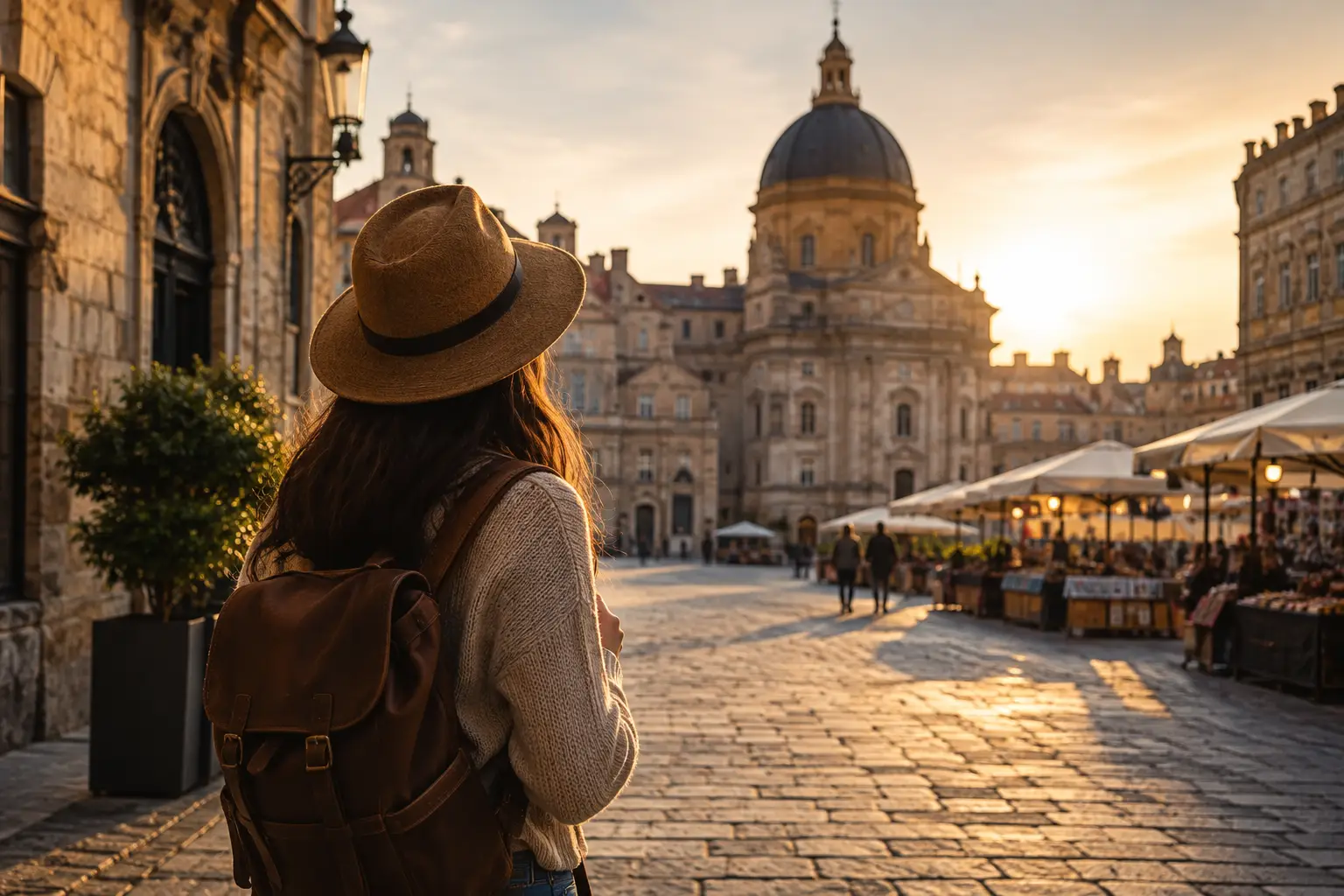
Plan self guided sightseeing with offline maps, clear routes and useful context, so you can move at your own pace through any city and museum without a group.
At 9:10 in the morning, the first courtyard of Prague Castle can feel like a station platform: groups gather around raised umbrellas, cameras lift, and one voice sets the speed for everyone. Self guided sightseeing gives you another option. You can pause below the Gothic ribs of St Vitus Cathedral, read the small detail you missed, or leave the complex when the crowds begin to flatten the experience.
It is not simply sightseeing without a guide. Done well, it is a way to give a city enough structure to make sense, while keeping your time, attention and budget in your own hands. You choose whether an old market deserves twenty minutes or an hour, whether to stop for lunch before a museum, and whether a narrow side street is worth the detour.
What self guided sightseeing does well
A scheduled walking tour is useful when you want a human being to answer questions, bring a neighbourhood to life through personal knowledge, or take charge on a complicated first day. It also gives you a fixed meeting point and a route you do not need to think about. Those are real advantages, especially if you are short on time or travelling somewhere that feels hard to read.
But a group has a pace. If someone is late, everyone waits. If a site interests you more than the guide expected, the group still moves on. Self guided sightseeing replaces that timetable with a simple sequence: where to begin, what to notice, why it matters and where to go next.
The gain is often most obvious in museums. A large collection can turn into a tired march from label to label after 90 minutes. A short route built around six or eight objects is more useful than trying to see every gallery. At the Prado, for example, you might follow the thread from court portraiture to Goya's darker rooms, then stop when your attention fades rather than treating the museum as a test of endurance.
There is a financial reason too. Paying separately for entry and an on-site guide rental at every landmark adds up. That does not mean paid audio is always poor value. The Louvre's own guide, for instance, costs €6 and is available in nine languages. It can be the sensible choice when you want the museum's official route and its current practical information. The question is whether you need that service at every door, every day.
Build a day around a route, not a checklist
A good independent day has a beginning, a middle and an exit. It does not need to be packed. Start with one area you can walk through in a few hours, then add one substantial interior visit if it fits your energy.
In Rome, that might mean beginning around the Capitoline Hill, walking down towards the Forum, and leaving room for a late coffee before choosing whether to enter a museum. In Tbilisi, it could mean the sulfur baths, the old streets rising towards Narikala, carved wooden balconies, and the bells around Sioni Cathedral. The value is not in collecting names. It is in seeing how the slope, river, materials and buildings explain one another.
Before you leave your accommodation, decide on three things: your first stop, the place where you will take a break, and a finish point that is easy to recognise on a map. This small plan prevents the common independent-travel mistake of spending an hour choosing what to do while standing on a pavement.
Keep the route geographically honest. Crossing a city twice because two famous sites appear on the same list wastes daylight and attention. A map should show walking distance, not just pins. If a site is 35 minutes away on foot, treat it as a separate part of the day unless the walk itself has a reason: a waterfront, a historic avenue or a neighbourhood you want to understand.
Give every stop a question
Context is what turns a building into a place. Instead of arriving at a church with only its name, arrive with a question. Why was this square made so large? What was here before the palace? Which details show that a former industrial district became fashionable?
You do not need an academic lecture. Two or three clear ideas are enough. At a city gate, learn whether it marked defence, taxation or ceremony. In a former palace, notice who could enter which rooms. At a monument, look for the people and labour that made it possible, not only the person at the top.
This is where audio can help because your eyes stay on the street. Written text has its own advantage: you can scan it in a noisy square, reread a date, or skip a section that does not interest you. Use the format that matches the moment. A pair of headphones is not a requirement for understanding a city.
Prepare for the parts your phone cannot solve
Your phone is an excellent guide until the battery falls below ten percent or a signal disappears behind thick stone walls. Download maps and any audio or reading material before you set out. Save the route, take a screenshot of the key turns, and carry a battery pack if you plan to use navigation for several hours.
Offline preparation matters most in large sites. Palaces, archaeological parks and old fortresses often have poor reception exactly where you need orientation. A guide that works without mobile data lets you continue at the entrance, underground or halfway up a hill.
Lokali is one free option for this kind of day. It offers narrated walks, landmark and museum guides, written versions for reading, offline downloads and maps across more than 190 cities in 45 languages. Its historical Time Machine scenes can be particularly useful when a square looks calm now but was once the setting for a decisive public moment. Use it as a layer of context, not a command telling you where to stand next.
Do not overprepare, either. Twenty saved guides can make a free day feel like homework. Choose one main route and one backup idea for rain, fatigue or a place that is more interesting than expected. The rest can remain open.
Know when not to go alone
Independent sightseeing has limits. If you have only one afternoon in a city and feel overwhelmed by its scale, a well-chosen scheduled tour may be worth the fixed pace. A local human guide also makes more sense when your questions are highly specific, when a place has few signs in a language you can read, or when the point is conversation rather than information.
Some interiors are difficult to understand without expert interpretation. A room full of religious images, an archaeological layer with almost no visible structure, or a collection built around technical craft can need more than a short audio stop. In those cases, take the official guide, join a specialist visit, or read first and return with a clearer purpose.
There are also days when you should leave the plan behind. If rain starts on the walk from the Rijksmuseum to the canal belt, staying in a gallery longer may be wiser than forcing the route. If a market is being set up in a square, watch it happen. The useful route is the one that gives you permission to notice the unplanned scene.
Make room for memory
The strongest self guided days usually contain fewer stops than expected. You remember the echo under a station roof, the paint worn away on a handrail, the sudden view at the end of a steep street. Those details arrive when nobody is hurrying you towards the next numbered attraction.
Set a modest route, bring enough context to see beyond the façade, and leave empty time between places. A city does not become clearer because you move through it faster. It becomes clearer when you have time to look up, stop, and decide what matters to you.