Zayed National Museum
24.5346° N · 54.4188° E · Museum
Zayed National Museum is a museum from United Arab Emirates. It is in Abu Dhabi, United Arab Emirates. Designed by the British architecture firm Foster and Partners. The free Lokali audio guide runs 7 minutes.
✓ Published October 2026 · how we write these guides
Visitor facts
| Lokali audio guide | 7 min · free |
|---|---|
| Type | Museum |
| Location | Abu Dhabi, United Arab Emirates |
| Coordinates | 24.5346, 54.4188 |
| Official website | zayednationalmuseum.ae |
| Languages | 50+, in the Lokali app |
The story
Stand still for a moment and let the heat settle on your shoulders. Then look up. Above you, tall curved forms of pale steel rise from a green mound of earth. They lean slightly, like feathers caught in the wind. On a bright Saadiyat morning they throw long, shifting shadows across the ground. As the sun moves, those shadows move too, so the building looks different every hour you stand here.
This is the Zayed National Museum, the national museum of the United Arab Emirates. It stands in the Saadiyat Cultural District of Abu Dhabi, a stretch of the island set aside for museums and the arts. The museum tells two stories at once. One is the story of this land and its people, across thousands of years. The other is the story of one man who shaped the modern nation — Sheikh Zayed bin Sultan Al Nahyan.
First, the man. Sheikh Zayed is known across the Emirates as the founding father. In 1971, separate emirates along this coast joined together to form a single country, and he became its first president. Many older Emiratis still speak of him with personal warmth, as if he were a grandfather they knew. You will hear his name everywhere in this city — on mosques, roads, and schools. Here, his name is on the place that holds the nation's memory.
Now look again at those soaring wings. The design comes from Foster and Partners, the British architecture firm. The shapes take their inspiration from the wing feathers of a falcon. That choice is personal. Falconry is one of the oldest traditions of the Arabian Peninsula, and Sheikh Zayed was a devoted falconer. So the building does more than honour him in words. Its very outline carries the image of a bird he loved.
Here is a detail that many visitors miss. Those wings are not only decoration. They are designed to work like thermal towers. Hot air rises inside them and draws cooler air through the spaces below. The idea comes from an old regional tradition, the wind tower, a structure that cooled homes long before electricity. So a very modern building uses a method that people on this coast understood for centuries.
The mound itself matters too. The building sits on a raised, landscaped hill, so much of the museum rests partly inside the earth. Earth is a natural insulator. It keeps the inner galleries more stable against the desert heat. As you walk around the base, notice how the planting and the paths lead you gently upward. Arriving here feels a little like a climb toward something, rather than a walk into a box.
Inside, the galleries move through the long human story of this region. They begin deep in prehistory. Long before oil, long before cities, people lived here by the sea and in the desert. They fished, they traded, and they dived for pearls. The displays trace how those communities adapted to a hard and beautiful environment, where water was precious and shade was life.
One small object deserves your full attention. Look for the Abu Dhabi Pearl. It was found on Marawah Island, off the coast of this emirate, and it is roughly eight thousand years old. It is often described as the oldest natural pearl ever discovered. Think about that for a moment. Someone in the Stone Age valued this tiny, glowing bead enough to keep it. Pearls would shape life on this coast for thousands of years afterward.
And pearling really did shape everything here. Before the oil age, many families along this coast depended on the pearl season. Men went out on wooden boats for months at a time. Divers held their breath and dropped to the seabed again and again, gathering oysters by hand. It was dangerous, exhausting work. Watch for references to this world as you move through the galleries — it explains much about how Emiratis remember their grandparents.
The sea also connected this land to distant places. In the Bronze Age, this region was part of a trading culture known in ancient texts as Magan. Its people traded copper and other goods with Mesopotamia, the land between the rivers in modern Iraq. Ships made of reeds and sealed with bitumen, a natural tar, carried that trade. The museum has supported efforts to rebuild such a boat using ancient methods, a practical way to test how those sailors once worked.
Other galleries bring the story closer to the present. They follow the founding of the nation and the vision of Sheikh Zayed himself. He was famous for his love of the land. He pushed hard to plant trees and green spaces in the desert, at a time when many people thought it impossible. Keep that in mind as you look at the gardens outside. The greenery around this museum is a quiet echo of his own ideas.
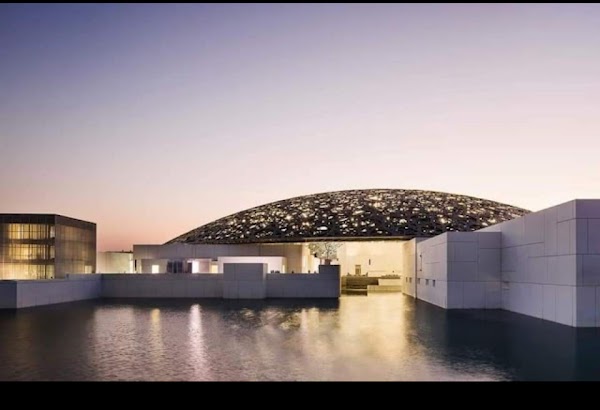
Take a moment, too, to look at the neighbourhood. This building is one of several major cultural institutions on Saadiyat Island. Louvre Abu Dhabi, with its great perforated dome, sits not far away along the shore. Together these buildings form a deliberate statement. Abu Dhabi wants to be a place where the world comes to look at art, history, and ideas — and where the country tells its own story in its own voice.
Before you leave, walk slowly around the outside once more. Notice how the light changes on the steel. In the morning it looks cool and silver. Later in the afternoon it turns warmer, almost golden, and the shadows stretch across the grass. Notice the sound, too — the soft wind, the distant traffic, perhaps birds in the planting. It is calm here, even on busy days.
So look up one last time at those wings against the sky. They rise from the earth, a falcon's feathers made of steel, above a pearl that someone treasured eight thousand years ago. Between those two things lies the whole story of this coast. As you walk away, let the heat return to your shoulders... and remember that people have stood in this same sun, on this same shore, for a very long time.
Key facts
What to look for
Practical tips
Common questions
Is there a free audio guide to Zayed National Museum?
Yes — the Lokali app narrates Zayed National Museum free of charge in 50+ languages. The guide runs about 7 minutes, covers the history, what to look for on site and practical tips, and works offline once downloaded.
Where is Zayed National Museum?
Zayed National Museum is in Abu Dhabi, United Arab Emirates, at 24.5346, 54.4188. Tap the map link on this page for directions from where you are.
What is Zayed National Museum known for?
Designed by the British architecture firm Foster and Partners. Steel wings take inspiration from a falcon's feathers.
What should you look for at Zayed National Museum?
Shadows from the steel wings shifting across the grass. The tiny Abu Dhabi Pearl found on Marawah Island. Displays on pearl diving and its wooden boats.
What should you know before visiting Zayed National Museum?
Walk the full exterior before entering the galleries. Visit in late afternoon for warm light on the steel.
When is the best time to visit Zayed National Museum?
Visit in late afternoon for warm light on the steel.
On the map
Opens directions to Zayed National Museum from your location.
More to see in Abu Dhabi


Hear Zayed National Museum in your language
The full story, narrated, in 50+ languages. Download it before you go and it plays offline, at your own pace, with no ticket and no tour group.