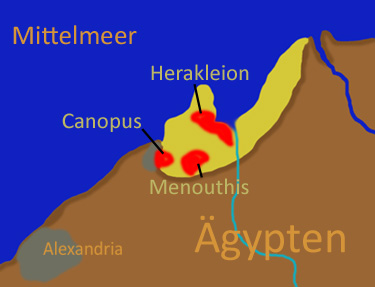
Canopus
31.3000° N · 30.0833° E · Archaeological Site
Photo: ChrisOsenbrück · Public domain · Wikimedia Commons
Canopus is an ancient Egyptian town. It is near Alexandria, Egypt. Canopus stood near the Nile's westernmost, Canopic branch. The free Lokali audio guide runs 7 minutes.
✓ Published October 2026 · how we write these guides
Visitor facts
| Lokali audio guide | 7 min · free |
|---|---|
| Type | Archaeological Site |
| Location | Alexandria, Egypt |
| Coordinates | 31.3000, 30.0833 |
| Languages | 50+, in the Lokali app |
The story
Listen first. Out in the bay, small waves slap against the rocks. A fishing boat idles somewhere, and the air carries salt, diesel, and grilled fish from the restaurants along the shore. This is Abu Qir, on the eastern edge of Alexandria. The ground under your feet looks ordinary. But somewhere beneath this coastline, and under the water in front of you, lies one of the most talked-about towns of the ancient Mediterranean. Its name was Canopus.
To understand why it mattered, picture the map as it once was. The Nile did not reach the sea through one channel. It split into several branches across the Delta, and the westernmost of them was called the Canopic branch. Canopus sat close to its mouth. Ships coming from Greece and the wider Mediterranean could enter Egypt here. That made the town a gateway, long before Alexandria became the great city of the coast.
The Greeks had their own story about the name. According to the legend, Canopus was the helmsman of Menelaus, the Spartan king from the tale of Troy. On the voyage home, the story says, the helmsman died here, and the place was named in his honour. Historians treat this as myth. Many scholars think the name may have older Egyptian roots. Still, the tale tells you something real... Greeks wanted to see their own heroes in this foreign shore.
Here is the first surprise. Look up on a clear winter night, low in the southern sky, and you may see a bright star. Astronomers call it Canopus. It is the second brightest star in the night sky, and it carries the same name as this town. From Greece it barely clears the horizon, or does not rise at all. Here in Egypt it rides higher. Sailors from the north saw it as a southern marker, and the town and the star became linked.
After Alexander the Great founded Alexandria, the Ptolemies ruled Egypt. They were a Greek-speaking dynasty who also presented themselves as pharaohs. Canopus flourished under them. Its most famous temple was dedicated to Serapis, a god the Ptolemies promoted. Serapis blended Egyptian and Greek ideas — part Osiris, part Zeus, with a full beard and a basket of grain on his head. People came to his temple at Canopus seeking cures. Some slept inside the sanctuary, hoping the god would send healing dreams.
Canopus also had a reputation, and not a quiet one. Ancient writers, including the geographer Strabo, described crowds travelling along the canal from Alexandria. They came by boat, day and night, with music and dancing on deck. The festivals were famous for their excess. In Roman times, the name Canopus became shorthand for luxury and pleasure. Think of it as the place where city people went to forget the city.
That reputation travelled far. Near Rome, at Tivoli, the emperor Hadrian built a vast villa in the second century. One of its features is a long pool lined with columns and statues. Today it is known as the Canopus. Hadrian had travelled in Egypt, and this pool is usually understood as a tribute to this place, or to the canal leading here. So a small Egyptian harbour town gave its name to a famous corner of an Italian palace.
Here is a second surprise, and you may already know the word. In museums you have probably seen canopic jars. These are the vessels that held the organs of mummified Egyptians. Ancient Egyptians did not call them that. Early European scholars gave them the name. They connected the jars with a form of Osiris worshipped at Canopus, shown as a jar with a human head. The link is a little mistaken, but the name stuck. Every museum label that says canopic points back to this coast.
The town also produced one of the key documents of Ptolemaic Egypt. In 238 BC, priests gathered at Canopus and issued a decree honouring King Ptolemy the Third and his queen, Berenice. It was carved on stone in three scripts — hieroglyphic, Demotic, and Greek — much like the Rosetta Stone. Copies were found elsewhere in Egypt in the nineteenth century, and they helped scholars confirm the reading of hieroglyphs. Among other things, the decree proposed a reform to the calendar, adding a leap day.
Then the world changed. In the late fourth century, as Christianity became the official faith, the temple of Serapis at Canopus was closed and destroyed. Monks settled on the site. Later, relics of two Christian healers, Saint Cyrus and Saint John, were brought to the neighbouring town of Menouthis. Pilgrims now came for Christian cures instead of dreams from Serapis. Many scholars believe the modern name Abu Qir comes from Abba Cyrus — Father Cyrus. The old healing tradition simply changed its god.
And then the land itself gave way. Over the centuries, this stretch of coast sank. Earthquakes, rising sea level, and the soft, waterlogged soil of the Delta all played a part. Parts of Canopus, together with nearby Menouthis and the port of Heracleion, slipped beneath the bay. For a long time, they were known mostly from ancient texts. From the 1990s, underwater archaeologists led by Franck Goddio mapped the seabed here. They found statues, temple remains, and objects from daily life lying under sand and water.
So what you see today is modest on land. There is no grand ruin to walk through. The most striking finds now sit in museums, including collections in central Alexandria. But this bay holds another layer of history too. In 1798, the British fleet under Horatio Nelson destroyed Napoleon's fleet here, in what the British call the Battle of the Nile. Wrecks from that night also lie on this seabed, not far from the drowned temples of the Ptolemies.
Before you leave, stand still for a moment and face the water. The colour shifts from pale green near the rocks to a deeper blue further out. Somewhere under that surface are the streets where boats once arrived with music playing. The fishermen mending nets nearby are working the same water that carried Greek sailors, Roman pleasure-seekers, and Christian pilgrims. As you walk back toward the road, listen once more to the waves. They are washing over a town that never fully disappeared.
Key facts
What to look for
Practical tips
Common questions
Is there a free audio guide to Canopus?
Yes — the Lokali app narrates Canopus free of charge in 50+ languages. The guide runs about 7 minutes, covers the history, what to look for on site and practical tips, and works offline once downloaded.
Where is Canopus?
Canopus is near Alexandria, Egypt, at 31.3000, 30.0833. Tap the map link on this page for directions from where you are.
What is Canopus known for?
Canopus stood near the Nile's westernmost, Canopic branch. The bright southern star Canopus shares the town's name.
What should you look for at Canopus?
The colour change from green shallows to deep blue water. Fishing boats and nets along the Abu Qir waterfront. Low rocky outcrops where the ancient coastline once ran.
What should you know before visiting Canopus?
Visit Alexandria's museums to see objects raised from the bay. Combine Abu Qir with a seafood lunch along the shore.
When is the best time to visit Canopus?
Come in late afternoon when the bay light is softer.
On the map
Opens directions to Canopus from your location.
More to see in Alexandria


Hear Canopus in your language
The full story, narrated, in 50+ languages. Download it before you go and it plays offline, at your own pace, with no ticket and no tour group.