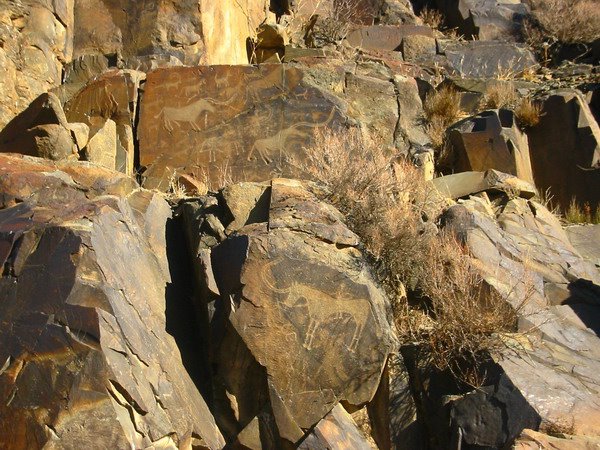
Tanbaly
43.8033° N · 75.5350° E · Archaeological Site
Photo: Jonas Satkauskas · Attribution · Wikimedia Commons
Tanbaly is an archaeological site in Kazakhstan. Listed as a UNESCO World Heritage Site in 2004. The free Lokali audio guide runs 6 minutes.
✓ Published October 2026 · how we write these guides
Visitor facts
| Lokali audio guide | 6 min · free |
|---|---|
| Type | Archaeological Site |
| Location | Almaty Region, Kazakhstan |
| Coordinates | 43.8033, 75.5350 |
| Languages | 50+, in the Lokali app |
The story
Listen for a moment. Wind moves through dry grass, and somewhere a grasshopper clicks against the stone. Under your feet, the ground is hard and pale, scattered with sharp gravel. Around you, low dark rocks rise from the steppe. In the strong light, their surfaces shine almost black. Look closer at one of those rocks, and you may see a shape looking back at you. A bull. A rider. A figure with a strange round head. Welcome to Tanbaly.
You may also hear this place called Tamgaly. Both names point to the same idea. In Kazakh and other Turkic languages, a tamga is a mark or a sign. Clan symbols, brands on horses, signs of ownership... all of these are tamgas. So the name means something like the place of marks. It is a fitting name. Few places in Central Asia hold so many carved images in such a small valley.
Tanbaly sits in the Almaty Region of Kazakhstan, a few hours' drive northwest of the city of Almaty. Here the land breaks into a group of low, rocky hills at the edge of the steppe. The hills are not high, but they hold water and shelter. In a dry landscape, that matters. A spring, a sheltered gorge, grass for animals — people noticed these things, and they returned to them again and again across thousands of years.
In 2004, UNESCO added this site to its World Heritage List. The official name describes petroglyphs within an archaeological landscape. That phrase is important. A petroglyph is an image cut or pecked into rock, not painted on it. And the word landscape tells you that the carvings are only one part of the story. Around them are ancient burial places, traces of settlements, and old ritual spaces.
Researchers count roughly five thousand petroglyphs here. The oldest are generally dated to the Bronze Age, in the second millennium before the Common Era. But the carving did not stop then. People kept adding images through the Iron Age, through the medieval period, and into much more recent times. Some marks are only about a century old. So when you walk this gorge, you are reading layers of messages, left by many different peoples.
How were they made? The rocks here carry a dark surface layer, often called desert varnish. It forms slowly over long periods, as minerals settle on the stone. Beneath it, the rock is lighter. An artist struck the surface with a harder stone, again and again, removing the dark skin. The lighter rock underneath showed through. That contrast is why the figures still stand out today, even after thousands of years of sun and frost.
The most famous images here are the so-called sun-headed figures. They are human shapes, but their heads are large circles, surrounded by rays or dots. Some look like they wear a halo. Others look almost like a sunflower on a body. Scholars often interpret them as solar deities, or as people in ritual dress. No one knows for certain. That uncertainty is part of their power. You are free to look and wonder.
Here is something many visitors miss. The densest groups of images are not spread randomly. In the main gorge, certain rock faces carry many carvings, while nearby faces stay almost empty. Archaeologists have suggested that some of these clusters worked as sanctuaries, places for ceremony, perhaps with offerings made in front of them. The open ground before some panels may have been a space where people gathered. You may be standing in one right now.
Now look for the animals. They far outnumber the human figures. You will see bulls with long curved horns, horses, camels, wild goats, and deer. Some animals are drawn in simple outlines. Others are filled in solidly. In places, a hunter stands with a bow, aimed at a goat. These are scenes from a life built around herds and hunting. For the people who made them, animals meant food, wealth, and survival.
Some scenes are harder to read. You may find figures that seem to dance, holding hands in a line. You may see small human shapes beside large animals, or strange mixed creatures that are part human and part beast. Later carvings bring different subjects. Riders with weapons appear. And sometimes you will notice actual tamga signs, the clan marks that gave this place its name. Each era added its own vocabulary to the rock.
There is a second surprise. Some of the later carvings sit directly on top of older ones. A newer rider may cross an ancient bull. This was not always an accident. Returning to a sacred rock, and adding your own image, may have been a way to connect with the people who came before. The rock face became a long conversation. It was carried on across centuries by people who never met.
Take a moment to notice how fragile all this is. The images survived sun, wind, and snow for thousands of years. Human hands are a greater danger. Touching the carvings leaves oils that damage the surface. Chalking or wetting them for photographs can harm them too. Please look closely, photograph freely, but keep your fingers off the stone. The best way to honour these makers is to leave their work as you found it.
Before you leave, stand still once more. Look out past the rocks to the open steppe. The light changes quickly here as the sun moves, and with it, the carvings appear and fade. A figure you could not see an hour ago may now be sharp in the low light. Listen again to the wind in the grass. The people who carved these rocks heard that same sound. As you walk back, glance at the dark stones you pass. One of them may hold a mark you are the first to notice today.
Key facts
What to look for
Practical tips
Common questions
Is there a free audio guide to Tanbaly?
Yes — the Lokali app narrates Tanbaly free of charge in 50+ languages. The guide runs about 6 minutes, covers the history, what to look for on site and practical tips, and works offline once downloaded.
Where is Tanbaly?
Tanbaly is near Almaty Region, Kazakhstan, at 43.8033, 75.5350. Tap the map link on this page for directions from where you are.
What is Tanbaly known for?
Listed as a UNESCO World Heritage Site in 2004. Roughly five thousand petroglyphs are recorded across the site.
What should you look for at Tanbaly?
Sun-headed human figures with rays around round heads. Bulls with long curved horns pecked into dark rock. Newer riders carved directly over older animal images.
What should you know before visiting Tanbaly?
Visit in early morning or late afternoon for clearer carvings. Bring plenty of water, sun protection, and a hat.
When is the best time to visit Tanbaly?
Visit in early morning or late afternoon for clearer carvings.
On the map
Opens directions to Tanbaly from your location.
Hear Tanbaly in your language
The full story, narrated, in 50+ languages. Download it before you go and it plays offline, at your own pace, with no ticket and no tour group.