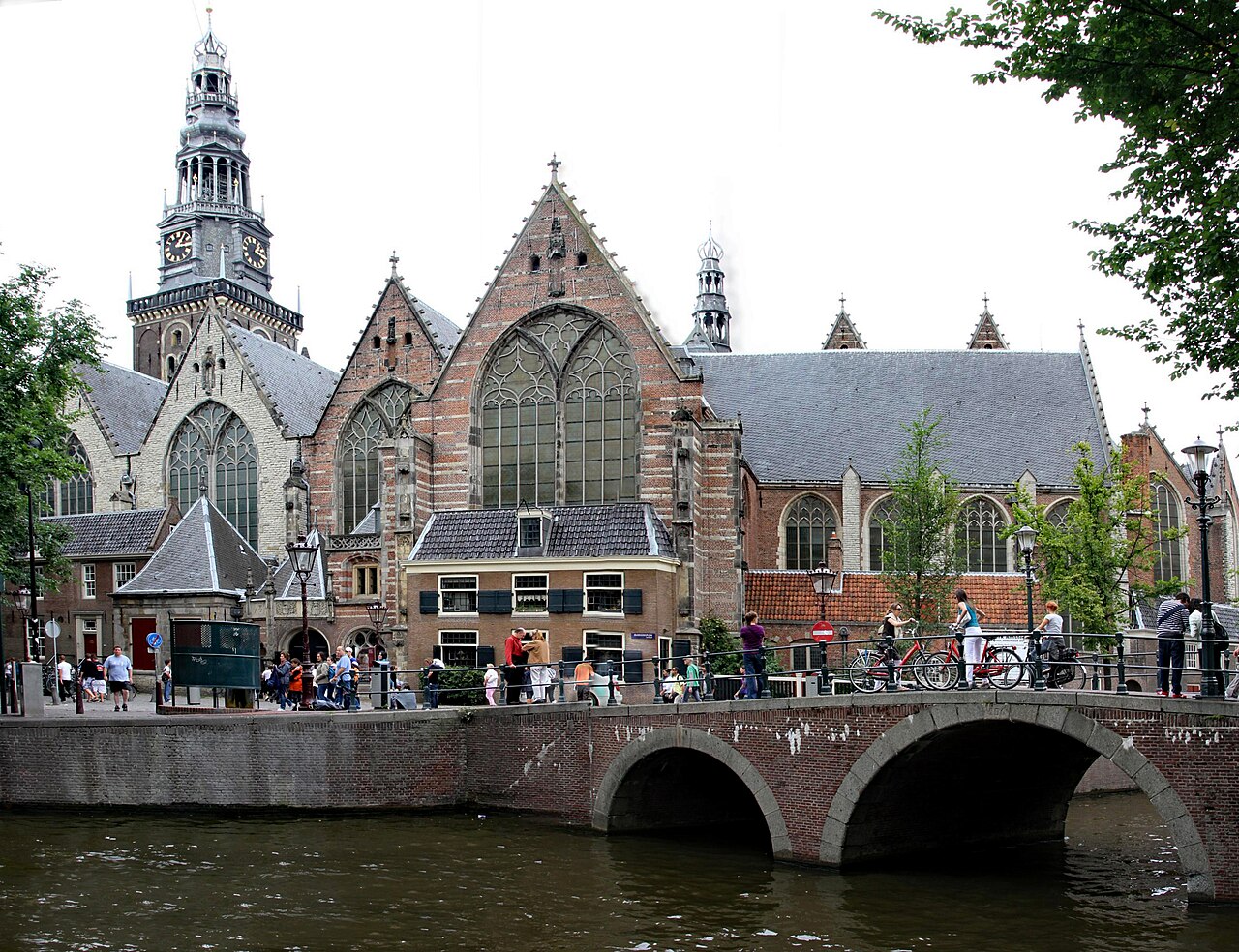
Oude Kerk is a church in Amsterdam, Netherlands. Amsterdam's oldest building (1213), Oude Kerk dominates the Red Light District with its soaring Gothic interior and ornate wooden ceiling. Most visitors spend 45–60 min here. The free Lokali audio guide runs 5 minutes.
✓ Verified August 2026 · how we write these guides
Visitor facts
| Time needed | 45–60 min |
|---|---|
| Lokali audio guide | 5 min · free |
| Type | Church |
| Best for | History |
| Location | Amsterdam, Netherlands |
| Coordinates | 52.3740, 4.8995 |
| Languages | 45, in the Lokali app |
The story
Around you, neon glows in the windows of narrow lanes. This is one of the oldest and strangest corners of Amsterdam. And in the middle of it stands a great stone church, dark and patient. It has watched over this neighborhood, through every kind of change, for more than seven hundred years.
This is the Oude Kerk, the Old Church. It is the oldest building in the entire city. A wooden chapel stood here first, near the harbor, where sailors and traders gathered. The stone church that grew from it was consecrated around 1306. Around it, the lanes and canals of the old town wrap close, much as they did when the first stones were laid. Everything else in Amsterdam is younger than these walls.
The church was dedicated to Saint Nicholas. He is the patron saint of the city, and also of sailors. That choice fit this place well. Amsterdam lived by the water. Ships came and went, and the men who sailed them wanted a saint to watch over their voyages. The church stood near the docks, close to the working life of the port.
Step inside and look up. The ceiling is made of wood, curved high overhead. It is one of the largest medieval wooden vaults in Europe. The timber has hung in place for centuries. Long ago, painters decorated parts of it. Some of that faded work can still be made out, pale against the grain of the wood.
The floor tells its own story. It is paved almost entirely with gravestones. Thousands of people were buried beneath this church over the centuries. You walk across their names as you cross the room. Worn smooth by generations of feet, the stones still carry dates, initials, and small carved marks. The whole floor is a record of the city's dead.
One of those graves belongs to a woman named Saskia. She was the wife of the painter Rembrandt, who lived close by. She died in 1642, still young, and was buried here. Rembrandt knew this church well. His children were baptized at its font. Standing near her grave, you share the same floor that Rembrandt himself once crossed.
The church changed its faith during the Reformation. In the sixteenth century, Amsterdam turned Protestant. Statues and altars were stripped away in a wave of image-breaking. Most of the Catholic decoration vanished. What remained was the bare frame of the building. The stone, the wood, and the light through tall windows. That plainness is still part of its character.
Some of the old windows survived it all. High in the walls, stained glass throws colored light down onto the stone. A few of the panels are centuries old. On a bright day, the colors drift slowly across the floor and walls as the sun moves overhead. It is a quiet, changing kind of spectacle, different from one hour to the next.
The church holds a famous organ as well. Its pipes rise in a carved wooden case above the floor. For hundreds of years, an organ like this gave the church its voice, filling the great vaulted space with sound. Music is still played here today. The high ceiling carries every note out across the room.
Outside, the tower rises above the rooftops. A set of bells hangs within it. For generations, their chimes marked the hours for the people living below. From the top, on certain days, you can look out over the old center. A tangle of red roofs, narrow canals, and stepped gables, all pressed close together.
Today the Oude Kerk is more than a church. It hosts art exhibitions and events, set against its ancient stone. Paintings, sculpture, and sound have all filled the nave in recent years. Modern works appear beneath the medieval ceiling, and the contrast is deliberate. The building keeps on living by letting the present sit beside the past, sheltered under the same old roof.
It is a strange and moving thing, this old church ringed by the lanes around it. Sacred and worldly, side by side, for centuries. Neither has driven the other out. The church does not hide from its surroundings, and the neighborhood has never quite swallowed the church.
When you step back outside, the lanes close in again, with their noise and their colored light. The church stays just as it was, calm in the middle of it all. Seven centuries of prayer, burial, music, and change, held in one stone shell. Rest a hand on the cool wall before you go, and feel how long it has stood.
Key facts
What to look for
Practical tips
Common questions
How long do you need at Oude Kerk?
Plan 45–60 min. That is the time most visitors spend at Oude Kerk. The free Lokali audio guide adds about 5 minutes of narration you can listen to as you walk, so it fits inside your visit rather than adding to it.
Is there a free audio guide to Oude Kerk?
Yes — the Lokali app narrates Oude Kerk free of charge in 50+ languages. It covers the history, what to look for on site and practical tips, and it works offline once downloaded.
Where is Oude Kerk?
Oude Kerk is in Amsterdam, Netherlands, at 52.3740, 4.8995. Tap the map link on this page for directions from where you are.
What should you know before visiting Oude Kerk?
Check opening hours, as events sometimes close it.
What is Oude Kerk known for?
Amsterdam's oldest building, consecrated around 1306.
What is the best time to visit Oude Kerk?
The ceiling is painted wood, not stone — intricate and warm.
On the map
Opens directions to Oude Kerk from your location.
Reference
More to see in Amsterdam


Hear Oude Kerk in your language
The full story, narrated, in 50+ languages. Download it before you go and it plays offline, at your own pace, with no ticket and no tour group.