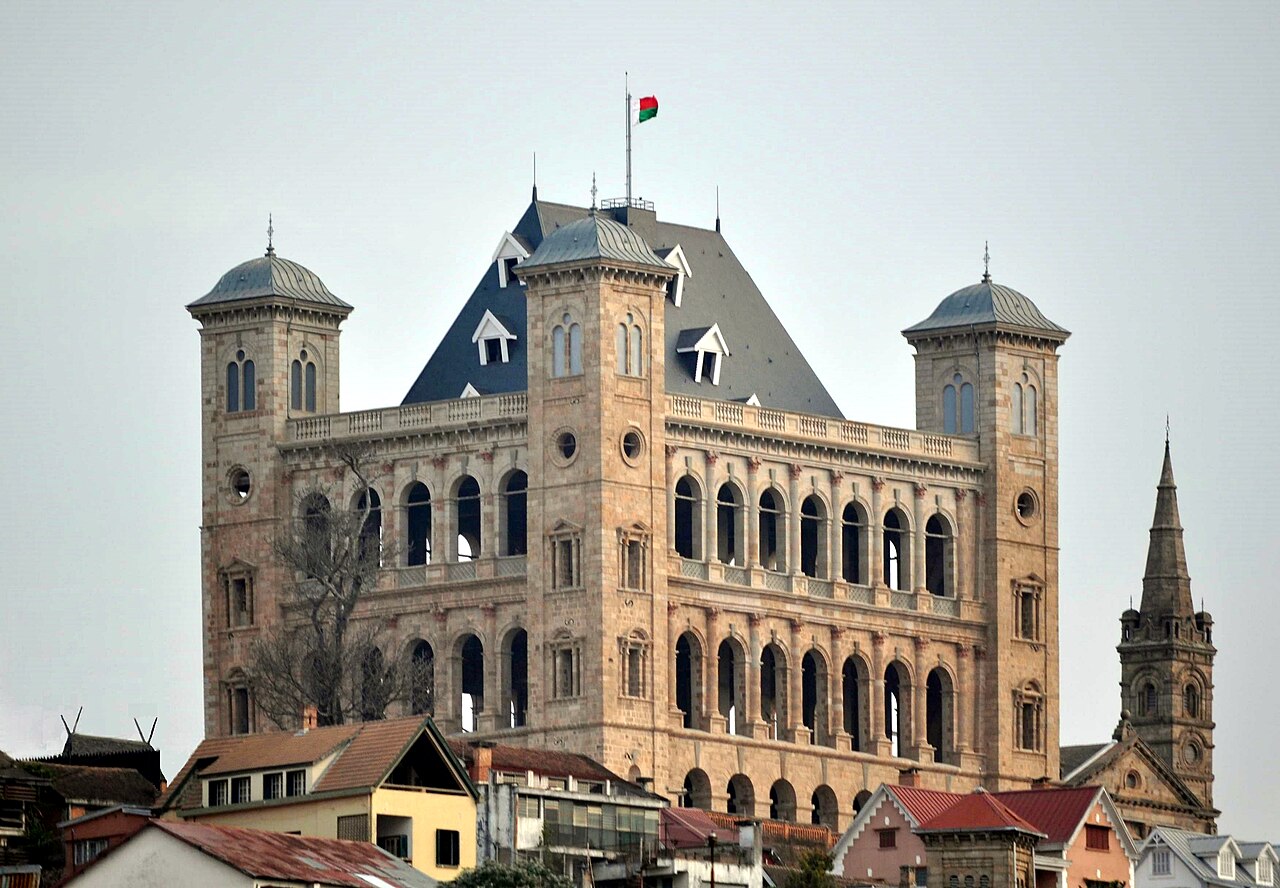
Rova of Antananarivo
18.9061° S · 47.5269° E · Palace Complex
Rova of Antananarivo is a palace complex in Antananarivo, Madagascar. Merina kingdom capital from early nineteenth century. Fire in November 1995 destroyed wooden palace interiors. Most visitors spend 1-2 hours here. The free Lokali audio guide runs 5 minutes.
✓ Verified October 2026 · how we write these guides
Visitor facts
| Time needed | 1-2 hours |
|---|---|
| Lokali audio guide | 5 min · free |
| Type | Palace Complex |
| Best for | History |
| Location | Antananarivo, Madagascar |
| Coordinates | -18.9061, 47.5269 |
| Languages | 45, in the Lokali app |
The story
The air up here is thinner, cooler. You are standing on the highest point in Antananarivo, where the red laterite soil of the highlands meets the sky. This is the Rova — the royal palace complex that once crowned Madagascar's capital, a cluster of wooden palaces and stone tombs that ruled the island for nearly three centuries.
The Merina kingdom rose to power in the central highlands during the seventeenth century, unifying much of Madagascar under a single crown. By the early eighteen hundreds, King Andrianampoinimerina had established Antananarivo as his capital, and his son Radama the First began building the Rova as we know it today. The name itself — Rova — simply means fortified enclosure, but this was far more than a fortress. It was the sacred heart of the kingdom, a place where political power and ancestral reverence intertwined.
The original palaces were built entirely of rosewood, a dense hardwood that grows in Madagascar's rainforests. Queen Ranavalona the First expanded the complex in the eighteen thirties, commissioning the Manjakamiadana — the palace that would become the centrepiece of the Rova. A Scottish missionary named James Cameron, trained as an engineer, designed much of the stonework and introduced European architectural elements. The result was a hybrid structure: rosewood frames wrapped in stone facades, Malagasy craftsmanship meeting Victorian ambition.
Tragedy struck in November 1995. A fire tore through the Rova, consuming the wooden interiors of the palaces. The flames burned for hours, and when they subsided, only the stone shells remained. The cause was never definitively established — some suspected arson, others blamed faulty electrical wiring. What is certain is that centuries of royal artifacts, manuscripts, and sacred objects were lost. The rosewood beams, some of them two centuries old, turned to ash.
Today, the Rova stands as a ruin in restoration. The stone walls of Manjakamiadana still rise above the city, their red-painted exteriors visible from almost anywhere in Antananarivo. Scaffolding clings to parts of the structure — reconstruction has been slow, funded in fits and starts. The site remains open to visitors, though access to certain buildings is restricted for safety.
Walk the perimeter of the complex and you will find the tombs of Merina royalty, small stone houses where queens and kings are buried. These tombs survived the fire intact. The Malagasy practice of famadihana — the turning of the bones — is not performed here, but the tombs are still treated as sacred ground. Locals leave offerings at the gates, small tokens of respect for ancestors who shaped the nation.
From the western edge of the Rova, the view unfolds across the entire city. Antananarivo sprawls below in layers of rust-red brick and corrugated iron, rice paddies tucked into the valleys between hills. On clear mornings, you can see the rice terraces of the Betsimitatatra plains stretching toward the horizon. This vantage point is why the Merina chose this hill — it offered sight lines in every direction, a strategic advantage in an era of rival kingdoms.
The wind up here carries the scent of eucalyptus from the trees planted along the slopes. In the late afternoon, the light turns golden, and the stone walls of the palace glow warm against the sky. Guides gather near the entrance, offering tours in French and Malagasy, though many speak some English. They will tell you stories of Queen Ranavalona the Third, the last monarch to live in the Rova before the French colonial forces deposed her in 1897.
The Rova is not a polished monument. It is a burned palace, a work in progress, a place where history is still being negotiated. The Malagasy government has debated for decades how to restore it — whether to rebuild the interiors as they were, or to leave the ruins as a memorial to what was lost. For now, it remains both: a shell of stone that holds the memory of wood.
As you walk back down the hill, notice the stone staircases cut into the slope, worn smooth by centuries of footsteps. The Rova is not just above the city — it is woven into it, a reminder that power and memory occupy the same ground.
Key facts
What to look for
Practical tips
Common questions
How long do you need at Rova of Antananarivo?
Plan 1-2 hours. That is the time most visitors spend at Rova of Antananarivo. The free Lokali audio guide runs 5 minutes and is made to listen to while you walk.
Is there a free audio guide to Rova of Antananarivo?
Yes — the Lokali app narrates Rova of Antananarivo free of charge in 50+ languages. No ticket, tour group or subscription, and it works offline once downloaded.
Where is Rova of Antananarivo?
Rova of Antananarivo is in Antananarivo, Madagascar, at -18.9061, 47.5269. Tap the map link on this page for directions.
What should you know before visiting Rova of Antananarivo?
Come in late afternoon for golden light on stone
What is Rova of Antananarivo known for?
Merina kingdom capital from early nineteenth century
What is the best time to visit Rova of Antananarivo?
Come in late afternoon for golden light on stone
On the map
Opens directions to Rova of Antananarivo from your location.
Hear Rova of Antananarivo in your language
The full story, narrated, in 50+ languages. Download it before you go and it plays offline, at your own pace, with no ticket and no tour group.