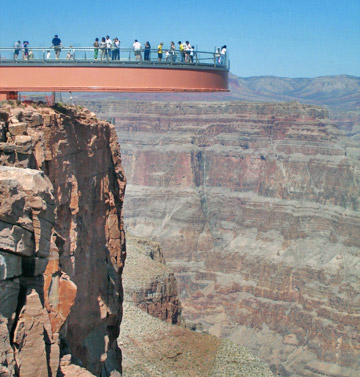
Grand Canyon Skywalk
36.0122° N · 113.8110° W · Bridge
Photo: Complexsimplellc at English Wikipedia · CC BY 2.5 · Wikimedia Commons
Grand Canyon Skywalk is a footbridge. It is near Arizona, United States. The Skywalk opened to the public in 2007. The free Lokali audio guide runs 7 minutes.
✓ Published October 2026 · how we write these guides
Visitor facts
| Lokali audio guide | 7 min · free |
|---|---|
| Type | Bridge |
| Location | Arizona, United States |
| Coordinates | 36.0122, -113.8110 |
| Official website | grandcanyonwest.com |
| Languages | 50+, in the Lokali app |
The story
Listen first. Out here on the western rim, the wind arrives in long, steady pushes. It carries the dry smell of warm rock and juniper. Underfoot, the ground changes. The solid stone ends, and something cooler and smoother begins. Then you look down. There is nothing between your shoe covers and the canyon except a few layers of clear glass. For most people, this is the moment the body goes quiet.
You are standing on the Grand Canyon Skywalk. It is a horseshoe-shaped walkway of steel and glass that extends out beyond the cliff edge at a place called Eagle Point. The bridge makes a loop. You walk out along one arm, curve around the open end, and come back along the other. At the far point of that curve, the rim sits behind you and the open air surrounds you.
Here is the first surprise for many visitors. This is not the Grand Canyon National Park that most postcards show. The South Rim, with its lodges and park rangers, is a long drive to the east. The Skywalk stands at Grand Canyon West, on the lands of the Hualapai Tribe. The Hualapai own and run this place. Everything around you, from the shuttle roads to the viewpoints, sits on their reservation.
The Hualapai have lived in this country of plateaus and side canyons for many generations. Their name is usually translated as "people of the tall pines." For centuries their homeland stretched across a large part of what is now northwestern Arizona. In the twentieth and twenty-first centuries, tourism became one of the ways the tribe built an economy on its own land. The Skywalk is the best-known part of that effort.
The bridge opened to the public in 2007. The idea came from a businessman from Las Vegas, who partnered with the tribe to build it. The partnership later ended in a long and public legal dispute, and the tribe took full control of the operation. So when you walk this glass, you are walking on a project that has a complicated story behind its smooth surface. That story is part of the place too.
Now look at the structure itself. The walkway is wide enough for people to pass each other comfortably. The glass floor runs down the middle, and glass panels form the side walls at about waist height. Heavy steel supports the whole frame. The anchoring is set deep into the rock behind you. The engineers designed it to carry large crowds and to stand up to the strong desert winds that move through the canyon.
Here is the second surprise. You cannot bring your phone or camera onto the bridge. Visitors store personal items in lockers before they walk out. The staff say this protects the glass, because a dropped phone could scratch it, and nobody wants to lose a camera over the edge. You also wear soft covers over your shoes for the same reason. Official photographers on the bridge take pictures that you can buy afterwards.
At first, the no-phone rule can feel like a loss. But many people find that it changes the experience. Without a screen in your hand, you look longer. You notice the way your own shadow falls across the glass and seems to hang above the void. You feel the slight hum of other footsteps through the floor. You hear people laughing nervously, or going completely silent. This is a place you remember with your body, not your camera roll.
Take a moment to study the canyon wall around you. The rock is layered in bands of rust, cream, grey, and deep red. Each band is a different layer of sediment, laid down over a very long span of time and then cut open by water. Far below, the Colorado River runs through the bottom of the canyon. From here it can look thin and still. In reality, that river carved this whole landscape.
Now look back toward the rim and find the rock formation that gives this viewpoint its name. Many visitors see the shape of an eagle with its wings spread wide, set into the canyon wall. The Hualapai regard this formation as a sacred place. The shape is natural, made by erosion, but its meaning comes from the people who have lived beside it for generations. Seen from the bridge, the eagle seems to keep watch over the walkway.
The area around the Skywalk is worth your time as well. Near Eagle Point, there is often a small display of traditional Native American dwellings from several tribal cultures. You can walk among them and see how different peoples built shelters from wood, brush, and earth. Members of the community sometimes perform dances or share crafts here. Shuttle buses also connect Eagle Point with Guano Point, another viewpoint with wide, open views and fewer structures in the way.
The desert climate shapes your visit more than you might expect. In summer, the sun is intense and there is little shade on the rim. In winter, the wind can feel sharp and cold, even on a clear day. Light changes the canyon colours through the day. Early and late hours bring longer shadows and deeper reds. At midday, the rock looks paler and flatter, and the glass under your feet shines more brightly.
Some visitors come for the thrill. They want to test their nerves on the glass. Others come for the view, or for the chance to see this part of the canyon through the eyes of the Hualapai. All of these reasons fit here. The Skywalk is a piece of modern engineering, a tourist attraction, and a statement by a tribe about its own land. You can hold all of those ideas at once.
Before you leave the glass, stop at the far end of the curve. Put your hand on the rail. Feel the wind against your face, and look straight down one last time. Then turn and walk back toward the solid rock. Notice the moment the glass ends and the stone begins again. As you step off, look out at the canyon once more... it was here long before the bridge, and it will be here long after.
Key facts
What to look for
Practical tips
Common questions
Is there a free audio guide to Grand Canyon Skywalk?
Yes — the Lokali app narrates Grand Canyon Skywalk free of charge in 50+ languages. The guide runs about 7 minutes, covers the history, what to look for on site and practical tips, and works offline once downloaded.
Where is Grand Canyon Skywalk?
Grand Canyon Skywalk is near Arizona, United States, at 36.0122, -113.8110. Tap the map link on this page for directions from where you are.
What is Grand Canyon Skywalk known for?
The Skywalk opened to the public in 2007. It stands on Hualapai Tribe land at Grand Canyon West.
What should you look for at Grand Canyon Skywalk?
The eagle-shaped rock formation in the canyon wall. Your own shadow floating on the glass floor. Banded layers of red, cream, and grey rock.
What should you know before visiting Grand Canyon Skywalk?
Leave your phone and camera in the provided lockers. Wear the shoe covers given to you before stepping out.
On the map
Opens directions to Grand Canyon Skywalk from your location.
Hear Grand Canyon Skywalk in your language
The full story, narrated, in 50+ languages. Download it before you go and it plays offline, at your own pace, with no ticket and no tour group.