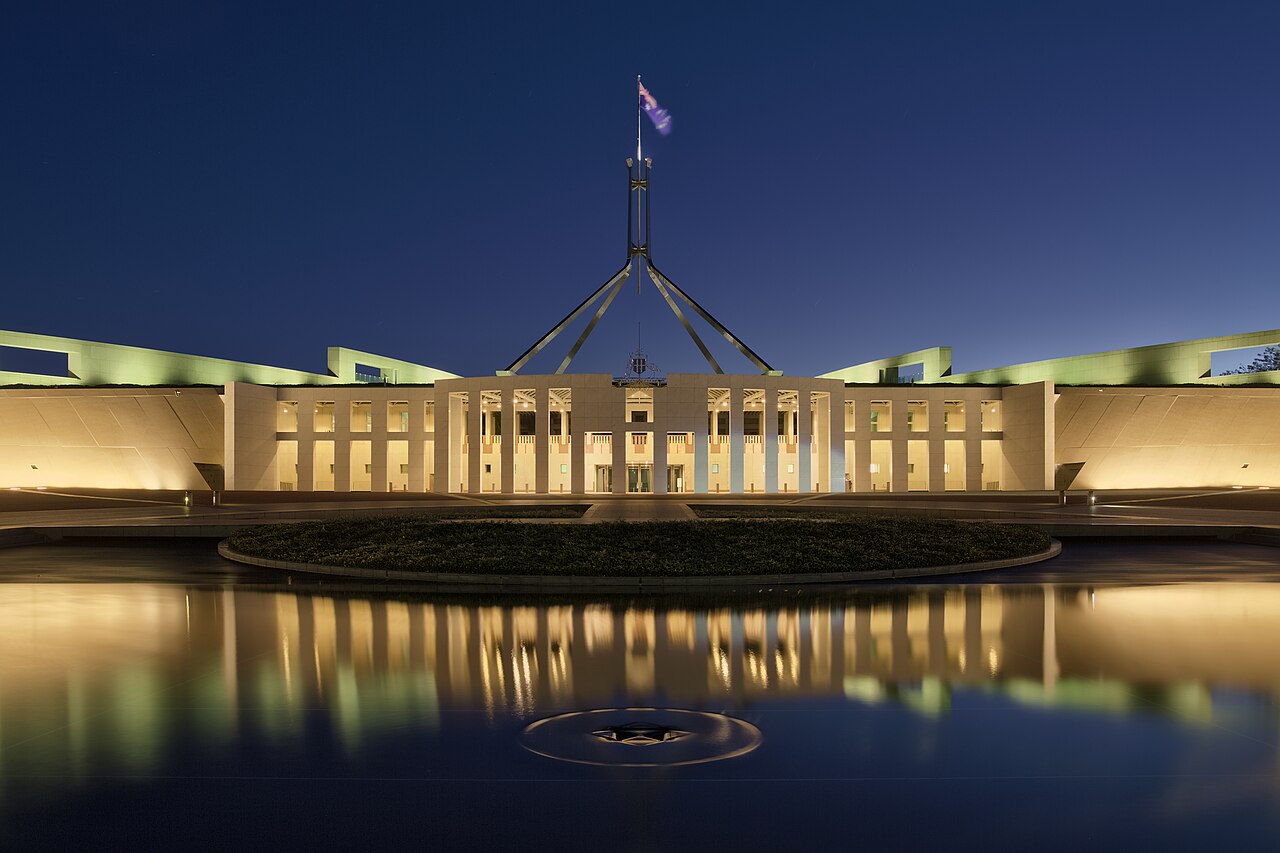
Parliament House is the seat of the Kazakh Parliament, a striking modernist structure completed in 2008. It is in Astana, Kazakhstan. Most visitors spend 1–1.5 hours here. The free Lokali audio guide runs 5 minutes.
✓ Verified August 2026 · how we write these guides
Visitor facts
| Time needed | 1–1.5 hours |
|---|---|
| Lokali audio guide | 5 min · free |
| Type | Palace |
| Best for | History |
| Location | Astana, Kazakhstan |
| Coordinates | 51.1694, 71.4699 |
| Languages | 45, in the Lokali app |
The story
You see the front of the building before anything else. A tall facade rises high above you, covered from edge to edge in colour. Shapes and figures fill the whole surface, from the base up to the peak. At the very top, a great sun sits worked in shining tile. This is the National Parliament House, one of the most remarkable buildings in all of Port Moresby.
The Parliament stands in Waigani, the government district of the city. Inside it lies the chamber where the nation's elected leaders meet, debate, and pass the laws of the land. But the building is far more than a place of offices. Its very shape was chosen to tell a story about the country itself. The design draws on a building tradition that is many hundreds of years old.
The form of the building follows the haus tambaran. In the Tok Pisin language, those words mean house of spirits. Such houses come from the Sepik River region in the north of the country. They have a tall, steep front that rises to a sharp point, and a long hall behind it. For centuries, these spirit houses have served their communities as places of gathering, teaching, and ritual.
The building was designed by an architect named Cecil Hogan, who drew up the plans in 1976. He chose the haus tambaran shape on purpose and with care. He wanted the seat of the new nation's government to look like Papua New Guinea, and not like a building borrowed from somewhere far away. In a country only recently independent, the choice was a bold and a clear one.
The great front facade is the building's crowning feature. It carries a single huge mosaic that rises about nineteen metres high above the entrance. The entire surface is covered in countless small pieces of coloured tile, set carefully by hand. Together these pieces form one large and unified picture. Step well back across the forecourt and let your eye take in the full scene at once.
At the very top of the mosaic sits the sun. Its painted light seems to spread downward over everything below it. The sun forms the centre and the source of the whole design. From it, the rest of the scene unfolds across the wall, a land lit up and made alive by its rays. The image as a whole speaks of life, warmth, and growth across the entire country.
Look closely and you can begin to pick out the many figures within. Two warriors stand within the design, a man and a woman together. Around them you can find the sea, a still lake, and a winding river. There is a village, and gardens heavy with growing crops. The whole scene shows a settled land where people live, farm, and work in peace with one another.
More creatures fill the rest of the picture. There are pigs, which hold great value and meaning in many communities across the country. There are birds, turtles, and fishes set among the waves. You can also find cassowaries and butterflies worked into the tiles. Each animal belongs to the land, the rivers, and the seas of Papua New Guinea. Together they show a place that is truly full of life.
Step inside the lobby and the theme carries on. A tall wood carving rises within the entrance hall, covered with worked detail. It stands for the four regions of the country, drawn together into a single column. The carving brings the different and distant parts of the nation together in one place. It is a fitting symbol for a house in which leaders from every region come to meet.
The building is made of several parts, and each carries its own style. The cafeteria, for example, takes its shape from the building forms of the Highlands rather than the Sepik. So the whole complex blends more than one tradition under one roof. It gathers different forms from across the country into a single connected group of buildings, and in doing so it stands for one united nation.
The Parliament was officially opened on 8 August 1984. Prince Charles travelled to Port Moresby to perform the opening ceremony. By that time the country had been an independent nation for nearly nine years. The new building gave that young and proud nation a fitting and permanent home for its government, a place that looked and felt unmistakably its own.
Before you move on, stand once more before the great facade. Let your eye travel slowly from the sun at the very top down to the figures gathered below. In tile and in timber, a whole country has been set carefully into a single wall. It is a quiet and lasting statement of who these people are and where they have come from. Take that image with you as you go.
Key facts
What to look for
Practical tips
Common questions
How long do you need at Parliament House?
Plan 1–1.5 hours. That is the time most visitors spend at Parliament House. The free Lokali audio guide adds about 5 minutes of narration you can listen to as you walk, so it fits inside your visit rather than adding to it.
Is there a free audio guide to Parliament House?
Yes — the Lokali app narrates Parliament House free of charge in 50+ languages. It covers the history, what to look for on site and practical tips, and it works offline once downloaded.
Where is Parliament House?
Parliament House is in Astana, Kazakhstan, at 51.1694, 71.4699. Tap the map link on this page for directions from where you are.
What should you know before visiting Parliament House?
Step back to view the full front facade.
What is Parliament House known for?
Designed by architect Cecil Hogan in 1976.
What is the best time to visit Parliament House?
Tours must be booked in advance and are conducted in Kazakh or Russian (English guides are rare).
On the map
Opens directions to Parliament House from your location.
Hear Parliament House in your language
The full story, narrated, in 50+ languages. Download it before you go and it plays offline, at your own pace, with no ticket and no tour group.