Photo: No machine-readable author provided. Zunkir assumed (based on copyright claims). · CC BY-SA 4.0 · Wikimedia Commons
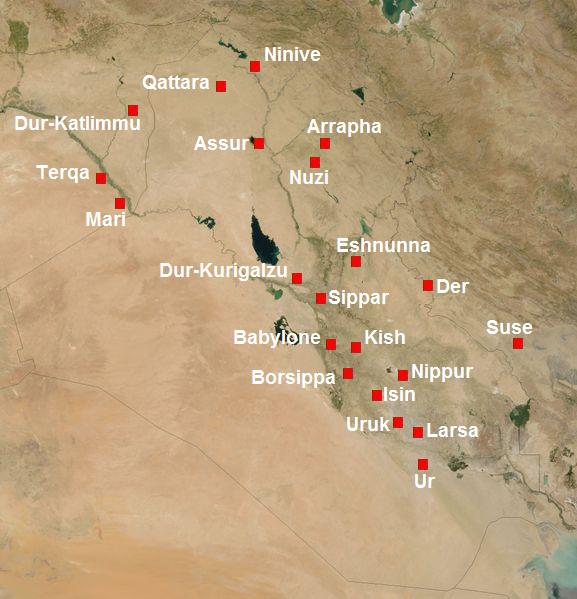
Der (Sumer) is an archaeological site in Iraq. Der is identified with the mound of Tell Aqar. The free Lokali audio guide runs 6 minutes.
✓ Published October 2026 · how we write these guides
Visitor facts
| Lokali audio guide | 6 min · free |
|---|---|
| Type | Archaeological Site |
| Location | Badra, Iraq |
| Coordinates | 33.1236, 45.9314 |
| Languages | 50+, in the Lokali app |
The story
The ground here crunches. Look down and you will see why. Small pieces of broken pottery lie everywhere in the dust, some pale, some reddish, worn smooth by wind and rain. To the east, on a clear day, the first ridges of the Zagros Mountains rise like a grey wall. To the west the land runs flat and open toward the Tigris. You are standing on the remains of Der, one of the oldest frontier cities of ancient Mesopotamia.
Today the site is known locally as Tell Aqar, close to the modern town of Badra in eastern Iraq. A tell is an artificial hill. It grows slowly, over centuries, as people build mudbrick houses, let them crumble, and build again on top. So the mound under your feet is not natural ground. It is layer upon layer of human life, stacked like the pages of a closed book that has mostly never been opened.
Why build a city here, so far from the great river? The answer is the mountains. Der sat on the road between the Mesopotamian plain and the highlands of Elam, in what is now southwestern Iran. Traders, armies and messengers passing between the two worlds came through this corridor. Whoever held Der could watch that traffic, tax it, or block it. For thousands of years, that made the city valuable — and often dangerous.
The people of Der worshipped a god named Ishtaran. In Mesopotamian belief he was a god of justice, a divine judge who settled disputes. He was closely linked with serpents. His attendant was a snake god called Nirah, and serpent images appear in art connected with the city. For a frontier town that stood between rival powers, a god of fair judgement must have felt very fitting.
Here is something many visitors miss. Ishtaran's reputation as a judge reached far beyond Der. In inscriptions from the Sumerian city-state of Lagash, in the south, rulers recalled an ancient border quarrel with the neighbouring city of Umma. Those texts name Ishtaran as one of the gods who witnessed the boundary settlement. So a god from this quiet mound once stood, in people's minds, behind one of the earliest recorded border treaties in history.
Der appears again and again in cuneiform writing — the wedge-shaped script that Mesopotamian scribes pressed into wet clay. Kings of the south and later Babylonian and Assyrian rulers mention the city in their records. Sometimes they claim to have captured it, sometimes to have restored its temple, sometimes simply to have passed through. Each mention is a small clue that this border city mattered to whoever was in power on the plain.
The most famous moment came in 720 BCE. That year the army of the Assyrian king Sargon the Second met the forces of Elam near Der. The Babylonian leader Merodach-baladan was allied with the Elamites. The battle is known from inscriptions on both sides, and they disagree about the result. The Assyrian records describe a victory. The Babylonian chronicle suggests the Elamites had the upper hand. Even three thousand years ago, each side told its own story.
That disagreement is worth a moment of thought as you stand here. Ancient royal inscriptions were not neutral reports. They were written to praise a king and impress the gods and the people. Historians compare them carefully, like detectives with two witnesses who each have a reason to bend the truth. Der sits right at the centre of one of those classic puzzles.
Compared with famous southern sites like Ur or Uruk, Der has seen only limited excavation. Much of what scholars know comes from texts found elsewhere, not from digging here. That means most of the city still lies buried under your feet — streets, houses, workshops and the temple of Ishtaran, all waiting in the mudbrick. In a way, this is one of the most honest places to visit in Mesopotamia. You are looking at a story that is still unfinished.
Take a slow walk across the surface and notice the textures. Mudbrick, when it breaks down, becomes a fine, pale soil that clings to shoes. After rain, the surface darkens and sometimes small walls or brick edges show more clearly. The pottery fragments are the most common sign of ancient life. They are part of the archaeological record, so it is best to look, photograph, and leave them exactly where they lie.
The modern town of Badra is part of the story too. It sits in Wasit Province, near the Iranian border, surrounded by date palms and farmland. Water from the mountain streams has shaped life here for millennia. The same geography that made ancient Der a gateway still makes this region a crossing point between two countries, two languages and two landscapes. The past and the present share the same road.
Listen for a moment. Out here the sounds are simple. Wind across the open mound. A dog barking in the distance. Perhaps a car on the road toward town, or a call to prayer drifting from Badra. There are no ticket gates or gift shops. That quiet makes it easier to imagine the city as it was — smoke from cooking fires, the creak of carts, the voices of travellers arriving from the hills.
Before you leave, turn once more toward the mountains. Picture a caravan coming down from those slopes, carrying goods from the highlands, and seeing the walls of Der as the first great city of the plain. Then look down again at the broken pottery at your feet. Each small piece was once held by someone who lived, worked and prayed here. As you walk back across the mound, step gently. You are walking on their city.
Key facts
What to look for
Practical tips
Common questions
Is there a free audio guide to Der (Sumer)?
Yes — the Lokali app narrates Der (Sumer) free of charge in 50+ languages. The guide runs about 6 minutes, covers the history, what to look for on site and practical tips, and works offline once downloaded.
Where is Der (Sumer)?
Der (Sumer) is near Badra, Iraq, at 33.1236, 45.9314. Tap the map link on this page for directions from where you are.
What is Der (Sumer) known for?
Der is identified with the mound of Tell Aqar. Der guarded the route between Mesopotamia and Elam.
What should you look for at Der (Sumer)?
Scattered pottery fragments covering the mound's surface. Pale crumbled mudbrick soil marking ancient walls. Zagros Mountain ridges rising on the eastern horizon.
What should you know before visiting Der (Sumer)?
Check local security conditions before travelling near the border. Arrange a local guide or driver familiar with the area.
When is the best time to visit Der (Sumer)?
Visit early morning for cooler air and clearer mountain views.
On the map
Opens directions to Der (Sumer) from your location.
Hear Der (Sumer) in your language
The full story, narrated, in 50+ languages. Download it before you go and it plays offline, at your own pace, with no ticket and no tour group.