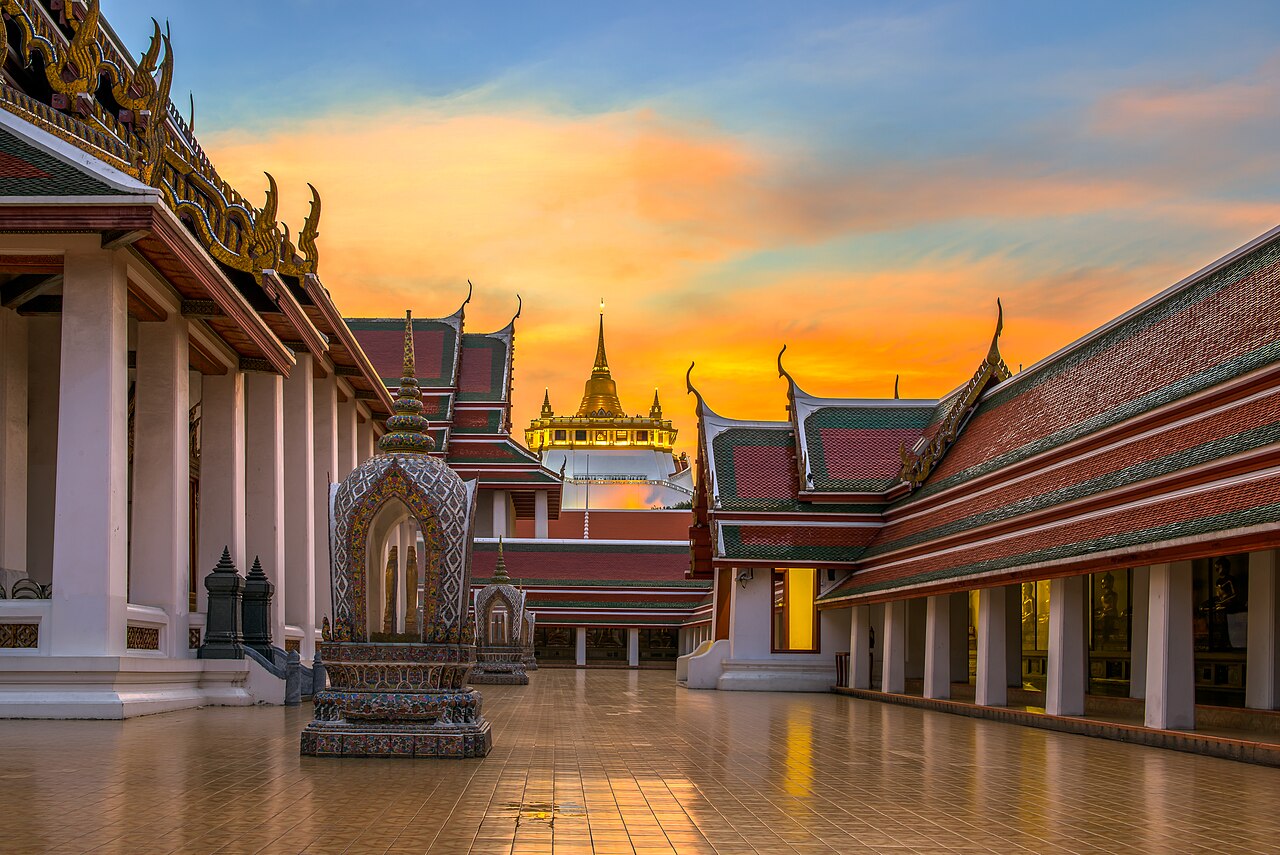
Wat Saket is a temple in Bangkok, Thailand. Known as the Golden Mount, this temple sits atop an artificial hill built from the earth dredged during canal construction in the 19th century. Most visitors spend 45–60 min here. The free Lokali audio guide runs 5 minutes.
✓ Verified August 2026 · how we write these guides
Visitor facts
| Time needed | 45–60 min |
|---|---|
| Lokali audio guide | 5 min · free |
| Type | Temple |
| Best for | Photography |
| Location | Bangkok, Thailand |
| Coordinates | 13.7539, 100.5083 |
| Languages | 45, in the Lokali app |
The story
A golden spire rises on top of a steep green hill in the old city, reached by a long stairway that winds up around the slope past bells and shrines. From the top, the whole low old town spreads out below. This is Wat Saket, known as the Golden Mount, one of the most rewarding temple climbs in Bangkok.
The temple's signature is the artificial hill it crowns, built up over time in the flat city to raise a golden chedi, a bell-shaped tower holding relics, high above the rooftops. In a city with few hills, this man-made mount was for a long time among its highest points.
A winding stairway of a few hundred steps circles up the green slope to the top, passing small shrines, rows of bells that visitors ring as they climb, and shady planting. The climb is gentle and gradual, and the ringing of the bells gives it a particular atmosphere.
At the summit sits the gilded chedi, said to enshrine a relic of the Buddha, with a terrace around it where visitors walk, pray, and take in the view. The gold catches the sun and is visible from far across the old city.
The reward at the top is one of the best views over old Bangkok, a low sea of rooftops, temple spires, and trees, with the river and the modern towers beyond. Because the old city has few tall buildings, the mount still gives an open outlook.
At the foot of the mount lies the rest of the temple, an old and important one with halls and a community of monks, often quieter than the famous temples by the river and worth a look before or after the climb.
The mount was built and rebuilt over the nineteenth century, a major undertaking in the soft ground of the city, and it became a landmark and a place of pilgrimage. It carries a long history as one of the city's spiritual high points.
Once a year the temple holds a great fair, when the mount is wrapped in red cloth and the surrounding streets fill with stalls, rides, and crowds, one of the liveliest religious festivals in the city.
The climb, with its bells, greenery, and gradual reveal of the view, makes Wat Saket feel like a small journey rather than a single sight, and many find it more peaceful and rewarding than the grander, busier temples.
The temple sits in an old quarter away from the riverside crowds, near canals and old neighbourhoods, so a visit can be combined with a wander through a more everyday, less touristy part of the historic city.
A few practical notes. There is a small charge near the top; dress modestly, as at any temple, with shoulders and knees covered, and come early or late to avoid the heat on the climb. Carry water for the steps.
Climb slowly, ringing the bells as you go, and step out at the top by the golden spire to look over the old city spread below. Wat Saket lifts you, gently, above the flat city to see it whole. When you walk back down the winding steps, the rooftops you just surveyed close in around you again.
Key facts
What to look for
Practical tips
Common questions
How long do you need at Wat Saket?
Plan 45–60 min. That is the time most visitors spend at Wat Saket. The free Lokali audio guide adds about 5 minutes of narration you can listen to as you walk, so it fits inside your visit rather than adding to it.
Is there a free audio guide to Wat Saket?
Yes — the Lokali app narrates Wat Saket free of charge in 50+ languages. It covers the history, what to look for on site and practical tips, and it works offline once downloaded.
Where is Wat Saket?
Wat Saket is in Bangkok, Thailand, at 13.7539, 100.5083 Tap the map link on this page for directions from where you are.
What should you know before visiting Wat Saket?
Climb early or late to avoid the heat.
What is Wat Saket known for?
A hilltop temple known as the Golden Mount.
What is the best time to visit Wat Saket?
The climb is steep but manageable; wear shoes with grip.
On the map
Opens directions to Wat Saket from your location.
Reference
More to see in Bangkok


Hear Wat Saket in your language
The full story, narrated, in 50+ languages. Download it before you go and it plays offline, at your own pace, with no ticket and no tour group.