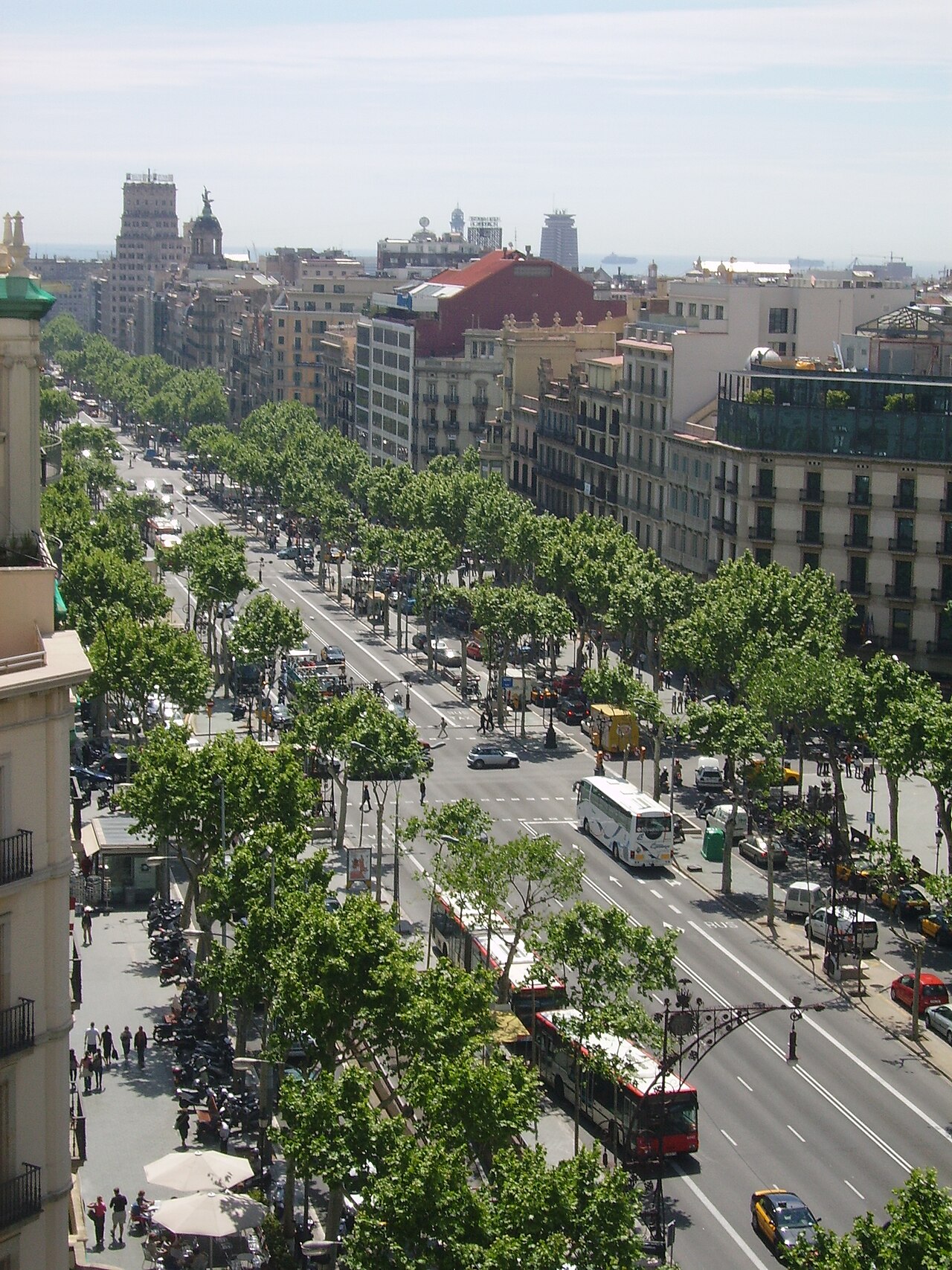
Passeig de Gràcia is a street in Barcelona, Spain. Barcelona's grand avenue, lined with Modernist mansions, shops, and cafés. Most visitors spend 45–90 min here. The free Lokali audio guide runs 9 minutes.
✓ Verified August 2026 · how we write these guides
Visitor facts
| Time needed | 45–90 min |
|---|---|
| Lokali audio guide | 9 min · free |
| Type | Street |
| Best for | Photography |
| Location | Barcelona, Spain |
| Coordinates | 41.3952, 2.1619 |
| Languages | 45, in the Lokali app |
The story
The pavement beneath your feet is not ordinary stone. Look down — you are walking on hexagonal tiles designed by Antoni Gaudí himself, each one embossed with starfish and sea snails, a reminder that Barcelona began as a port city long before it became a showcase for modern architecture. Passeig de Gràcia stretches wide and straight ahead of you, lined with plane trees whose mottled bark catches the Mediterranean light in patches of cream and grey.
This boulevard was farmland until the eighteen-fifties. Barcelona's medieval walls came down in 1854, and the city exploded outward into the grid of Eixample — the Expansion — designed by engineer Ildefons Cerdà. He wanted rational blocks, chamfered corners for better sightlines, courtyards flooded with air and sun. Passeig de Gràcia became the spine of this new district, the address where Barcelona's industrial families — textile magnates, shipping fortunes, wine exporters — built their townhouses to announce their arrival.
By the turn of the twentieth century, those families were competing for prestige through architecture. They hired the boldest designers of the Modernisme movement — Catalonia's answer to Art Nouveau — and turned this single street into an open-air gallery. Walk the four blocks between Carrer del Consell de Cent and Carrer d'Aragó, and you pass three masterpieces in a row: Casa Batlló, Casa Amatller, and Casa Lleó Morera. Locals call this stretch the Manzana de la Discordia — the Block of Discord — because the three buildings argue with each other in stone, ceramic, and wrought iron, each architect refusing to yield.
Casa Batlló is the most famous, its facade a rippling surface of blue and green trencadís — broken tile mosaic — that shifts color as clouds pass overhead. Gaudí remodeled an existing house in 1904 for textile manufacturer Josep Batlló, covering the front in bone-shaped balconies and a roof that curves like a dragon's back. The building has no straight lines. Stand across the street and watch how the windows seem to breathe, how the whole structure feels alive, almost wet, as if it might slide back into the sea.
Next door, Casa Amatller is the counterargument. Architect Josep Puig i Cadafalch gave chocolate maker Antoni Amatller a neo-Gothic facade in polychrome ceramic, sharp gables, and heraldic shields. The roofline steps up in a jagged silhouette inspired by Flemish guild halls — a nod to northern Europe, not the Mediterranean. The contrast with Gaudí's organic curves is deliberate. Puig wanted geometry, order, a building that stood firm rather than undulated.
Further up, past the luxury boutiques and cafe terraces, you reach Casa Milà — La Pedrera, the Stone Quarry. Gaudí built this apartment block between 1906 and 1912, and it caused a scandal. The facade is a wave of limestone with no load-bearing walls, the entire structure held up by an internal skeleton of steel and stone columns. Balconies twist like seaweed, chimneys on the rooftop terrace rise as sculptural warriors in white mosaic. Neighbors called it ugly, compared it to a pile of rubble. Today it is a UNESCO World Heritage site.
The street itself has changed. In the nineteen-sixties and seventies, Passeig de Gràcia became a highway for cars, the plane trees choked by exhaust, the wide pavements surrendered to parking. The city reclaimed it in stages — pedestrian zones widened in the nineteen-nineties, traffic lanes reduced, outdoor seating returned. Now it is a promenade again, though the luxury brands — Chanel, Hermès, Loewe — occupy the ground floors where those industrial families once entertained.
Notice the street lamps as you walk. They are modernista originals, cast iron posts with benches built into the base, designed by Pere Falqués in 1906. Each lamp is topped with a trencadís mosaic helmet in the colors of the Catalan flag — gold and red stripes. They were functional public furniture, but Falqués made them sculpture. Sit on one of the benches for a moment and you feel the weight of the iron, the coolness of the stone seat, the way the city designed rest into its infrastructure.
Above the shopfronts, look up at the residential floors. Many of the original apartments survive behind those ornate facades — high ceilings, stained glass transoms, parquet floors laid in herringbone. These were family homes, not museums. People still live above the Prada store, still hang laundry on interior courtyards, still hear the rumble of the metro beneath Gaudí's starfish tiles.
As you reach the top of the boulevard, where Passeig de Gràcia meets Avinguda Diagonal, the buildings shift from Modernisme to mid-century rationalism — clean lines, curtain walls, the aesthetics of international finance. The street tells the story of Barcelona in layers: medieval port, industrial capital, dictatorship, democracy, global brand. But the plane trees remain, their roots cracking the pavement in places, their branches meeting overhead in a green tunnel that filters the light into coins of shadow and sun.
Stand still for a moment and let the boulevard move around you — tourists photographing balconies, delivery bikes weaving between pedestrians, the faint smell of roasting coffee from a side street, the distant clatter of construction as another building gets renovated behind scaffolding. This is not a museum street. It is a working avenue that happens to contain masterpieces, a place where people live and shop and argue and fall in love beneath the gaze of dragons and warriors made of stone.
Key facts
What to look for
Practical tips
Common questions
How long do you need at Passeig de Gràcia?
Plan 45–90 min. That is the time most visitors spend at Passeig de Gràcia. The free Lokali audio guide adds about 9 minutes of narration you can listen to as you walk, so it fits inside your visit rather than adding to it.
Is there a free audio guide to Passeig de Gràcia?
Yes — the Lokali app narrates Passeig de Gràcia free of charge in 50+ languages. It covers the history, what to look for on site and practical tips, and it works offline once downloaded.
Where is Passeig de Gràcia?
Passeig de Gràcia is in Barcelona, Spain, at 41.3952, 2.1619. Tap the map link on this page for directions from where you are.
What should you know before visiting Passeig de Gràcia?
Walk the four blocks between Consell de Cent and Aragó.
What is Passeig de Gràcia known for?
Gaudí designed the hexagonal pavement tiles with sea creatures.
What is the best time to visit Passeig de Gràcia?
Walk it in late afternoon when the light catches the façade details and crowds thin slightly.
On the map
Opens directions to Passeig de Gràcia from your location.
Reference
More to see in Barcelona


Hear Passeig de Gràcia in your language
The full story, narrated, in 50+ languages. Download it before you go and it plays offline, at your own pace, with no ticket and no tour group.