Photo: Unknown authorUnknown author · Public domain · Wikimedia Commons
Lambaesis is a roman fort. It is near Batna, Algeria. Base of the Third Augustan Legion for over two centuries. The free Lokali audio guide runs 7 minutes.
✓ Published October 2026 · how we write these guides
Visitor facts
| Lokali audio guide | 7 min · free |
|---|---|
| Type | Archaeological Site |
| Location | Batna, Algeria |
| Coordinates | 35.4889, 6.2558 |
| Languages | 50+, in the Lokali app |
The story
Start with the ground under your feet. It is dry, pale earth, scattered with fragments of cut stone and broken tile. A wind comes down from the mountains to the south and moves through the grass between the ruins. Around you, low walls run in long straight lines across the plain. Those straight lines are the first clue. This was not a town that grew slowly. It was laid out on purpose, by soldiers, with measuring rods and a plan.
This is Lambaesis, a short drive from the modern city of Batna, in the high country of northeastern Algeria. Behind you rise the Aurès Mountains, a rugged range that shaped life here for thousands of years. For Rome, these mountains were a frontier. Beyond them lay the edge of the desert and peoples who did not answer to the emperor. Lambaesis was where Rome chose to stand and watch that edge.
The reason this place exists is a single military unit: the Third Augustan Legion, known in Latin as Legio Tertia Augusta. A Roman legion was a professional army of several thousand heavily trained infantry, supported by engineers, clerks, and craftsmen. For most of the Roman period, this was the only legion stationed permanently in the whole of North Africa west of Egypt. That one fact gives Lambaesis its importance. The security of a vast region depended on the men who lived here.
The legion did not begin here. It moved between several bases before settling at Lambaesis in the early second century, during the reigns of the emperors Trajan and Hadrian. Once it arrived, it stayed for a very long time. Generations of soldiers served here, retired nearby, married local women, and raised children who sometimes joined the same legion. Over time, a civilian town grew up beside the fortress, full of traders, families, and veterans.
Now, here is a detail that surprises many visitors. In the year 128, the emperor Hadrian himself came here. He watched the troops perform military exercises, and then he spoke to them. His speech was carved in stone and set up on a monument in the camp. Fragments of that inscription survive. In them, the emperor praises some manoeuvres and gently criticises others, like a demanding but fair commander. It is one of the rare places where we can still read the actual words a Roman emperor said to his soldiers.
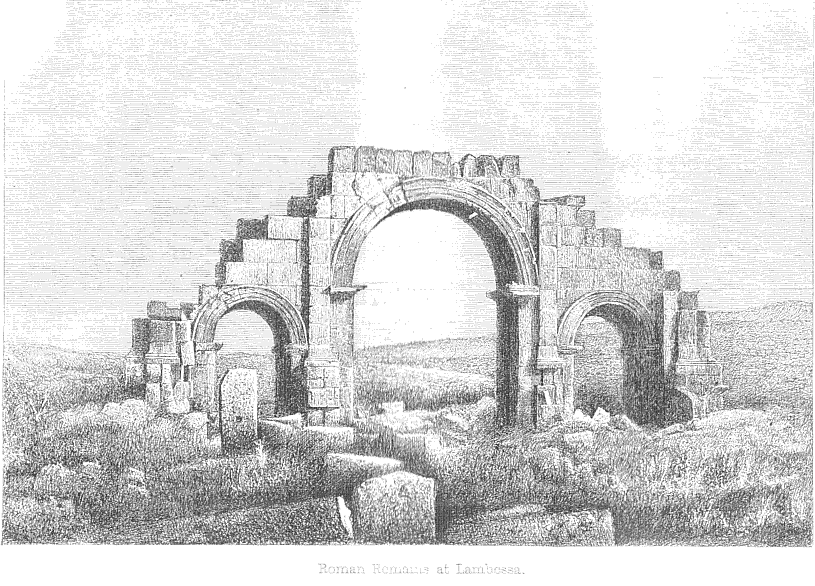
Lift your eyes to the largest structure on the site. This tall, rectangular stone building is often called the Praetorium, a name early visitors gave it because they believed it was the commander's residence. Scholars now think it was something different: a monumental entrance hall at the heart of the camp's headquarters, standing where the main streets crossed. Its walls are built from large, carefully squared blocks. Arched openings pierce each side. Even without a roof, it still holds the space like a great stone frame.
Walk closer and look at the scale of the stonework. These blocks were cut, lifted, and fitted without modern machines. Roman legions were not only fighters. They were builders, and they were very good at it. Soldiers dug roads, raised aqueducts, and constructed public buildings across the provinces. Much of what you see at Lambaesis was made by the same men who carried shields and spears.
Around the site you will find other traces of the town that grew beside the camp. There are triumphal arches, built to honour emperors, including arches associated with Commodus and Septimius Severus. There was a temple to Aesculapius, the Greek and Roman god of medicine, which is fitting for a place full of soldiers who needed healing. There was also an amphitheatre, where crowds gathered for public spectacles. Bathhouses, too, were part of daily life here. A Roman soldier expected to wash in warm water, even on the frontier.
At the beginning of the third century, under Septimius Severus, an emperor who was himself born in North Africa, Lambaesis became the capital of the province of Numidia. Numidia was an ancient kingdom that Rome had absorbed, and the name survived as a Roman province. This gave the town a new role. It was no longer only a fortress. It was a centre of government, where officials kept records, heard disputes, and managed a large territory.
The legion's story has a dramatic turn. In 238, a year of civil war and rival emperors, the Third Augustan Legion took the losing side in a struggle over the throne. As punishment, the new emperor Gordian the Third disbanded the entire legion and erased its name from inscriptions. You can sometimes still see where the name was chiselled out of the stone. Some years later, the legion was restored and returned to Lambaesis. But that empty gap in the carving is a quiet record of disgrace.
Centuries later, after Roman rule had long faded, the site took on a darker modern role. In the nineteenth century, during the French colonial period in Algeria, a prison was built near the ruins at Lambèse, as the French called it. It held, among others, political prisoners sent from France. Some of the ancient stone was reused in new construction. So the history of this landscape is not only Roman. It also carries the harder memories of the colonial era and the people who lived through it.
If you have time, remember that Lambaesis has a sister site nearby: Timgad, a Roman town to the east, founded for retired soldiers. Together, the two places show both sides of Roman life in this region. Lambaesis was the working base, the place of drills and duty. Timgad was where many veterans hoped to finish their lives in comfort. Visiting both helps you understand how an army could turn into a community.
Before you leave, stand still for a moment near the great stone hall. Look at the long lines of the old streets, still visible in the earth. Listen to the wind and, perhaps, the distant sound of the modern town. Then turn toward the Aurès Mountains, the same view that soldiers watched for more than two centuries. As you walk back across the dusty ground, notice the pieces of carved stone at your feet. Each one was shaped by a human hand, here, a very long time ago.
Key facts
What to look for
Practical tips
Common questions
Is there a free audio guide to Lambaesis?
Yes — the Lokali app narrates Lambaesis free of charge in 50+ languages. The guide runs about 7 minutes, covers the history, what to look for on site and practical tips, and works offline once downloaded.
Where is Lambaesis?
Lambaesis is near Batna, Algeria, at 35.4889, 6.2558. Tap the map link on this page for directions from where you are.
What is Lambaesis known for?
Base of the Third Augustan Legion for over two centuries. Emperor Hadrian addressed the troops here in 128.
What should you look for at Lambaesis?
The tall stone hall long called the Praetorium. Straight Roman street lines still visible in the ground. Arched openings piercing each side of the great hall.
What should you know before visiting Lambaesis?
Visit early morning to avoid the strong midday sun. Wear sturdy shoes for uneven ground and loose stones.
When is the best time to visit Lambaesis?
Visit early morning to avoid the strong midday sun.
On the map
Opens directions to Lambaesis from your location.
More to see near Lambaesis

Hear Lambaesis in your language
The full story, narrated, in 50+ languages. Download it before you go and it plays offline, at your own pace, with no ticket and no tour group.