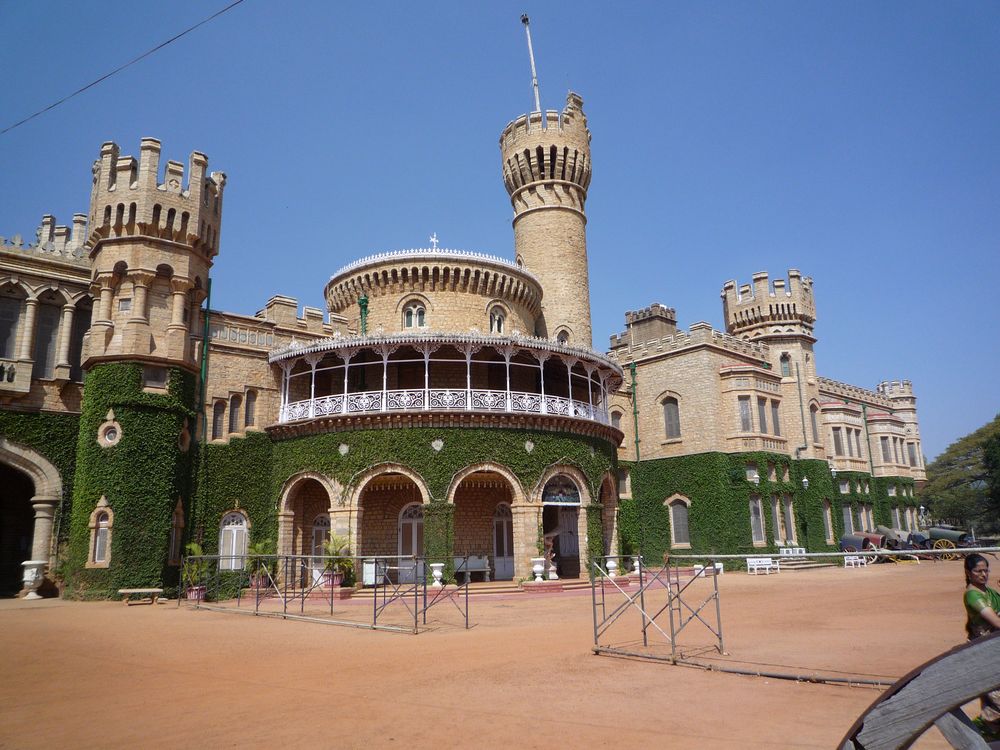
Photo: Argographx · Public domain · Wikimedia Commons
Bengaluru Palace is a palace in Bengaluru, India. Built for the Wadiyar dynasty, rulers of Mysore. The free Lokali audio guide runs 6 minutes.
✓ Published October 2026 · how we write these guides
Visitor facts
| Lokali audio guide | 6 min · free |
|---|---|
| Type | Palace |
| Location | Bengaluru, India |
| Coordinates | 12.9985, 77.5921 |
| Languages | 50+, in the Lokali app |
The story
Listen for a moment before you look up. Gravel crunches under your shoes, and somewhere a crow complains from the trees. Then the palace comes into view. You see grey stone, pointed arches and crenellated towers that look as if they belong under an English sky. Yet the air here is warm, the light is sharp and tropical, and the traffic of a modern Indian city hums just beyond the gates. That contrast is the heart of this place.
This is Bengaluru Palace, a royal residence built in the late nineteenth century for the Wadiyar dynasty, the rulers of the old Kingdom of Mysore. Their main seat was in the city of Mysore, about three hours to the southwest. Bengaluru was a cooler retreat, and the palace gave the family a grand base close to the British establishment. The story of this building is the story of a royal family negotiating its place within an empire.
The young king behind the project was Chamarajendra Wadiyar the Tenth. He grew up under British guardianship and received an English-style education. According to the most widely repeated account, the land for the palace was bought from an English clergyman and educator who ran a school in the city. Construction took place in the 1870s and continued in stages afterwards. Later generations of the family added to the rooms and the furnishings.
Now look at the facade itself. The style is often called Tudor Revival. That is a nineteenth-century fashion that copied the castles and manor houses of sixteenth-century England. You can see the battlements along the roofline, the turrets at the corners and the tall, narrow windows. Many visitors and guidebooks compare it to Windsor Castle, the home of the British royal family. The comparison is loose, but the inspiration is clear.
Here is the first surprise. Those fortress features are almost entirely decorative. The battlements were never meant to hold archers, and the towers were not built to resist a siege. By the time this palace went up, the Wadiyars ruled under British supervision, and real military defence was out of the question. So the castle is a costume. It is a statement of status and taste, written in stone, rather than a working fortress.
As you step inside, the mood changes. The thick walls keep the rooms cooler, and the light becomes softer. The interiors mix European and Indian ideas. You will see carved wooden ceilings, floral tiles, heavy furniture and long corridors lined with framed photographs. Many of those pictures show members of the royal family, visiting officials and hunting parties. Together they form a kind of family album of the late colonial period.
One of the grandest spaces is the Durbar Hall. A durbar is a formal royal assembly, where a ruler received guests and held court. The hall has Gothic-style windows with coloured glass, and on a bright day the colours fall across the floor. Look along the walls for paintings. The collection includes works associated with Raja Ravi Varma, a celebrated Indian painter who blended European oil techniques with Indian subjects and myths.
The second surprise is a little less elegant. The palace keeps reminders of royal hunting. Mounted animal heads and trophies appear in parts of the building, including the head of an elephant. To many modern visitors, these feel uncomfortable. They are, however, an honest record of how Indian and British aristocrats spent their leisure time in that era. Hunting was a social ritual, and it was a way to display power.
Pause in one of the courtyards if you can. The palace has open spaces where you can see the building from the inside out. Notice the granite, the plasterwork and the detail around the doorways. Some walls are decorated with painted tiles and carved panels. These small details reward slow looking. They also show the skill of local craftspeople, who worked within a foreign architectural style.
This palace has an unusual modern story. The Wadiyar family still owns it. For decades the family and the Karnataka state government have been involved in a long legal dispute over the land and its acquisition. The case has passed through the courts, including the Supreme Court of India. That is one reason why the palace feels more like a private home opened to visitors than a state museum.
The wide lawns around the building also have a second life. The Palace Grounds are one of the largest open spaces in central Bengaluru. They host weddings, trade fairs, exhibitions and large concerts. Some well-known international musicians have performed here over the years. So on a weekend evening, the same lawns where royal guests once strolled might fill with thousands of people, stage lights and amplified sound.
Think about the city around you, too. When this palace was built, Bengaluru was a modest town with a large British military area nearby. Today it is one of the major technology centres of the world. Glass office towers and flyovers surround the old estate. The palace has become an island of an older time, and the green grounds help to explain why. Without them, the city would have swallowed this land long ago.
Before you leave, walk back out and turn around once more. Look at the towers against the sky and the ivy on the stone. Listen to the birds in the trees and the faint horns of the traffic outside the walls. Here, an Indian king built an English castle in a South Indian city. Take a slow breath, and carry that small strangeness with you as you walk back into the modern streets.
Key facts
What to look for
Practical tips
Common questions
Is there a free audio guide to Bengaluru Palace?
Yes — the Lokali app narrates Bengaluru Palace free of charge in 50+ languages. The guide runs about 6 minutes, covers the history, what to look for on site and practical tips, and works offline once downloaded.
Where is Bengaluru Palace?
Bengaluru Palace is in Bengaluru, India, at 12.9985, 77.5921. Tap the map link on this page for directions from where you are.
What is Bengaluru Palace known for?
Built for the Wadiyar dynasty, rulers of Mysore. Commissioned by Chamarajendra Wadiyar the Tenth.
What should you look for at Bengaluru Palace?
Battlements and turrets along the roofline. Coloured glass in the Durbar Hall windows. Paintings linked to the artist Raja Ravi Varma.
What should you know before visiting Bengaluru Palace?
Pick up the on-site audio guide for room details. Check whether photography inside needs a separate permit.
When is the best time to visit Bengaluru Palace?
Visit early in the day for softer light.
On the map
Opens directions to Bengaluru Palace from your location.
More to see in Bengaluru


Hear Bengaluru Palace in your language
The full story, narrated, in 50+ languages. Download it before you go and it plays offline, at your own pace, with no ticket and no tour group.