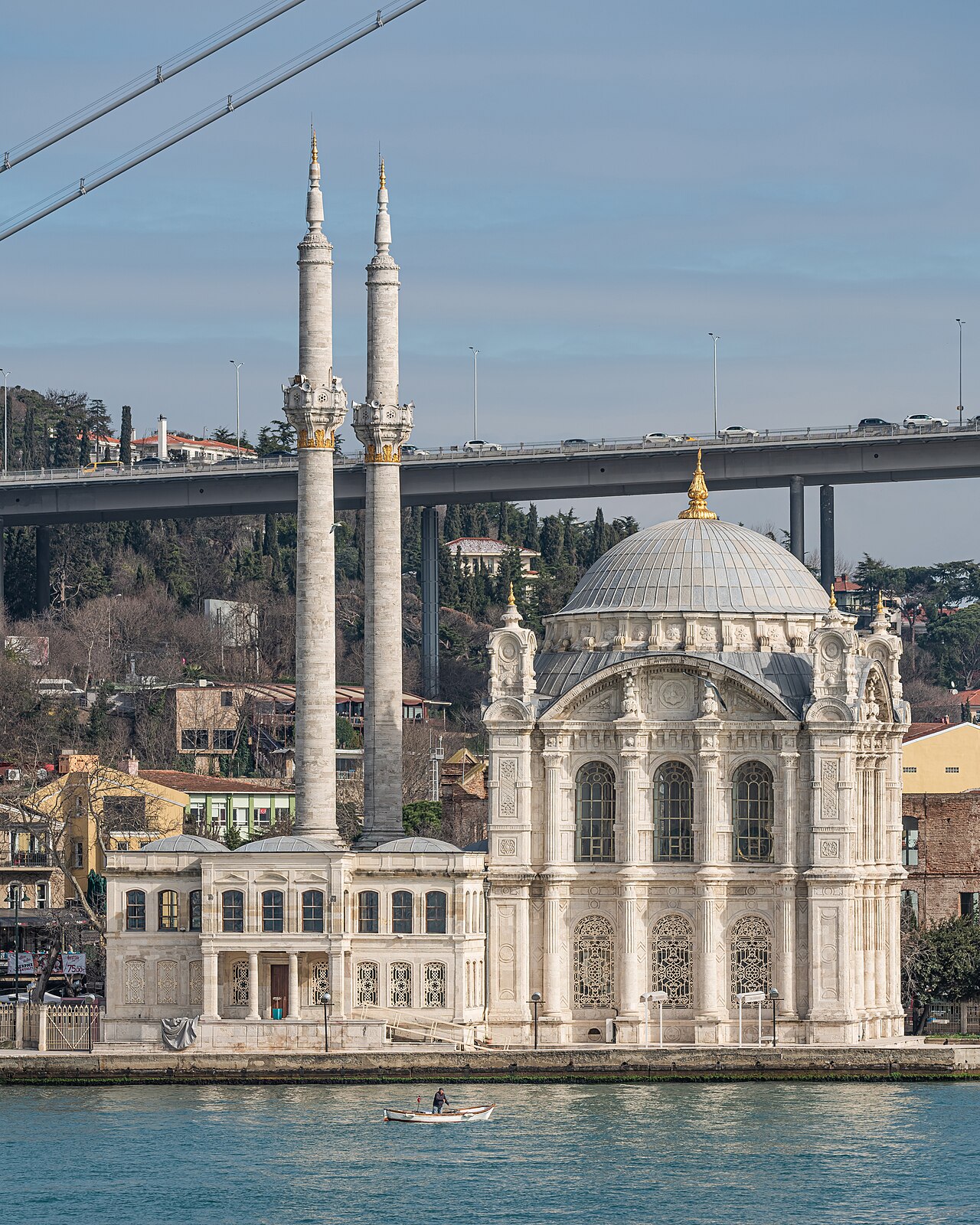
Ortaköy Mosque is a mosque in Beşiktaş, Türkiye. Commissioned by Sultan Abdülmecid, completed in the 1850s. Designed by the Balyan family of Ottoman court architects. Most visitors spend 30-45 min here. The free Lokali audio guide runs 7 minutes.
✓ Verified October 2026 · how we write these guides
Visitor facts
| Time needed | 30-45 min |
|---|---|
| Lokali audio guide | 7 min · free |
| Type | Mosque |
| Best for | Photography |
| Location | Beşiktaş, Türkiye |
| Coordinates | 41.0472, 29.0269 |
| Languages | 45, in the Lokali app |
The story
Water first. It slaps against the stone quay in short, uneven beats, and light reflected off the Bosphorus moves across the mosque's pale walls. Gulls argue overhead. Behind you, tea glasses clink in the cafes of Ortaköy square. The mosque stands at the very edge of the strait — a few steps closer and it would be in the water. Few buildings in Istanbul sit this close to the sea. Take a breath of the salt air before you go in, and notice how the building seems to float on its own quay.
Its formal name is the Büyük Mecidiye Mosque, but everyone calls it Ortaköy Mosque, after the neighbourhood. Ortaköy means middle village — one of the old fishing villages strung along the European shore of the Bosphorus. Sultan Abdülmecid ordered the mosque built here in the mid nineteenth century, on the site of an earlier one, and it was completed in the 1850s. The sultan could arrive by boat, pray, and depart by boat. The waterfront location was not an accident. It was the whole point.
A mosque stood here before this one — a smaller eighteenth-century building that had aged badly. Rebuilding it grander suited the times. The empire in the mid nineteenth century was reforming itself, borrowing European dress, music, and architecture. Sultans were leaving Topkapı Palace, the old seat of power, for new waterfront palaces along the Bosphorus. Ortaköy Mosque belongs to that shoreline world of marble quays and state ceremony. Small as it is, it was built to be seen from the water — by ambassadors, merchants, and princes passing in boats.
The design came from the Balyan family — Armenian architects who served the Ottoman court for generations. The same family worked on Dolmabahçe Palace, the sultan's vast new residence a short way down the shore. You can see the family resemblance. Both buildings turned away from classical Ottoman architecture toward European Baroque — a style of curved lines, rich ornament, and theatrical light. Here the result is compact: a small mosque dressed like a palace. Carved swags and shells decorate stone that earlier centuries would have left plain.
Walk around the outside before entering. The mosque has a single main dome and two slender minarets, each with one balcony. The stone is pale, and the corners are softened with rounded mouldings. On the land side stands a two-story section — the sultan's pavilion, where the ruler could rest, receive officials, and reach his private gallery upstairs. Because the building juts into the strait on its little quay, you can view it from three sides with open water behind it. Ferries and tankers slide past constantly.
Inside, the surprise is brightness. Tall, wide windows fill the walls — unusual for a mosque, and entirely deliberate. The architects wanted the water outside to light the room. On a clear day, reflections from the strait ripple across the ceiling. The dome is painted with delicate patterns, and a chandelier hangs at the centre of the hall. The prayer space is small, almost intimate. You can stand in the middle and take in the whole interior with one slow turn of the head.
Look at the large round calligraphy panels on the walls — the names of God, the Prophet Muhammad, and the early caliphs, written in flowing Arabic script. Sultan Abdülmecid trained as a calligrapher himself, and some panels here are said to be his own work. True or not, the attribution fits the building. This was a personal project of a young sultan who admired European art but prayed in the tradition of his ancestors. The mosque is the place where those two instincts meet.
Step back outside and lift your eyes. Directly beside the mosque, the Bosphorus Bridge crosses to the Asian shore in one long span. It opened in 1973, and photographers have paired the two structures ever since — the nineteenth-century mosque in front, the modern suspension bridge behind. At night the bridge cables change colour and the mosque glows under floodlights. The gap between them is more than a century, yet from the square they read as one composition. Few views in the city compress so much time so neatly.
Ortaköy square behind the mosque has its own rituals. Stalls sell kumpir — enormous baked potatoes split open and loaded with cheese, sausage, olives, and a dozen other toppings. Others sell waffles buried in chocolate and fruit. On weekends a small craft market appears, and the cafe tables fill with students and families. The neighbourhood has long been known for its mixed heritage — a church and a synagogue stand within a short walk of the mosque. Buy something to eat and find a spot on the quay wall.
The mosque has needed rescuing more than once. Standing on soft ground at the water's edge, it has endured earthquakes, storms, and slow structural strain. A major restoration finished in 2014, which is why the stone looks so crisp and pale today. Conservators reinforced the structure and cleaned decades of grime from the facade. What you see now is a building in perhaps its best condition since the sultan's own era — scrubbed, stabilized, and busy with visitors and worshippers alike.
Prayer still structures the day here. Five times daily, the call to prayer sounds from the minarets and mingles with the ferry horns. Visitors wait outside for a few minutes while worshippers pray, then the doors open again. Dress modestly to enter — shoulders and knees covered, headscarves for women, shoes off at the door. The carpet is soft underfoot, and conversation drops to a murmur. However crowded the square gets, the prayer hall keeps its own quieter tempo.
Before you leave, walk to the tip of the quay, as close to the water as the railing allows. To your left, the bridge hums with traffic. Behind you, the mosque's windows hold the afternoon light. In front, the Bosphorus does what it has always done — carries ships, currents, and birds between two continents. The sultan chose this spot so that prayer and open water would share one view. Stand in that view for a moment. It still works.
Key facts
What to look for
Practical tips
Common questions
How long do you need at Ortaköy Mosque?
Plan 30-45 min. That is the time most visitors spend at Ortaköy Mosque. The free Lokali audio guide runs 7 minutes and is made to listen to while you walk.
Is there a free audio guide to Ortaköy Mosque?
Yes — the Lokali app narrates Ortaköy Mosque free of charge in 50+ languages. No ticket, tour group or subscription, and it works offline once downloaded.
Where is Ortaköy Mosque?
Ortaköy Mosque is in Beşiktaş, Türkiye, at 41.0472, 29.0269. Tap the map link on this page for directions.
What should you know before visiting Ortaköy Mosque?
Cover shoulders and knees; women need a headscarf inside
What is Ortaköy Mosque known for?
Commissioned by Sultan Abdülmecid, completed in the 1850s
What is the best time to visit Ortaköy Mosque?
Come at sunset for photos of mosque and bridge together
On the map
Opens directions to Ortaköy Mosque from your location.
More to see in Beşiktaş


Hear Ortaköy Mosque in your language
The full story, narrated, in 50+ languages. Download it before you go and it plays offline, at your own pace, with no ticket and no tour group.