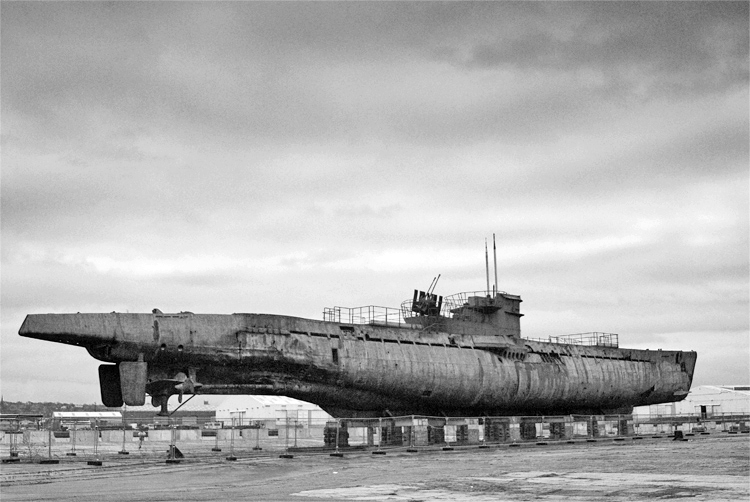
German submarine U-534
53.3951° N · 3.0093° W · Museum
Photo: Paul adams · Public domain · Wikimedia Commons
German submarine U-534 is a 1942 Type IXC/40 submarine. It is near Birkenhead, United Kingdom. U-534 was a long-range Type IX German submarine. The free Lokali audio guide runs 7 minutes.
✓ Published October 2026 · how we write these guides
Visitor facts
| Lokali audio guide | 7 min · free |
|---|---|
| Type | Museum |
| Location | Birkenhead, United Kingdom |
| Coordinates | 53.3951, -3.0093 |
| Languages | 50+, in the Lokali app |
The story
Listen first. Wind comes off the River Mersey, gulls call over the water, and a ferry engine rumbles at the landing stage nearby. Then look at the steel in front of you. It is dark and pitted, the colour of old iron left too long in the sea. This is U-534, a German submarine from the Second World War. It now rests on the Birkenhead waterfront, a long way from where it fought and where it sank.
The first thing most visitors notice is that the submarine is not whole. It has been cut into sections, and the pieces stand apart from each other on the quayside. That was a deliberate choice. Each cut gives you a cross-section, a view straight into the inside of a fighting machine. You can see how pipes, frames and compartments were packed together. Normally, you would only see the smooth outside of a hull like this. Here, you can see its insides.
U-534 was a Type IX boat. This was a larger class of German submarine, built for long patrols far out into the Atlantic Ocean. It was built at a shipyard in Hamburg and launched during the war. Boats like this could stay at sea for weeks. They crossed huge distances to hunt the convoys that carried food, fuel and weapons to Britain. For the men inside, those weeks meant cramped bunks and stale air.
That brings us to the first surprise. Despite its long service, U-534 is not credited with sinking a single ship. Much of its career was spent on patrols, weather reporting and training rather than in successful attacks. By the time it went to sea, the Atlantic had become a far more dangerous place for submarines. Allied aircraft, radar and escort ships had turned the hunters into the hunted. Many German submarines of this period never came home.
You are standing in the right place to understand that change. Across the river is Liverpool. During the war, the city was the headquarters of Western Approaches Command. From there, British officers directed the long fight to protect the Atlantic convoys. Ships sailed in and out of this river under constant threat. So there is a quiet irony here. A submarine built to cut Britain's lifeline now sits beside the very water that lifeline ran through.
The story of the sinking is short and sharp. It happened in early May 1945, in the last days of the war in Europe. Germany was close to surrender. U-534 was travelling through the Kattegat, the stretch of sea between Denmark and Sweden. Royal Air Force aircraft found it on the surface and attacked with depth charges. The boat was badly damaged, and it went down.
Most of the crew escaped. They climbed out as the submarine flooded and many reached the surface alive. Three men lost their lives. It is worth pausing on that number while you look at the narrow hatches and the tight spaces inside. Escaping from a sinking submarine was extremely difficult. That so many survived is remarkable, and it gives this wreck a human story beyond the steel.
Then U-534 lay on the seabed for nearly fifty years. And in that silence, rumours grew. Why was a submarine still at sea so close to the surrender? Some people believed it carried something secret. Stories spread about hidden gold, valuable cargo, or senior Nazis trying to escape. These were tales, not documented history. But they were strong enough to attract attention, and money.
Here is the second surprise. In 1993, the submarine was raised from the seabed in a privately funded salvage project from Denmark. It was a rare event. Very few German submarines from the war have ever been lifted and preserved. When investigators searched the boat, they did not find treasure. They found the ordinary objects of daily life at sea, and the equipment of a working warship. The legend of the gold remained just that, a legend.
After the salvage, the submarine came to Merseyside. It was put on display by a heritage group in Birkenhead, near the old docks. Later, when that organisation ran into financial trouble, the local transport authority took over the boat. They faced a practical problem. The submarine was too long to move easily to a new site. The solution was dramatic. They cut it into sections, moved the pieces here to Woodside, and created the exhibition you see today.
Take a moment with the exposed ends of the sections. Look at the thickness of the pressure hull, the curved inner shell that kept the sea out at depth. Notice how close every piece of machinery sits to the next. There was almost no unused space. Sailors slept near torpedoes and ate beside equipment. The smell inside would have been diesel, cooking and damp clothing. Standing here in open air, it is hard to imagine weeks without daylight.
Now walk slowly around the outside. Notice the corrosion, the dents, and the places where marine life once clung to the steel. Decades underwater left their marks, and the preservation work has kept many of them visible. This is not a restored museum ship painted to look new. It shows its time on the seabed honestly. That honesty is part of what makes it powerful. You are looking at real damage, not a model.
Then turn toward the river. Look across the water to the Liverpool waterfront and its large buildings at the Pier Head. Watch a ferry cross the Mersey, the same short journey people have made here for generations. In wartime, this river was full of convoy ships, and danger waited out at sea. Today, the water is calm and ordinary.
Before you leave, stand still for a final moment. Listen again to the gulls, the wind and the ferry engines. The submarine sits in pieces, open to the sky, beside a river it was built to threaten. Around it, people buy coffee, catch ferries and walk their dogs. Perhaps that is the clearest ending to this story... an old weapon, cut open, resting quietly in peacetime.
Key facts
What to look for
Practical tips
Common questions
Is there a free audio guide to German submarine U-534?
Yes — the Lokali app narrates German submarine U-534 free of charge in 50+ languages. The guide runs about 7 minutes, covers the history, what to look for on site and practical tips, and works offline once downloaded.
Where is German submarine U-534?
German submarine U-534 is near Birkenhead, United Kingdom, at 53.3951, -3.0093. Tap the map link on this page for directions from where you are.
What is German submarine U-534 known for?
U-534 was a long-range Type IX German submarine. RAF aircraft sank it in the Kattegat in May 1945.
What should you look for at German submarine U-534?
Exposed pressure hull visible at each cut section. Tightly packed pipes and machinery inside the hull. Corrosion and dents left by decades underwater.
What should you know before visiting German submarine U-534?
Check current exhibition access before travelling to Woodside. Combine your visit with a Mersey ferry crossing.
On the map
Opens directions to German submarine U-534 from your location.
More to see near German submarine U-534


Hear German submarine U-534 in your language
The full story, narrated, in 50+ languages. Download it before you go and it plays offline, at your own pace, with no ticket and no tour group.