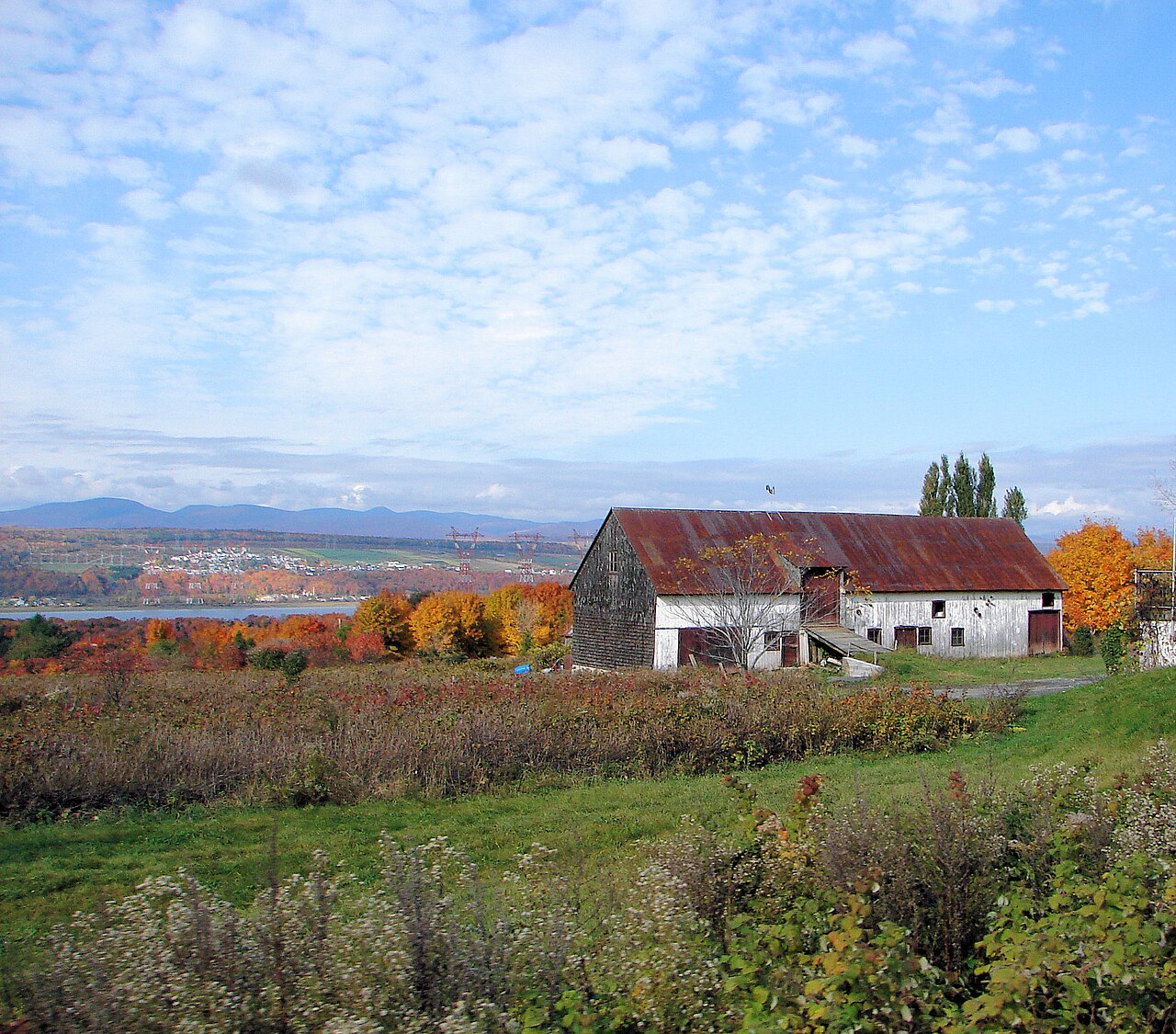
Île d'Orléans is an island in Boischatel, Canada. Pastoral island 10 minutes from downtown, ringed by a scenic driving loop (67 km) past heritage farms, artisan studios, and charming villages. Most visitors spend 2–4 hours here. The free Lokali audio guide runs 5 minutes.
✓ Verified August 2026 · how we write these guides
Visitor facts
| Time needed | 2–4 hours |
|---|---|
| Lokali audio guide | 5 min · free |
| Type | Island |
| Best for | Local life |
| Location | Boischatel, Canada |
| Coordinates | 46.9333, -71.1500 |
| Languages | 45, in the Lokali app |
The story
You cross a long bridge, and the city falls behind you. Fields open on both sides of the road. The wide Saint Lawrence River shines around the edges of the land. The air smells of soil and water. Already the pace of things feels slower. You have arrived on Île d'Orléans.
This is an island in the middle of the great river, just east of Quebec City. It is long and narrow. From end to end it runs about thirty-four kilometres. A single bridge links it to the mainland. Before that bridge opened in 1935, people crossed by boat in summer and over the ice in winter. The island has always kept a little apart from the city.
The island is known above all for its farms. The soil here is rich and dark. Farmers grow strawberries, potatoes, apples, and grapes. Small shops along the roads sell fruit, bread, cheese, wine, and blackcurrant drinks. Many people call the island the garden of the region. In summer, the smell of ripe fruit drifts from the stands.
Europeans have known this island for a very long time. The French explorer Jacques Cartier came here in 1535. He found wild grapevines growing on the land. Because of the vines, he first called it the Island of Bacchus, after the old god of wine. Later it was renamed for the Duke of Orléans, a French royal. The newer name has lasted ever since.
Many French families settled here in the early days of the colony. They built farms and raised children on this land. Today a large number of French-speaking people in North America can trace their roots back to this small island. For them, it is a kind of ancestral home. Some come here just to find the village their family once left.
The island is divided into six villages. Each has its own church and its own character. Their names honour saints, such as Saint-Pierre, Saint-Laurent, and Sainte-Famille. As you drive the road around the edge, you pass from one village into the next. Old stone and wooden houses line the way. Tall church steeples mark each small centre from far off.
Some of the houses here are very old. A number of them date from the years of French and early British rule. Their thick walls, steep roofs, and small windows were built to hold heat through long winters. The whole island is protected for its old buildings and its landscape. Builders are careful to keep the old look when they repair them.
A famous singer made his home on this island. His name was Félix Leclerc. He wrote songs that many people across the French-speaking world still know. He lived here, and he is buried here. A walking path on the island now carries his name. For many visitors from Quebec, this connection alone is reason enough to come.
The edge of the island gives wide views in every direction. To one side you can see the skyline of Quebec City. To another you can see the falls at Montmorency on the far shore. Boats move slowly along the river. The water changes colour with the sky, from grey to silver to deep blue.
Each season shows a different island. In spring the orchards flower in white and pink. In summer the fields are full and the roadside stands open. In autumn the apples ripen and the leaves turn red and gold. In winter the snow lies deep and quiet over the fields. Many visitors come back more than once to see it change.
Take your time here. The best way to see the island is to follow the main road that circles it. Stop often. Buy fruit from a farm stand. Step into a village church. Walk down to the water where you can. There is no need to rush, and rushing would miss the point.
This is a place for slow travel. Cyclists ride the road that circles the island, stopping at farms and lookouts. Walkers follow quiet lanes between the fields. Some visitors set up to paint along the shore. There are few large hotels here, so the evenings stay calm. When the day visitors leave, the island grows very still.
Stand at the shore and look back at the river. People have lived and worked on this land for almost five hundred years. The seasons have turned over them again and again. The same wide river has always flowed past. Carry that calm with you when you cross the bridge home.
Key facts
What to look for
Practical tips
Common questions
How long do you need at Île d'Orléans?
Plan 2–4 hours. That is the time most visitors spend at Île d'Orléans. The free Lokali audio guide adds about 5 minutes of narration you can listen to as you walk, so it fits inside your visit rather than adding to it.
Is there a free audio guide to Île d'Orléans?
Yes — the Lokali app narrates Île d'Orléans free of charge in 50+ languages. It covers the history, what to look for on site and practical tips, and it works offline once downloaded.
Where is Île d'Orléans?
Île d'Orléans is in Boischatel, Canada, at 46.9333, -71.1500. Tap the map link on this page for directions from where you are.
What should you know before visiting Île d'Orléans?
Follow the main road that circles the whole island.
What is Île d'Orléans known for?
Island sits in the Saint Lawrence east of Quebec City.
What is the best time to visit Île d'Orléans?
Rent a bike and stop at Mauvide-Genest Manor — a 1734 house open for tours that gives you the lived texture of colonial rural life.
On the map
Opens directions to Île d'Orléans from your location.
Hear Île d'Orléans in your language
The full story, narrated, in 50+ languages. Download it before you go and it plays offline, at your own pace, with no ticket and no tour group.