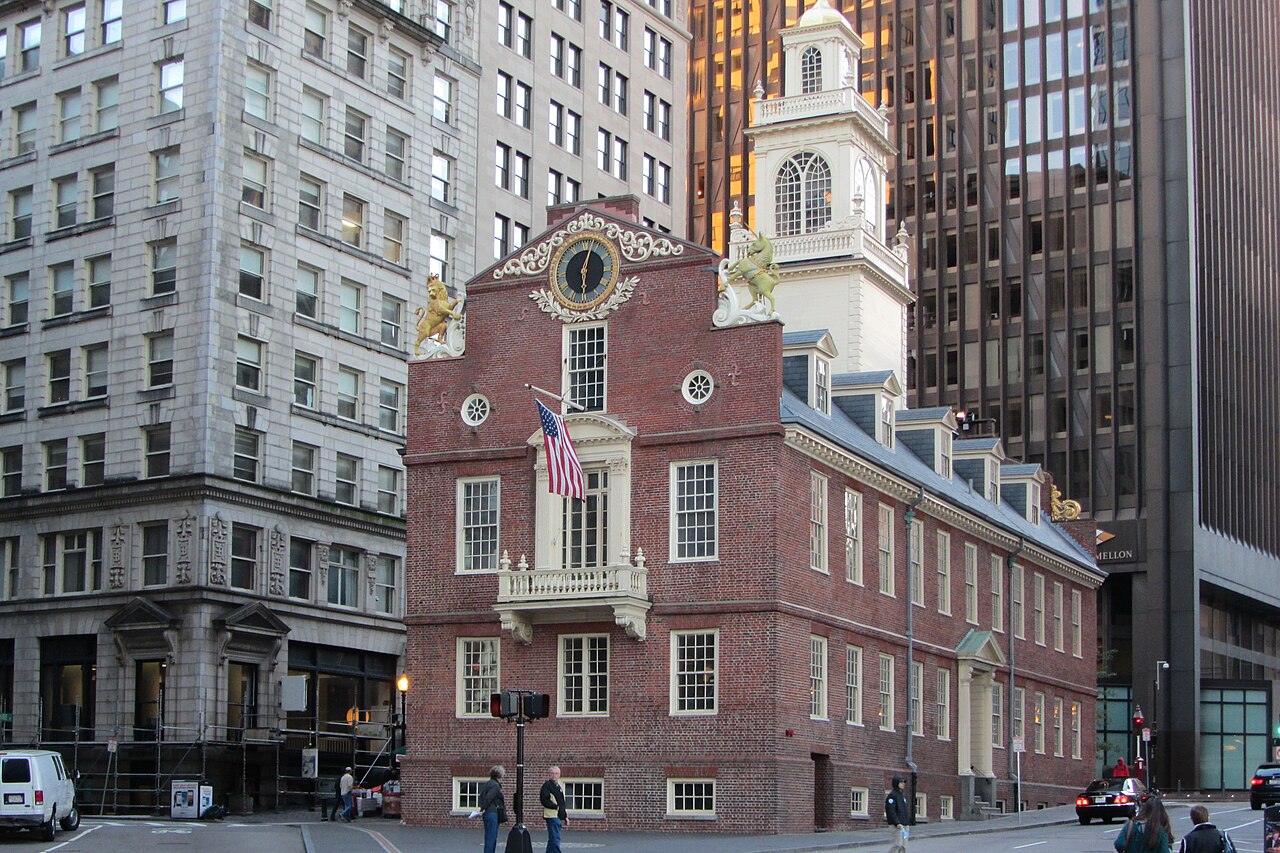
Old State House
42.3583° N · 71.0604° W · Historic Building
Old State House is a historic building in Boston, United States. Built in 1713, this brick Georgian structure served as the seat of British colonial government and later the Massachusetts State House. Most visitors spend 45–60 min here. The free Lokali audio guide runs 5 minutes.
✓ Verified August 2026 · how we write these guides
Visitor facts
| Time needed | 45–60 min |
|---|---|
| Lokali audio guide | 5 min · free |
| Type | Historic Building |
| Best for | History |
| Location | Boston, United States |
| Coordinates | 42.3583, -71.0604 |
| Languages | 45, in the Lokali app |
The story
Tall towers of glass and steel rise on every side. Then, low among them, a small brick building holds its ground. It has a white tower and a row of windows. On the roof, a golden lion and a unicorn look out over the street. These animals are symbols of the British crown. This is the Old State House, and it has stood on this corner since 1713.
It is the oldest surviving public building in Boston. When it was new, it stood at the center of the town. From inside these walls, the British governors ruled the colony of Massachusetts. The lower floor was used by merchants for trade. The upper floor held the rooms of government. Power and money met under one roof. For the people of the town, this was where decisions were made.
The building sits where State Street meets Washington Street. In colonial days, this was the heart of Boston. The main roads of the town came together right here. News passed through this corner by word of mouth. Goods and money moved along these same streets. Sailors, traders, and officials all crossed this spot each day. To stand here was to stand at the center of everything.
One of the most important moments in American history happened just outside this building. On the night of March 5, 1770, tension between soldiers and townspeople boiled over. British soldiers fired into a crowd. Five colonists were killed. The event became known as the Boston Massacre. It pushed the colonies closer to war. A ring of stones set into the ground below marks the spot today.
Now look up at the balcony on the east end of the building. On July 18, 1776, the Declaration of Independence was read aloud from this balcony. The people of Boston filled the street below to listen. The words announced a break from British rule. After the reading, the crowd pulled down the royal symbols nearby and burned them. It was a day the town would never forget.
That history makes the lion and the unicorn on the roof remarkable. They are signs of the British crown, the very power the colonists rejected. The first carvings were torn down in 1776. The figures you see now are later copies. They were placed back on the roof so that the building would look as it once did, even though the meaning has changed.
For many years, this was the seat of government. The colonial assembly gathered here to debate and decide. After independence, the new state government of Massachusetts used these same rooms. That continued until 1798. In that year, a larger State House opened on nearby Beacon Hill. The work of government moved up the hill, and the old building was left behind.
After that, the old building took on many different uses. At various times it served as a city hall, a market, and a home for shops and offices. The walls that once held a government were filled with everyday business. At one low point, there was even talk of tearing the building down. The city of Chicago once offered to buy it and carry it away, stone by stone.
The people of Boston chose to save it instead. In 1881, the building was carefully restored and protected. Since then it has been kept as a museum. Inside, visitors learn about the city's revolutionary years. Without that decision, this old survivor would be gone. Steady care has kept it standing among the banks and office towers. Each generation has chosen to protect it.
Step inside, and the scale of the place may surprise you. The rooms are smaller than the towers outside would suggest. The wooden floors creak softly underfoot. Old paintings, documents, and objects fill the quiet space. From the windows on the east side, you can look down on the very street where the Massacre took place. The past feels very near from here.
There is a strange contrast at this corner. All around, the financial district hums with modern work. Office workers hurry past with phones and coffee. Yet this small brick survivor carries a heavier weight of memory than any glass tower beside it. Age gives it a quiet kind of strength. It does not need to be tall to matter.
Stand on the corner for a moment before you go. Watch the crowds cross the street under the golden lion. Most of them are looking ahead, not up. Few notice the old roof above them. But this building has watched over the same corner for more than three hundred years. It is patient, and it is in no hurry to leave.
Key facts
What to look for
Practical tips
Common questions
How long do you need at Old State House?
Plan 45–60 min. That is the time most visitors spend at Old State House. The free Lokali audio guide adds about 5 minutes of narration you can listen to as you walk, so it fits inside your visit rather than adding to it.
Is there a free audio guide to Old State House?
Yes — the Lokali app narrates Old State House free of charge in 50+ languages. It covers the history, what to look for on site and practical tips, and it works offline once downloaded.
Where is Old State House?
Old State House is in Boston, United States, at 42.3583, -71.0604. Tap the map link on this page for directions from where you are.
What should you know before visiting Old State House?
Allow about thirty minutes for the small museum.
What is Old State House known for?
Built in 1713, Boston's oldest surviving public building.
What is the best time to visit Old State House?
Stand in the basement where the Boston Massacre occurred in 1770.
On the map
Opens directions to Old State House from your location.
More to see in Boston


Hear Old State House in your language
The full story, narrated, in 50+ languages. Download it before you go and it plays offline, at your own pace, with no ticket and no tour group.