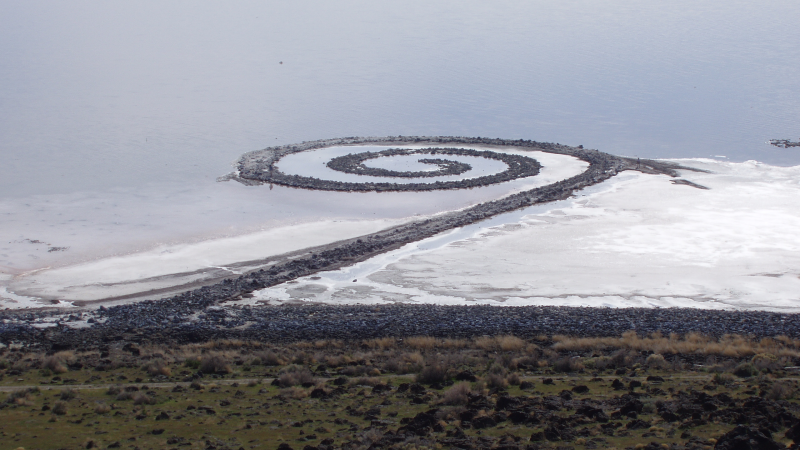
Photo: Sculpture: Robert Smithson 1938-1973Image:Soren.harward at en.wikipedia · Public domain · Wikimedia Commons
Spiral Jetty is an earthwork sculpture by Robert Smithson in Box Elder County, Utah, United States. Created by artist Robert Smithson in 1970. The free Lokali audio guide runs 6 minutes.
✓ Published October 2026 · how we write these guides
Visitor facts
| Lokali audio guide | 6 min · free |
|---|---|
| Type | Monument |
| Location | Box Elder County, United States |
| Coordinates | 41.4378, -112.6689 |
| Languages | 50+, in the Lokali app |
The story
Listen first. There is almost no sound out here. You hear the wind across the flats, the crunch of salt crust under your shoes, and perhaps a gull far off. The air smells of brine and warm stone. In front of you, a coil of black rock curls out into water that can look pink, rust red, or almost white, depending on the day. This is Spiral Jetty, and you are standing on the north shore of the Great Salt Lake in Utah.
The artist Robert Smithson built this work in 1970. He was a young American artist based in New York, and he wanted to make art that left the gallery behind. Instead of a canvas or a sculpture on a plinth, he chose the land itself. The movement he helped lead became known as Land Art, or Earthworks. Its idea was simple. The landscape is the material, the setting, and the frame all at once.
The jetty runs about 1,500 feet, roughly 460 metres, from the shore. It turns counterclockwise in a long, flat spiral and ends in a tight curl. Smithson's crew used heavy earth-moving machines to push basalt boulders and soil out into the shallow water. The basalt came from this point itself. Look at the hillside behind you and you will see the same dark volcanic rock. Nothing here was brought in from far away.
Why this place, of all the shores in the West? Smithson was drawn to the north arm of the lake because of its colour. The water here is far saltier than in the southern part. A railway causeway divides the lake and limits how the water mixes. In this extreme salt, tiny microbes and algae thrive, and they tint the water red and pink. Smithson saw that colour and decided this was his site.
Here is something many visitors do not expect. For most of its life, the jetty was underwater. A few years after it was finished, the lake rose and covered the spiral completely. For decades, people knew it mainly from photographs and from a short film Smithson made during its construction. Then, around the turn of the twenty-first century, drought lowered the lake. The coil slowly came back into the light.
When it returned, it had changed. The black basalt was now crusted with white salt crystals. In some seasons the whole spiral looks frosted, as if snow has settled on every stone. Smithson could not have planned that exact look, but it fits his thinking well. He was interested in entropy, the idea that all ordered things slowly break down and return to disorder. The lake has been editing his work ever since he made it.
In recent years, the lake has dropped even further. Today you may find the jetty sitting on dry, cracked flats, with the water's edge far beyond the final curl. This worries many people in Utah. The shrinking lake affects birds, local industry, and the air quality of nearby cities. So the spiral has gained a new meaning. It now works as a kind of gauge, showing the health of the lake by where the water meets the rock.
The spiral shape has its own story. Smithson wrote that a local legend helped inspire him. According to this old tale, the Great Salt Lake was once connected to the Pacific Ocean by an underground channel, and a great whirlpool swirled at its centre. There is no evidence that such a channel exists. But Smithson liked the image of a vortex pulling everything inward, and he shaped his jetty to echo it.
You are not completely alone in the landscape. Look along the shore and you may notice old wooden posts, rusted metal, and dark patches of tar. These are remains of earlier oil drilling at this point, where natural oil seeps up through the ground. Smithson noticed this debris when he first arrived, and it interested him. To him, the abandoned machinery and the new artwork belonged to the same story of people marking the land.
Smithson did not live to see his jetty rise again. He died in a plane crash in Texas in 1973, while he was surveying the site for another earthwork. He was only in his thirties. His wife, the artist Nancy Holt, continued to champion his work for decades. Today the jetty is cared for by the Dia Art Foundation, a New York organisation that supports large, site-specific art.
You are allowed to walk on the spiral, and most people do. Take it slowly. Walking the coil changes how you see it. From the shore it reads as a clear shape, almost a drawing. Once you are on it, the shape disappears. You see only the path just ahead and the curve bending away. Many visitors say the walk feels closer to a quiet ritual than a stroll.
The best view of the whole form is from the slope above the parking area. Climb a little way up the rocky hill and turn around. From there the spiral finally makes sense as a single gesture. You can also see how small it is against the scale of the lake and the mountains beyond. Smithson wanted that contrast. A human mark, careful and deliberate, set against an enormous and indifferent landscape.
Before you leave, stand still for a moment at the end of the spiral. Notice the light on the salt, the texture of the stones under your feet, the line where land and water blur together. Notice how far the shore is behind you. When you walk back to your car, look once more over your shoulder. The coil will look different again, flatter and quieter, already settling back into the land it came from.
Key facts
What to look for
Practical tips
Common questions
Is there a free audio guide to Spiral Jetty?
Yes — the Lokali app narrates Spiral Jetty free of charge in 50+ languages. The guide runs about 6 minutes, covers the history, what to look for on site and practical tips, and works offline once downloaded.
Where is Spiral Jetty?
Spiral Jetty is in Box Elder County, United States, at 41.4378, -112.6689. Tap the map link on this page for directions from where you are.
What is Spiral Jetty known for?
Created by artist Robert Smithson in 1970. Coil runs about 1,500 feet into the lake.
What should you look for at Spiral Jetty?
White salt crystals crusted over the black basalt stones. Pink or red tint in the north arm water. Old oil-drilling posts and tar seeps along the shore.
What should you know before visiting Spiral Jetty?
Fill your fuel tank well before the long gravel road. Bring plenty of water, food, and sun protection.
On the map
Opens directions to Spiral Jetty from your location.
Hear Spiral Jetty in your language
The full story, narrated, in 50+ languages. Download it before you go and it plays offline, at your own pace, with no ticket and no tour group.