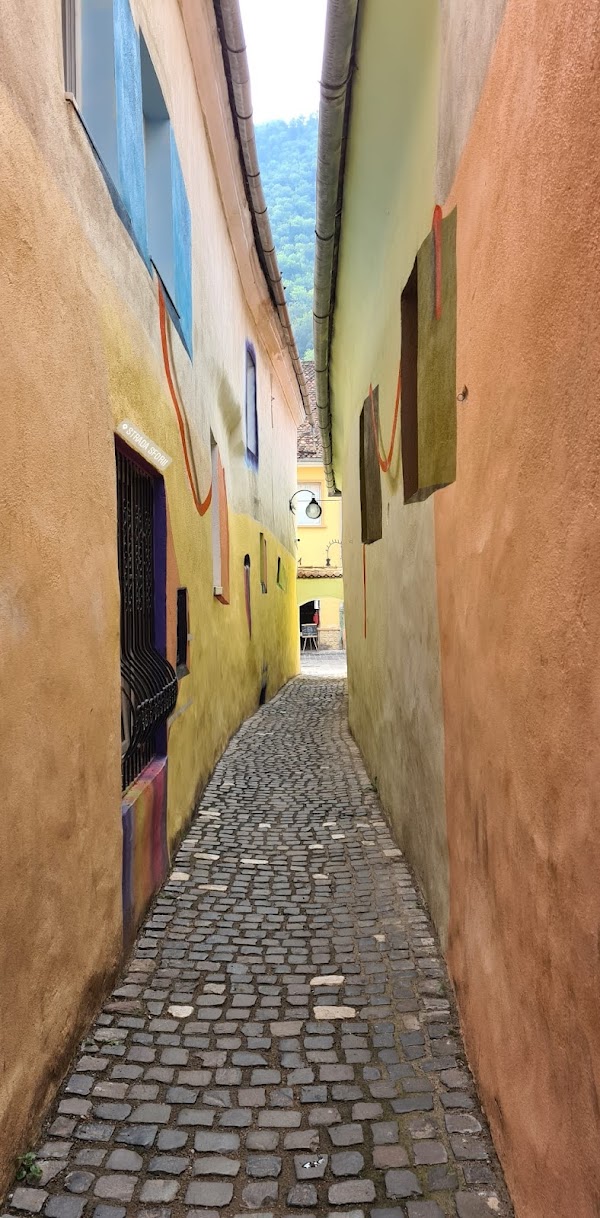
Rope Street is a street in Brașov, Romania. Named after ropemakers who worked here in earlier centuries. Iron rings in doorframes once held rope for twisting. Most visitors spend 10-15 min here. The free Lokali audio guide runs 5 minutes.
✓ Verified October 2026 · how we write these guides
Visitor facts
| Time needed | 10-15 min |
|---|---|
| Lokali audio guide | 5 min · free |
| Type | Street |
| Best for | Photography |
| Location | Brașov, Romania |
| Coordinates | 45.6396, 25.5885 |
| Languages | 45, in the Lokali app |
The story
The cobblestones under your feet are worn smooth by centuries of footsteps — polished by traders, soldiers, pilgrims, and now you. Rope Street is narrow, barely wide enough for two people to pass shoulder to shoulder, and it curves gently as it climbs, so you never quite see where it ends. The buildings lean in close on both sides, their plaster facades painted in faded ochres and blues, and the upper floors overhang the pavement just enough to cast the street in cool shadow even at midday.
This is one of the oldest lanes in the city, threading through the heart of the medieval quarter. The name comes from the ropemakers who once worked here — coiling hemp and flax into ship rigging and harness lines, their workshops spilling out onto the street. You can still see the iron rings set into some of the doorframes, where lengths of rope were stretched and twisted. The trade is long gone, but the name stuck.
Look up as you walk. The balconies above you are wooden, some carved with geometric patterns, others plain and weathered. Many date from the eighteenth and nineteenth centuries, when the street was home to merchants and artisans. A few still have the original glazed tiles around the doorways — small squares of blue and white, cracked but holding their color. These tiles were imported, a sign of modest prosperity, and they catch the light in a way that makes the whole street feel older than it is.
Rope Street connects two larger squares, so it has always been a shortcut, a vein of movement through the old town. During the day, locals use it to avoid the wider tourist routes. You might pass a woman carrying bread from the bakery, or a man wheeling a cart of vegetables toward the market. The street is quiet, but it is not empty — it still works.
Halfway along, there is a small shrine set into the wall, just a niche with a candle and a faded icon. Passersby leave flowers or coins. The tradition is not tied to any major saint or event — it is simply a habit, a gesture of continuity. The niche has been there for at least two hundred years, maybe longer, and no one remembers exactly why it started. That is part of the charm.
The street is too narrow for cars, so the sounds here are human-scale. Footsteps, voices echoing off the stone, the creak of a shutter opening above you. In the early morning, you might hear a radio playing from an open window, or the hiss of a coffee pot on a stove. These are the textures of a place that has not been stage-managed for visitors — it is still lived in.
At the upper end, Rope Street opens onto a small square with a fountain. The transition is sudden — from shadow to sunlight, from enclosure to open sky. The fountain is simple, a stone basin with a single spout, and the water runs cold even in summer. People stop here to fill bottles or splash their faces. The square is a natural gathering point, and you will often see a few locals sitting on the low wall around the fountain, talking or scrolling through their phones.
The street has survived because it was never important enough to demolish. Grander avenues were widened and paved, but Rope Street was left alone, too small to bother with. That neglect became its preservation. Now it is one of the few places in the old town where the medieval layout is still intact — the same width, the same curve, the same rhythm of doorways and windows.
Photographers love Rope Street in the late afternoon, when the sun slants in from the west and the shadows stretch long across the cobblestones. The light turns the plaster walls golden, and the contrast between the bright patches and the deep shade is dramatic. If you are here at that hour, stand near the middle of the street and look back toward the lower square — the composition writes itself.
As you leave, notice the small details. A wooden door painted green, its paint peeling in layers. A window box with geraniums, bright red against the pale stone. A cat asleep on a doorstep. These are not landmarks, but they are what make Rope Street feel real. You are walking through a place that has been shaped by use, not design, and that is worth more than any plaque.
Key facts
What to look for
Practical tips
Common questions
How long do you need at Rope Street?
Plan 10-15 min. That is the time most visitors spend at Rope Street. The free Lokali audio guide runs 5 minutes and is made to listen to while you walk.
Is there a free audio guide to Rope Street?
Yes — the Lokali app narrates Rope Street free of charge in 50+ languages. No ticket, tour group or subscription, and it works offline once downloaded.
Where is Rope Street?
Rope Street is in Brașov, Romania, at 45.6396, 25.5885. Tap the map link on this page for directions.
What should you know before visiting Rope Street?
Visit late afternoon for dramatic slanting light on cobblestones
What is Rope Street known for?
Named after ropemakers who worked here in earlier centuries
What is the best time to visit Rope Street?
Visit late afternoon for dramatic slanting light on cobblestones
On the map
Opens directions to Rope Street from your location.
Hear Rope Street in your language
The full story, narrated, in 50+ languages. Download it before you go and it plays offline, at your own pace, with no ticket and no tour group.