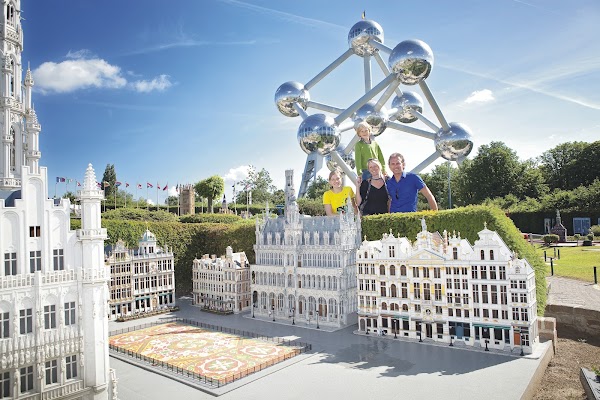
Mini-Europe is a museum in Brussels, Belgium. Open-air museum featuring over 350 miniature replicas of famous European landmarks and monuments, scaled to 1:25. Most visitors spend 2–3 hours here. The free Lokali audio guide runs 5 minutes.
✓ Verified August 2026 · how we write these guides
Visitor facts
| Time needed | 2–3 hours |
|---|---|
| Lokali audio guide | 5 min · free |
| Type | Museum |
| Best for | Family |
| Location | Brussels, Belgium |
| Coordinates | 50.8353, 4.3389 |
| Languages | 45, in the Lokali app |
The story
Step onto the winding path and look down. At your feet, a tiny continent spreads out in the sun. A small Eiffel Tower rises to your waist. A little clock tower marks the hour. Toy trains run on thread-thin tracks. Somewhere a small fountain trickles, no larger than a cup. This is Mini-Europe, a park in Brussels where the great buildings of a whole continent stand together, shrunk to the size of a child.
The park sits at the foot of the Atomium, on the northern edge of Brussels. The giant silver spheres of that famous structure float above you as you walk. Their reflections shift as clouds pass over the park. Mini-Europe opened in 1989. Since then, millions of visitors have wandered its paths, stepping like gentle giants over rivers, mountains, and the rooftops of distant cities.
Everything here is built to one careful scale: one to twenty-five. That means each model is twenty-five times smaller than the real building. A church that soars in stone becomes something you can lean over and study from above. The detail is fine. Tiny windows, tiny doors, tiny stairs, all shaped by patient hands. Lean in close and the craftsmanship rewards every second look.
There are around three hundred and fifty models in the park. Together they represent towns and landmarks from across the countries of the European Union. You can travel from Spain to Greece to Denmark in a single afternoon, on foot, with dry shoes. Signs along the way name each country and its treasures. The whole continent has been gathered into one quiet garden.
Begin near the entrance with the home country. The Grand Place of Brussels appears in miniature, its golden guild houses crowded around a tiny square. You may have stood in the real one earlier. Now you float above it, able to see the whole shape at once, the way a bird might. It is a strange delight to tower over a place that once towered over you.
Wander on and the famous shapes appear one by one. The leaning tower of Pisa tilts, just as it should. The canals of Venice hold small boats. Greek temples stand white on a little hill. Each model has been studied closely, so that even from above, the building is unmistakable. Part of the fun is naming each one before you read its label.
Many of the models do more than sit still. Press a button, and things begin to move. A tiny cable car climbs a model mountain. Small ferries cross painted water. A miniature train winds through the Alps. A little bull runs in a Spanish square. Children race from button to button, eager for the next surprise. These small machines bring the silent city to life.
One model marks a real moment in history. A section of the Berlin Wall stands here, and at the touch of a control, it falls, again and again. In 1989, the year this park opened, the true wall came down in Germany. Visitors of every age pause here for a quiet moment. So the park has, from its very first year, remembered that change in small and moving form.
Children move through here differently than adults. For once, they are the right size for the world. They crouch at eye level with windows and bridges. They spot details that taller visitors miss. Here, for an afternoon, the small are the giants. Watch a child lean close to a tiny doorway, and you will see the whole idea of the place at work.
Look closely at the small figures placed among the buildings. Tiny people fill the streets and squares. They wait at stations. They sit in parks. They line up at doors. Someone painted each one by hand. Each frozen scene hints at a story you can only guess. Together they suggest the millions of real lives lived inside the real versions of these faraway towns.
Near the end of the path, the mood turns thoughtful. A section called the Spirit of Europe looks at the union itself, its countries, its ideas, and how they fit together. After walking over the whole continent, you arrive at a simple question. It is a quiet end to a bright and busy walk. What does it mean for all these places to belong to one shared story?
As you leave, glance back across the little continent one last time. The towers, the bridges, the small still rivers, all bright under the open sky. A whole world you could cross in an hour, held in a single garden. Somewhere out there, full size, every one of these places is waiting for a real visit.
Key facts
What to look for
Practical tips
Common questions
How long do you need at Mini-Europe?
Plan 2–3 hours. That is the time most visitors spend at Mini-Europe. The free Lokali audio guide adds about 5 minutes of narration you can listen to as you walk, so it fits inside your visit rather than adding to it.
Is there a free audio guide to Mini-Europe?
Yes — the Lokali app narrates Mini-Europe free of charge in 50+ languages. It covers the history, what to look for on site and practical tips, and it works offline once downloaded.
Where is Mini-Europe?
Mini-Europe is in Brussels, Belgium, at 50.8353, 4.3389. Tap the map link on this page for directions from where you are.
What should you know before visiting Mini-Europe?
Press the buttons to trigger the moving models.
What is Mini-Europe known for?
Mini-Europe opened in 1989 beside the Atomium.
What is the best time to visit Mini-Europe?
Visit in late afternoon when the miniatures are lit by golden light, making photographs clearer.
On the map
Opens directions to Mini-Europe from your location.
More to see in Brussels


Hear Mini-Europe in your language
The full story, narrated, in 50+ languages. Download it before you go and it plays offline, at your own pace, with no ticket and no tour group.