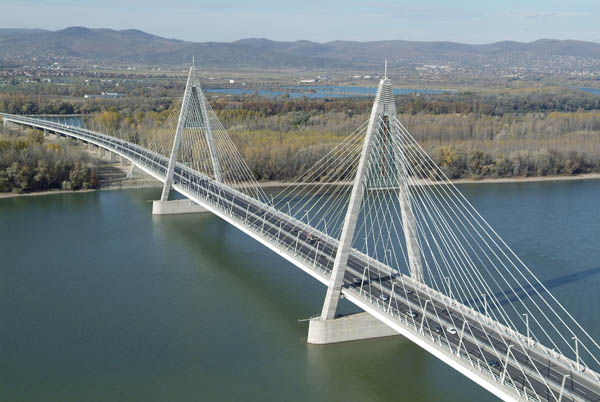
Photo: Civertan · CC BY-SA 3.0 · Wikimedia Commons
Megyeri Bridge is a bridge near Budapest, Hungary. Opened in 2008 as part of the M0 ring road. The free Lokali audio guide runs 7 minutes.
✓ Published October 2026 · how we write these guides
Visitor facts
| Lokali audio guide | 7 min · free |
|---|---|
| Type | Bridge |
| Location | Budapest, Hungary |
| Coordinates | 47.6069, 19.0919 |
| Languages | 50+, in the Lokali app |
The story
Listen first. Somewhere above you, tyres hum across concrete in a low, steady drone. It does not stop, day or night. Below that sound, the Danube moves wide and brown-green, slapping softly against the bank. Look up and you will see the cables, long straight lines fanning down from tall towers, catching the light like the strings of an enormous instrument.
This is the Megyeri Bridge, on the northern edge of Budapest. It is not the bridge on the postcards. There are no stone lions here, and no gas lamps. It is a working structure, built to carry heavy traffic around the city instead of through it. Yet many people who come here find that it holds their attention longer than they expected.
The bridge opened in 2008. At that time, it became the northernmost road crossing of the Danube within the Budapest area. Its job is clear and practical. It forms a key link in the M0, the motorway ring that loops around the Hungarian capital. Before this section existed, lorries and long-distance traffic often had no choice. They had to cross through the dense heart of the city, over bridges designed for a very different century.
Think about those older bridges for a moment. The Chain Bridge, the Elisabeth Bridge, the Liberty Bridge... they were built for carriages, trams and early cars. They were never meant for modern freight lorries. A ring road takes pressure off the centre, and the Megyeri Bridge closed one of the biggest gaps in that ring. So the quiet streets you enjoy downtown owe something to this loud ribbon of concrete in the north.
Now look at how the bridge holds itself up. This is a cable-stayed bridge. That means the road deck hangs from straight cables that run directly to the towers. It is different from a suspension bridge, where the deck hangs from one great curving cable draped between towers. Here, every cable pulls in a straight line. Together they form two fan shapes, one on each side of the towers.
The main span crosses the full width of the main Danube channel without any support in the water between the towers. That was important. This stretch of the river carries barges and river traffic, and the channel had to stay open. The engineers needed a long, clear span, and the cable-stayed design gave them one. Watch a barge pass underneath, and you will understand the scale.
Here is something many visitors miss. The Megyeri Bridge is not just one bridge. It is a whole crossing system. The Danube splits around Szentendre Island just north of the city, and the crossing has to deal with more than one branch of water. So the route includes the main cable-stayed span over the wide channel, plus other sections and viaducts that carry the motorway across the river, the island's southern tip and the low ground on either side.
Now the name. Megyer was one of the seven Hungarian tribes. According to tradition, these tribes arrived in the Carpathian Basin at the end of the ninth century, in the period Hungarians call the Conquest. The name Megyer is very old, and many scholars connect it with the word Magyar itself, which is what Hungarians call themselves. So this modern motorway bridge carries one of the oldest names in the nation's story.
The naming process has a second, lighter story. Before the bridge opened, the public was invited to suggest names through an online vote. As widely reported at the time, one name raced to the top of the poll — the Chuck Norris Bridge, after the American action film star. The internet loved it. Officials, however, did not adopt it, and the historic tribal name was chosen instead. Some locals still smile when the story comes up.
Step back and notice the colours around you. The structure is pale and clean against the sky. On grey days it almost disappears into the clouds. On clear evenings the low sun turns the cables gold, one line at a time. The river below changes too, from silver in the morning to darker green as the light drops. This is a place where the weather is part of the view.
If you are on the Buda side, the riverbank to the south is known as Római-part, the Roman bank. The name comes from the Roman past of this area. The ancient town of Aquincum, a Roman settlement, lay not far away in what is now Óbuda. Today the bank is a relaxed strip of riverside paths, bicycles and simple food stalls. From there, the bridge sits on the northern horizon like a set of sails.
There is something worth thinking about here. The Romans built along this river to guard the edge of their empire. The Danube was their frontier. Centuries later, the Megyeri Bridge does almost the opposite. It does not divide anything. It ties east and west banks together, and it links Budapest to roads that run across Hungary and onward into the rest of Europe. The same water, very different purposes.
One practical point is important. This is a motorway bridge, built for motor traffic. It is not a crossing for people on foot or casual cyclists, so do not plan to stroll across it as you would in the city centre. The best experience is from the riverbanks, looking up and along the span. From a distance, you see the full shape of the towers and cables, which you would never see from the deck itself.
So take a last look before you go. Follow one cable with your eye, from the top of the tower down to the road. Then listen again to that steady hum of traffic above the water. Every car and lorry up there is one less vehicle in the old streets of the city. As you walk away along the bank, notice how the bridge slowly shrinks behind you... and how the river keeps moving, just as it always has.
Key facts
What to look for
Practical tips
Common questions
Is there a free audio guide to Megyeri Bridge?
Yes — the Lokali app narrates Megyeri Bridge free of charge in 50+ languages. The guide runs about 7 minutes, covers the history, what to look for on site and practical tips, and works offline once downloaded.
Where is Megyeri Bridge?
Megyeri Bridge is in Budapest, Hungary, at 47.6069, 19.0919. Tap the map link on this page for directions from where you are.
What is Megyeri Bridge known for?
Opened in 2008 as part of the M0 ring road. Cable-stayed design with straight cables fanning from towers.
What should you look for at Megyeri Bridge?
Straight cables fanning down from each tall tower. Barges passing beneath the long unsupported main span. The pale deck fading into the sky on grey days.
What should you know before visiting Megyeri Bridge?
View the bridge from the Római-part riverbank on Buda. Do not plan to walk across; it is motorway only.
When is the best time to visit Megyeri Bridge?
Come near sunset when low light hits the cables.
On the map
Opens directions to Megyeri Bridge from your location.
More to see in Budapest


Hear Megyeri Bridge in your language
The full story, narrated, in 50+ languages. Download it before you go and it plays offline, at your own pace, with no ticket and no tour group.