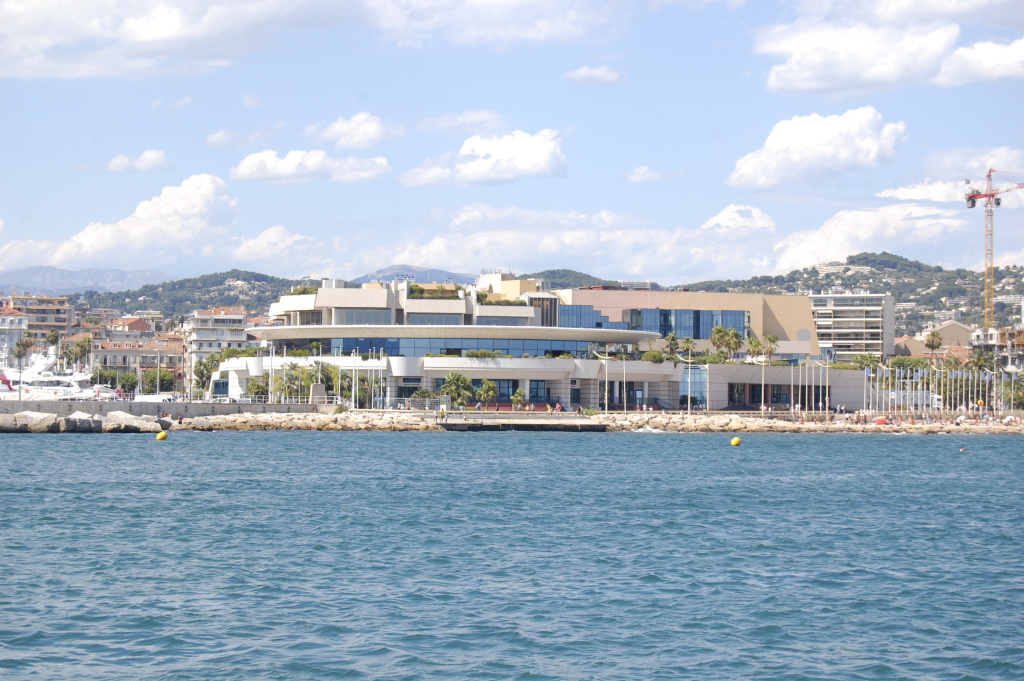
Palais des Festivals et des Congrès
43.5527° N · 7.0173° E · Palace
Palais des Festivals et des Congrès is the iconic venue of the Cannes Film Festival, built in 1982. It is in Cannes, France. Most visitors spend 30–45 min here. The free Lokali audio guide runs 5 minutes.
✓ Verified August 2026 · how we write these guides
Visitor facts
| Time needed | 30–45 min |
|---|---|
| Lokali audio guide | 5 min · free |
| Type | Palace |
| Best for | Photography |
| Location | Cannes, France |
| Coordinates | 43.5527, 7.0173 |
| Languages | 45, in the Lokali app |
The story
A wide flight of steps rises in front of you. They are bare now, gray stone under the sun. But once each year they wear a long red carpet. Cameras crowd the square. Crowds press against the barriers. This is the Palais des Festivals, the home of the Cannes Film Festival. Today you can climb these steps freely, with no crowd at all.
The building sits at the western end of the Croisette, beside the old port. It is large and plain, with broad concrete walls. Some people call it the Bunker for its heavy shape. It was built for function, not for beauty. The current hall opened in 1982. Before that, the festival used an older building further along the seafront.
The Cannes Film Festival began in 1946. A first edition had been planned for 1939, but the war stopped it. When peace returned, the festival started in earnest. Each May, films from around the world show here. Directors hope to win the top prize. It is a gold leaf shaped like a palm, called the Palme d'Or.
The palm shape has meaning for this coast. Palm trees grow all along the Croisette. The award takes its form from them. A jury of film people chooses the winner each year. Past winners have come from many countries. For a director, this prize can change a whole career. It is among the most respected awards in film.
The red-carpeted steps have their own name. People call the climb the montee des marches, the climb of the steps. Actors walk up slowly in evening dress. Photographers call out from below. The walk is short, but it is watched by millions on screens. For a few minutes, each guest is the center of the world's attention.
In front of the building runs a path set with handprints. It is the Allee des Etoiles, the walk of the stars. Film actors and directors have pressed their hands into clay tiles. Their names are marked beside them. You can walk the path and find familiar names. Place your own hand in a print and feel how it fits.
The hall does more than host the film festival. Through the year it holds many large meetings. There is a fair for television programs. There is a gathering for the advertising trade. There is one for property and building. The city of Cannes lives partly on these events. They fill the hotels long after the film crowds have gone.
Inside, the building holds theaters of different sizes. The largest seats over two thousand people. This is where the main films are shown first. The rooms are plain and dark, built for sound and screen. During the festival, the schedule runs from morning to night. Outside these weeks, the halls host concerts, talks, and award shows.
Stand at the foot of the steps and turn around. You face the old port, full of boats. Beyond it rises the old town on its hill. The festival hall looks out on all of this. The setting matters. The sea, the light, and the harbor are part of why the festival came to Cannes and stayed.
The square around the building is open to all. Visitors come to take photographs by the steps. Some sit at the cafes nearby and watch the port. In the festival season, fans wait here for hours hoping to see a star. Out of season, it is calm. Children chase pigeons across the stone. Gulls call from the masts.
At night, lights wash the front of the building. The plain walls soften in the glow. The red carpet, when it is there, seems to burn under the lamps. Even empty, the steps hold a certain weight. So many famous feet have climbed them. You feel a small echo of that as you climb them yourself.
The Palais is not a lovely building. It will not win you over with its walls. Its power lies in what happens here. For one month each year, the eyes of the film world turn to this spot. Stand on the steps and picture it. Then walk down to the port, where the boats rock gently and the day goes on.
Key facts
What to look for
Practical tips
Common questions
How long do you need at Palais des Festivals et des Congrès?
Plan 30–45 min. That is the time most visitors spend at Palais des Festivals et des Congrès. The free Lokali audio guide adds about 5 minutes of narration you can listen to as you walk, so it fits inside your visit rather than adding to it.
Is there a free audio guide to Palais des Festivals et des Congrès?
Yes — the Lokali app narrates Palais des Festivals et des Congrès free of charge in 50+ languages. It covers the history, what to look for on site and practical tips, and it works offline once downloaded.
Where is Palais des Festivals et des Congrès?
Palais des Festivals et des Congrès is in Cannes, France, at 43.5527, 7.0173. Tap the map link on this page for directions from where you are.
What should you know before visiting Palais des Festivals et des Congrès?
Climb the red-carpet steps when the festival is over.
What is Palais des Festivals et des Congrès known for?
The current festival hall opened in 1982.
What is the best time to visit Palais des Festivals et des Congrès?
Visit in the morning before crowds arrive.
On the map
Opens directions to Palais des Festivals et des Congrès from your location.
Reference
More to see in Cannes


Hear Palais des Festivals et des Congrès in your language
The full story, narrated, in 50+ languages. Download it before you go and it plays offline, at your own pace, with no ticket and no tour group.