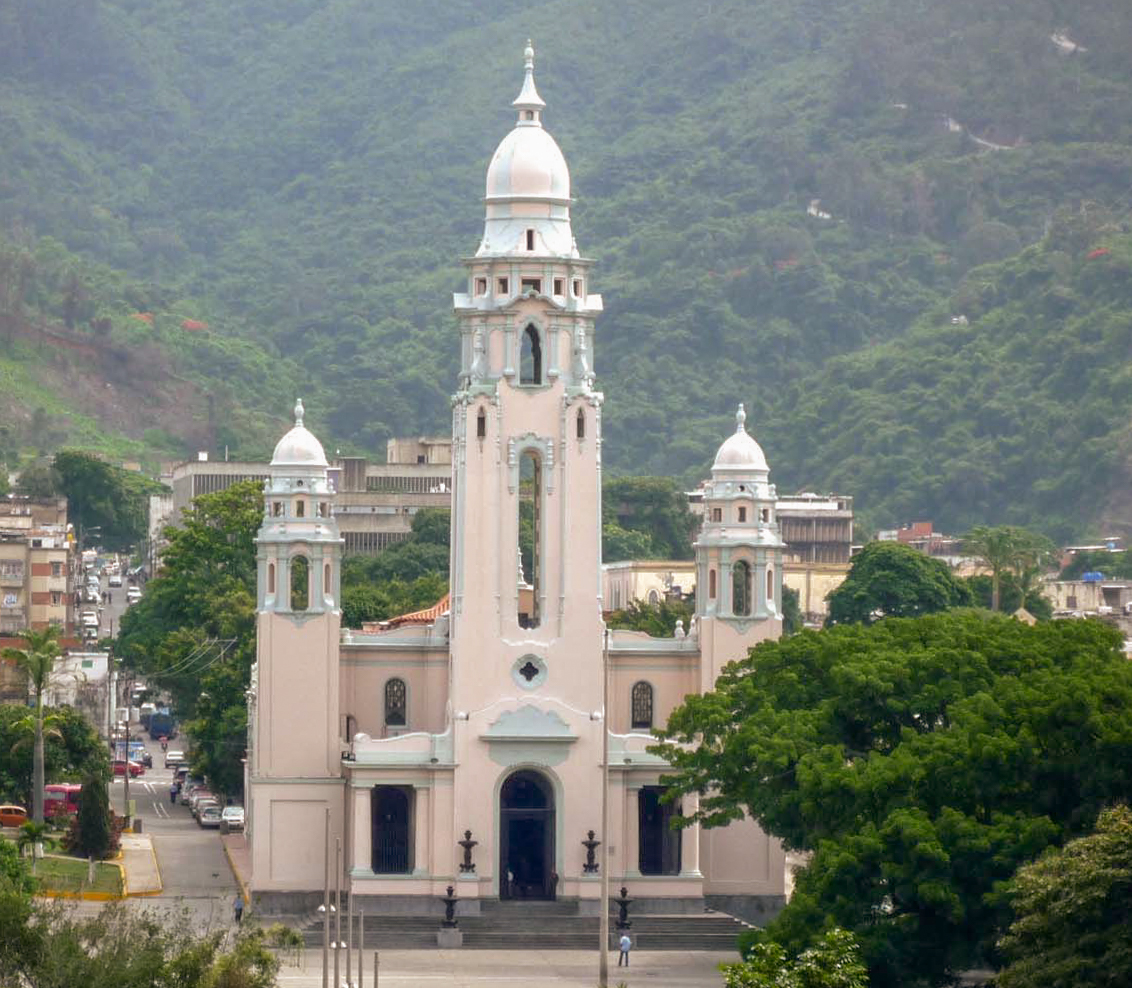
National Pantheon of Venezuela
10.5129° N · 66.9126° W · Monument
Photo: Wilfredor · CC BY-SA 4.0 · Wikimedia Commons
National Pantheon of Venezuela is a mausoleum of Venezuelan national heroes. Originally the colonial Church of the Holy Trinity. The free Lokali audio guide runs 6 minutes.
✓ Published October 2026 · how we write these guides
Visitor facts
| Lokali audio guide | 6 min · free |
|---|---|
| Type | Monument |
| Location | Caracas, Venezuela |
| Coordinates | 10.5129, -66.9126 |
| Languages | 50+, in the Lokali app |
The story
Listen first. Traffic hums somewhere below, but here the air goes still. Your footsteps sound sharper on the stone. Ahead, a pale facade rises in pointed arches and slender towers. It looks like a church, because it once was one. Today it is something else, a house of the dead built to hold the memory of a nation.
This is the National Pantheon of Venezuela. It stands at the northern edge of old Caracas, where the city starts to climb toward the green wall of the Ávila mountain. On a clear morning, the mountain fills the sky behind the building. The contrast is part of the experience: hard white stone in front, soft forest behind, and the noise of the capital fading as you approach.
The story begins with a church dedicated to the Holy Trinity. It stood on this site in colonial times, when Caracas was a much smaller city of red tile roofs. Then came the great earthquake of 1812. It shook much of the city to the ground and killed thousands of people. The Trinity church was badly damaged. For decades afterwards, the site carried the scars of that disaster.
In the 1870s, the president Antonio Guzmán Blanco gave the building a new purpose. He was a leader who loved grand gestures and modern public buildings. He decreed that the old church would become the National Pantheon, a resting place for the heroes of the republic. The model was clear. Paris had its Panthéon. Caracas would have its own, and it would have a central figure.
That figure is Simón Bolívar, the Liberator. He led the wars that freed much of South America from Spanish rule. He died in 1830 near Santa Marta, on the Caribbean coast of Colombia, sick and politically isolated. His remains came home to Caracas in 1842 and rested first in the cathedral. In 1876 they were moved here, and the Pantheon took its place at the heart of the nation's memory.
Step inside, and your eyes travel straight down the central nave. The space is long and narrow, like the church it used to be. At the far end, the tomb of Bolívar draws all the attention. Guards in ceremonial uniform stand nearby, very still. The light is soft, and the voices of visitors drop to a whisper without anyone asking them to.
Now look up. The ceiling is covered with paintings by Tito Salas, one of Venezuela's best-known painters of the twentieth century. He devoted much of his career to the life of Bolívar. Here you can follow scenes from that life across the vaults overhead. Many visitors walk the whole nave without raising their heads. Take a moment. The ceiling is half the story of this building.
Along the side aisles lie many other Venezuelans: generals of the independence wars, presidents, writers, scientists and artists. One of them surprises many visitors. Teresa Carreño, a pianist and composer, was born in Caracas in the nineteenth century. She became one of the most celebrated performers of her time in Europe and the United States. Her remains were brought here long after her death, a sign that the nation honours art as well as war.
Here is a detail that many people walk past. One tomb in the Pantheon is empty, and it is left open on purpose. It belongs to Francisco de Miranda, an older revolutionary and a precursor of independence. He died in a Spanish prison in Cádiz in 1816. His body was buried in a common grave and never identified. The open tomb waits for him, a quiet symbol of a hero who never came home.
There are other symbolic tombs too. Antonio José de Sucre, one of Bolívar's closest generals, is buried in Quito, in Ecuador, yet he is honoured here. Manuela Sáenz, Bolívar's companion and a figure of the independence era in her own right, received a symbolic burial in 2010. Her real remains were lost in a mass grave in Peru, so earth from that place stands in for her.
The Pantheon has also been a stage for modern politics. In 2010, under president Hugo Chávez, Bolívar's remains were exhumed for a scientific study of how he died. The event was broadcast live and caused strong debate across the country. Afterwards, a new mausoleum was built right beside the old church, and it opened in 2013 to hold the Liberator.
Walk outside and look at that newer structure. It is tall, white and sharply modern. It curves up into the sky in one long sweeping form. Some people admire its boldness. Others feel it clashes with the older Gothic-style facade next to it. Either way, standing between the two buildings, you see two very different ideas of how a nation should honour its founder.
The square in front of the Pantheon is a good place to slow down. Watch the guards, the school groups, the families taking photos in front of the doors. Notice how the old colonial streets around you climb gently uphill. This part of Caracas still keeps some of the scale of the old city, with lower buildings and narrower lanes.
Before you leave, turn around once more. Let your eyes move from the pointed arches to the white curve of the new mausoleum, and then up to the dark green slopes of the Ávila. Old stone, new concrete, ancient mountain. As you walk back down toward the city, the traffic noise will slowly return... but you may carry a little of this stillness with you.
Key facts
What to look for
Practical tips
Common questions
Is there a free audio guide to National Pantheon of Venezuela?
Yes — the Lokali app narrates National Pantheon of Venezuela free of charge in 50+ languages. The guide runs about 6 minutes, covers the history, what to look for on site and practical tips, and works offline once downloaded.
Where is National Pantheon of Venezuela?
National Pantheon of Venezuela is near Caracas, Venezuela, at 10.5129, -66.9126. Tap the map link on this page for directions from where you are.
What is National Pantheon of Venezuela known for?
Originally the colonial Church of the Holy Trinity. Damaged by the great Caracas earthquake of 1812.
What should you look for at National Pantheon of Venezuela?
Tito Salas paintings of Bolívar across the ceiling. The deliberately open, empty tomb of Francisco de Miranda. Ceremonial guards standing still near Bolívar's tomb.
What should you know before visiting National Pantheon of Venezuela?
Dress respectfully; this is a national memorial. Keep voices low near the honour guard.
When is the best time to visit National Pantheon of Venezuela?
Come on a clear morning for Ávila mountain views.
On the map
Opens directions to National Pantheon of Venezuela from your location.
Hear National Pantheon of Venezuela in your language
The full story, narrated, in 50+ languages. Download it before you go and it plays offline, at your own pace, with no ticket and no tour group.