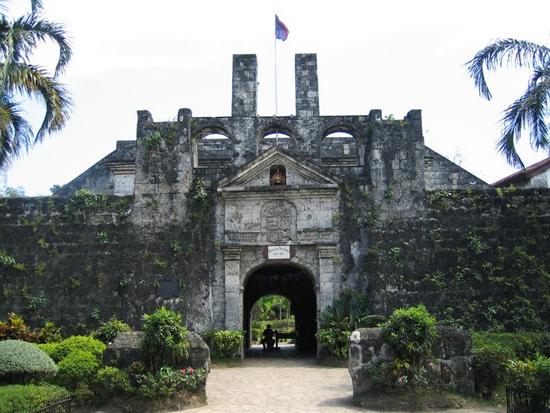
Photo: en:User:Ramirez72 · Public domain · Wikimedia Commons
Fort San Pedro is a Spanish-era military fortification in Cebu City, Philippines. Often called the oldest triangular bastion fort in the Philippines. The free Lokali audio guide runs 6 minutes.
✓ Published October 2026 · how we write these guides
Visitor facts
| Lokali audio guide | 6 min · free |
|---|---|
| Type | Museum |
| Location | Cebu City, Philippines |
| Coordinates | 10.2925, 123.9059 |
| Languages | 50+, in the Lokali app |
The story
Put your hand flat against the wall. The stone is coral, pale and porous, and on a hot Cebu afternoon it holds the sun like a warm loaf. Run your fingers across it and you can feel tiny pits and ridges. These are traces of a living reef, cut from the sea and stacked into a fortress. Somewhere beyond the walls, a ship horn sounds from the port. That sound has carried across this spot for centuries.
Welcome to Fort San Pedro, often described as the oldest and smallest triangular bastion fort in the Philippines. It sits at the edge of the old harbour, close to where Spanish ships first anchored. It is compact enough to walk around in a few minutes. But it holds more layers of Philippine history than places many times its size. Let us walk through those layers slowly, one at a time.
The story begins in 1565. That year, the Spanish expedition led by Miguel López de Legazpi arrived in Cebu. This was the start of more than three centuries of Spanish rule in the islands. Legazpi's men needed a defensive position quickly. Historical accounts describe a first fort built of wood and earth, a simple palisade. The fort took its name from one of the expedition's ships, the San Pedro.
That first wooden fort did not survive in its original form. Over time, it was replaced with the stone walls you see now. Most accounts date the present stone structure to the eighteenth century. So when you touch these walls, you are touching a later rebuilding of an older idea. The location, though, is the same. It is the ground where Spanish colonial Cebu, and in many ways colonial Philippines, began.
Now look at the shape. The fort is a triangle. Two sides face the water, and one side faces the land. Each corner carries a bastion, a pointed platform built for cannon. The three bastions carry names: La Concepción, Ignacio de Loyola, and San Miguel. Their angles let defenders fire along the walls and cover every approach. It is a small, clever piece of military geometry.
Why did Cebu need such a fort? The threat came mostly from the sea. During the Spanish period, raiders from the southern islands attacked coastal towns across the Visayas, the central island group of the Philippines. A stone fort at the harbour mouth gave the settlement a place to watch, defend, and shelter. From the walls, lookouts could see sails long before they reached shore.
Here is the first surprise. Fort San Pedro was not only a fortress. Over the generations, it changed jobs again and again. At the end of the nineteenth century, during the Philippine Revolution against Spain, Filipino revolutionaries took control of it. Soon after, under American rule, it became a barracks for American soldiers. Then, in the early twentieth century, it served as a school. Children studied inside walls built for war.
The Second World War brought a darker chapter. During the Japanese occupation, the fort was used to hold prisoners. When the fighting ended, Cebu City lay badly damaged, and the fort became an emergency hospital for wounded people. The same stones that sheltered soldiers and students now sheltered the sick. Few buildings in the city carry so many different memories in one small space.
And here is the second surprise, one that many visitors never hear. In the years after the war, the fort was used for a time as a small zoo. Imagine animal enclosures where cannon once stood. Later, the city restored the site as a historical monument and park. Today the courtyard is green and quiet, with lawns, trees, and paths that invite you to slow down.
Take a moment in the inner courtyard. Notice how the walls cut out the noise of the city. Outside, there are jeepneys, the colourful shared taxis of the Philippines, and the steady hum of traffic. Inside, you may hear birds, a gardener's broom, and quiet voices. Small rooms along the walls hold a museum display with objects from the Spanish era and later periods. Read the labels there for the details.
Now climb up to the walls, if the paths are open. From the top, the view opens toward the sea and the modern port. Cargo ships and ferries move through the channel toward Mactan Island across the water. You can also look back toward the city. This view connects the old harbour defence to the working port that still feeds Cebu today. Little has changed in the logic of this spot.
The fort does not stand alone. Right beside it lies Plaza Independencia, a wide public square with tall trees and memorials. A short walk away you will find Magellan's Cross, the cross that marks the arrival of Ferdinand Magellan's expedition in 1521. Nearby stands the Basilica del Santo Niño, one of the most important churches in the country. Together, these places form the historic heart of Cebu, all within easy walking distance.
Think about the people who passed through this gate. Spanish soldiers watching for sails. Revolutionaries raising their own flag. American troops. Schoolchildren with notebooks. Prisoners of war. Doctors and nurses after the bombing. Families visiting a zoo. Couples posing for wedding photos today. Each group saw the same coral walls with different eyes. The fort did not stay still. It kept adapting to the needs of the city around it.
Before you leave, look once more at the stone near the gate. See the dark streaks of weather, the patches of repair, the small plants in the cracks. Listen for the port again, and the wind off the water. As you step back into the plaza, the noise of modern Cebu will return. But for a few minutes, you stood on the ground where this city's long colonial story first took shape.
Key facts
What to look for
Practical tips
Common questions
Is there a free audio guide to Fort San Pedro?
Yes — the Lokali app narrates Fort San Pedro free of charge in 50+ languages. The guide runs about 6 minutes, covers the history, what to look for on site and practical tips, and works offline once downloaded.
Where is Fort San Pedro?
Fort San Pedro is in Cebu City, Philippines, at 10.2925, 123.9059. Tap the map link on this page for directions from where you are.
What is Fort San Pedro known for?
Often called the oldest triangular bastion fort in the Philippines. Legazpi's Spanish expedition arrived in Cebu in 1565.
What should you look for at Fort San Pedro?
Pitted coral stone texture on the outer walls. Three pointed corner bastions built for cannon fire. Ferries and cargo ships moving toward Mactan Island.
What should you know before visiting Fort San Pedro?
Visit in early morning to avoid the strongest midday heat. Bring water and a hat for the open walls.
When is the best time to visit Fort San Pedro?
Visit in early morning to avoid the strongest midday heat.
On the map
Opens directions to Fort San Pedro from your location.
Hear Fort San Pedro in your language
The full story, narrated, in 50+ languages. Download it before you go and it plays offline, at your own pace, with no ticket and no tour group.