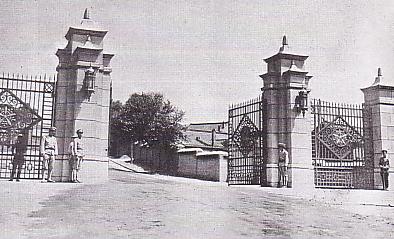
Museum of the Imperial Palace of Manchukuo
43.9036° N · 125.3422° E · Museum
Photo: Unknown authorUnknown author · Public domain · Wikimedia Commons
Museum of the Imperial Palace of Manchukuo is a museum in Kuancheng, Changchun, Jilin, China. Puyi was the last emperor of China's Qing dynasty. The free Lokali audio guide runs 7 minutes.
✓ Published October 2026 · how we write these guides
Visitor facts
| Lokali audio guide | 7 min · free |
|---|---|
| Type | Museum |
| Location | Changchun, China |
| Coordinates | 43.9036, 125.3422 |
| Official website | wmhg.com.cn |
| Languages | 50+, in the Lokali app |
The story
Listen for a moment before you look. The traffic of Changchun fades behind the walls, and what is left is the crunch of gravel and the low murmur of tour groups. The buildings around you are grey brick and yellow-glazed tile, a little worn, a little modest. Nothing here is grand in the way of Beijing's Forbidden City. That modesty is the first clue to the story you are standing inside.
This was the palace of Puyi, the last emperor of China's Qing dynasty. As a small child he sat on the Dragon Throne in Beijing. The dynasty fell in 1912, and he lost his empire before he was old enough to understand it. Two decades later, he arrived here in the northeast. He came to rule again, but in name only. The real power belonged to someone else.
In 1931, the Japanese army seized the northeast of China, a region often called Manchuria. The following year, Japan created a new state here and called it Manchukuo. Changchun was made its capital and renamed Xinjing, which means New Capital. Puyi was installed first as Chief Executive, and then in 1934 as emperor. Most historians describe Manchukuo as a puppet state. Japanese officers and advisers made the decisions, and Puyi signed what he was given.
Here is the first surprise. This palace was not built as a palace. Before Puyi arrived, these buildings were offices of the regional salt administration, the bureau that collected taxes on salt. When a capital and a court were needed quickly, the old government compound was adapted. So the halls where an emperor received officials began life as the workplace of tax clerks. Look at the plain, practical proportions and you can still see the office block underneath the imperial dress.
The compound is divided into two parts. In the outer court, the business of state took place. The main building here is the Qinmin Building, a name that roughly means Diligent Service to the People. Inside, you will find the rooms where Puyi held ceremonies and met visitors. The furniture, the carpets and the throne room try very hard to look imperial. Yet the space feels compact, almost domestic, compared to the vast courtyards he knew as a boy.
Walk on into the inner court, where the family lived. The Jixi Building was the private residence. Puyi had rooms here, and so did his wife, Empress Wanrong. Notice how the style mixes Chinese and Western elements. There are Chinese roof lines and painted details, but also Western-style windows, radiators and heavy European furniture. It is the home of a man caught between two worlds, and fully at ease in neither.
The empress's rooms carry one of the saddest stories in the palace. Wanrong was educated, spoke English, and was once known in society for her style. Here, her life closed in on her. She became isolated from her husband and dependent on opium. The museum shows her quarters, including the space associated with her addiction. Pause here a moment. The quiet in these rooms feels heavier than in the halls of ceremony.
Puyi's own life in the palace was also tightly controlled. He could rarely leave the grounds without Japanese approval. His movements, his visitors and even his household were watched. In his later memoir, he described himself as a prisoner in his own court. Visitors often expect a story of luxury. What the rooms show instead is a story of confinement, dressed in silk and lacquer.
Now look for the Tongde Hall, the largest and most polished building in the compound. It was built by the Japanese side in the late 1930s, meant as a more fitting imperial residence. Here is the second surprise. According to accounts from Puyi and people close to him, he refused to live in it. He suspected that the new hall was fitted with listening devices. So the finest building in the palace stood largely unused, a showpiece for an emperor who did not trust its walls.
The palace grounds also include gardens, a small artificial hill, and spaces once used for leisure, such as a swimming pool and a riding area. Puyi tried to recreate some fragments of court life. There were rituals, ranks of servants and portraits. But the scale stayed small, and the walls stayed close. As you walk the paths, notice how quickly you reach the edge of the compound. The world of this emperor ended a few minutes' walk in any direction.
The end came suddenly in August 1945. As the Soviet army advanced into the northeast and Japan moved towards surrender, Puyi fled the palace. He was captured by Soviet forces and held in the Soviet Union for several years. Later, he was returned to China and spent around a decade in a centre for war criminals. He was released in 1959, and lived out his final years in Beijing as an ordinary citizen. His autobiography became widely read, and much later his life inspired the film The Last Emperor.
Today the compound serves as a museum, and its purpose is clear. The exhibitions do more than show royal rooms. They also document the Japanese occupation of northeast China and its cost to ordinary people. You will find displays on forced labour, resistance and daily life under Manchukuo. For many Chinese visitors, this is a place of national memory, not nostalgia. Read the captions with that in mind, and the restored furniture takes on a different meaning.
It is worth remembering that Changchun itself still carries this period in its streets. Many large government buildings from the Manchukuo years remain standing across the city. Some now house universities and hospitals. The palace is the starting point for understanding them. Once you have seen these rooms, you may notice the same heavy roofs and solid stone fronts as you move around town.
Before you leave, stand for a moment in the courtyard again. Look at the yellow tiles, the colour once reserved for emperors, sitting on top of a former tax office. Listen to the footsteps on the gravel, the voices of school groups, the distant hum of the city beyond the wall. An emperor lived here who ruled almost nothing. And as you walk out through the gate, you are leaving with more freedom than he ever had within it.
Key facts
What to look for
Practical tips
Common questions
Is there a free audio guide to Museum of the Imperial Palace of Manchukuo?
Yes — the Lokali app narrates Museum of the Imperial Palace of Manchukuo free of charge in 50+ languages. The guide runs about 7 minutes, covers the history, what to look for on site and practical tips, and works offline once downloaded.
Where is Museum of the Imperial Palace of Manchukuo?
Museum of the Imperial Palace of Manchukuo is in Changchun, China, at 43.9036, 125.3422. Tap the map link on this page for directions from where you are.
What is Museum of the Imperial Palace of Manchukuo known for?
Puyi was the last emperor of China's Qing dynasty. Changchun was renamed Xinjing, meaning New Capital, under Manchukuo.
What should you look for at Museum of the Imperial Palace of Manchukuo?
Yellow-glazed roof tiles set on plain grey brick walls. Western radiators and windows inside the Chinese-style Jixi Building. The throne room inside the Qinmin Building.
What should you know before visiting Museum of the Imperial Palace of Manchukuo?
Allow at least two to three hours for the full compound. Visit early in the day to avoid large tour groups.
When is the best time to visit Museum of the Imperial Palace of Manchukuo?
Visit early in the day to avoid large tour groups.
On the map
Opens directions to Museum of the Imperial Palace of Manchukuo from your location.
Hear Museum of the Imperial Palace of Manchukuo in your language
The full story, narrated, in 50+ languages. Download it before you go and it plays offline, at your own pace, with no ticket and no tour group.