Photo: Unknown authorUnknown author · Public domain · Wikimedia Commons
Chester Castle is a castle in Chester, UK. Norman forces founded the first castle here around 1070. The free Lokali audio guide runs 7 minutes.
✓ Published October 2026 · how we write these guides
Visitor facts
| Lokali audio guide | 7 min · free |
|---|---|
| Type | Castle |
| Location | Chester, United Kingdom |
| Coordinates | 53.1853, -2.8923 |
| Official website | english-heritage.org.uk |
| Languages | 50+, in the Lokali app |
The story
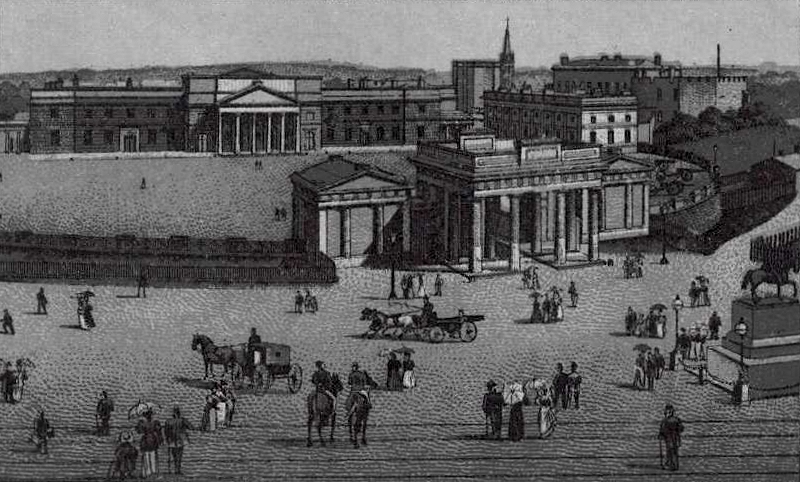
Stand for a moment in the wide open square in front of the castle. The paving stretches out flat and pale, and the noise of the city traffic drops away behind you. Ahead, a row of heavy stone columns holds up a long, calm facade. It looks more like a temple from ancient Athens than a fortress. And that is the first surprise of Chester Castle. The building most people see today is not medieval at all. The older castle is still here, but you have to look for it.
Let us begin with the oldest layer. After the Norman Conquest of 1066, William the Conqueror moved north to bring the region under control. Around 1070, his forces raised a castle on this rise above the River Dee. It was a motte and bailey castle. That means an earth mound with a timber tower on top, and a fenced yard below. The site was a careful choice. From here, soldiers could watch the river crossing and the road into Wales.
Over the next centuries, timber gave way to stone. Chester became one of the most important military bases on the Welsh border. In the late thirteenth century, King Edward the First used the city as a staging point for his campaigns into Wales. Supplies, soldiers, and money passed through these walls. For a time, this quiet corner of Chester sat close to the centre of English royal power in the west.
The best survivor from that medieval castle is the Agricola Tower. It is a square, squat block of red sandstone, and it dates from the twelfth century. It began as the main gateway into the inner part of the castle. Later, the gate passage was blocked, and the tower took on other roles. The soft red stone is the same local sandstone you see across the city. Look closely and you will notice how wind and rain have rounded its edges over the centuries.
Here is a detail many visitors miss. Inside the Agricola Tower, on an upper floor, is a small chapel dedicated to Saint Mary. Its walls carry fragments of medieval paintings, generally dated to the thirteenth century. The colours are faded, but you can still make out figures and patterned borders. It is a rare survival. Imagine soldiers and royal officials climbing these narrow stairs to pray, in a room painted with saints and stories, high above the river.
The castle also has a place in one of the great royal dramas of English history. In 1399, the exiled Henry Bolingbroke returned to England and turned against King Richard the Second. According to long tradition, Richard was brought to Chester and held here for a time, before he was taken on to London. He lost his crown that same year. Henry became King Henry the Fourth. It is a quiet thought, standing among these stones, that a reigning king may have waited here as a prisoner.
Now turn back to those Greek columns. By the late eighteenth century, much of the medieval castle was in poor condition. The county needed new courts, a prison, and offices. The architect Thomas Harrison won the task. Over several decades, from the 1780s into the early nineteenth century, he cleared away large parts of the old fortress. In their place, he built a complex in the Greek Revival style. That style copied the temples of ancient Greece, with plain columns, triangular gables, and clean, strong lines.
The great gateway in front of you is called the Propylaeum. The name comes from the monumental entrance to the Acropolis in Athens. Harrison used the Doric order here. That is the simplest of the classical column types, with no carved base and a plain, cushion-like top. The effect is serious and heavy, almost severe. Many architectural historians count this group of buildings among the finest Greek Revival work in Britain. Harrison was also behind other landmarks in the city, including the long single arch of the Grosvenor Bridge over the Dee.
The central block facing the square still holds a court. Justice has been delivered on this site for centuries, and that tradition continues today. So when you see people in suits walking briskly across the square, they may be lawyers or witnesses, not tourists. It is a working building. Please treat the court entrance with respect, and expect security checks if you go inside.
Here is a second surprise. In 1867, members of the Fenian movement, who were fighting for Irish independence from Britain, planned a raid on Chester Castle. Their aim was to seize the weapons stored in its armoury. The plan was betrayed before it could happen. Troops were sent to protect the castle, and the would-be raiders slipped away. Few people walking through this calm square know that it was once the target of an armed plot.
The castle kept its military role for a long time. Soldiers were based here well into the twentieth century. Today, part of the complex holds the Cheshire Military Museum. It tells the story of the regiments connected with the county, through uniforms, medals, letters, and personal objects. If you enjoy human stories behind the big events, this museum adds real depth to a visit. The Agricola Tower and the nearby stretch of medieval wall are cared for by English Heritage.
Take a short walk to the edge of the site, toward the river. From here, you can see how the castle connects to Chester's city walls. These walls form the most complete circuit of defensive walls in Britain, and you can walk along the top of them. The castle sat at the south-west corner of that circuit. Below, the Dee runs wide and slow. On a still day you may hear rowers, gulls, and the low sound of traffic crossing the bridges.
Before you leave, stand back in the square once more. In front of you are two very different ideas of power. One is the rough red stone of the Agricola Tower, built to hold the border by force. The other is Harrison's pale columns, built to show order, law, and calm authority. As you walk away, look back over your shoulder. Notice how the classical gateway frames the sky, and how the old red tower waits quietly behind it, still standing after more than eight hundred years.
Key facts
What to look for
Practical tips
Common questions
Is there a free audio guide to Chester Castle?
Yes — the Lokali app narrates Chester Castle free of charge in 50+ languages. The guide runs about 7 minutes, covers the history, what to look for on site and practical tips, and works offline once downloaded.
Where is Chester Castle?
Chester Castle is in Chester, United Kingdom, at 53.1853, -2.8923. Tap the map link on this page for directions from where you are.
What is Chester Castle known for?
Norman forces founded the first castle here around 1070. The Agricola Tower survives from the twelfth-century castle.
What should you look for at Chester Castle?
Plain Doric columns on the Propylaeum gateway. Weathered red sandstone edges of the Agricola Tower. Faded medieval wall paintings in the tower's chapel.
What should you know before visiting Chester Castle?
Visit the Cheshire Military Museum inside the castle complex. Walk the nearby city walls for views over the castle.
On the map
Opens directions to Chester Castle from your location.
More to see in Chester


Hear Chester Castle in your language
The full story, narrated, in 50+ languages. Download it before you go and it plays offline, at your own pace, with no ticket and no tour group.