Fishbourne Roman Palace
50.8366° N · 0.8103° W · Archaeological Site
Photo: Charlesdrakew · Public domain · Wikimedia Commons
Fishbourne Roman Palace is a roman palace and museum near Chichester in Sussex, United Kingdom. Discovered in 1960 during digging for a water main. The free Lokali audio guide runs 6 minutes.
✓ Published October 2026 · how we write these guides
Visitor facts
| Lokali audio guide | 6 min · free |
|---|---|
| Type | Archaeological Site |
| Location | Chichester, United Kingdom |
| Coordinates | 50.8366, -0.8103 |
| Official website | sussexpast.co.uk |
| Languages | 50+, in the Lokali app |
The story
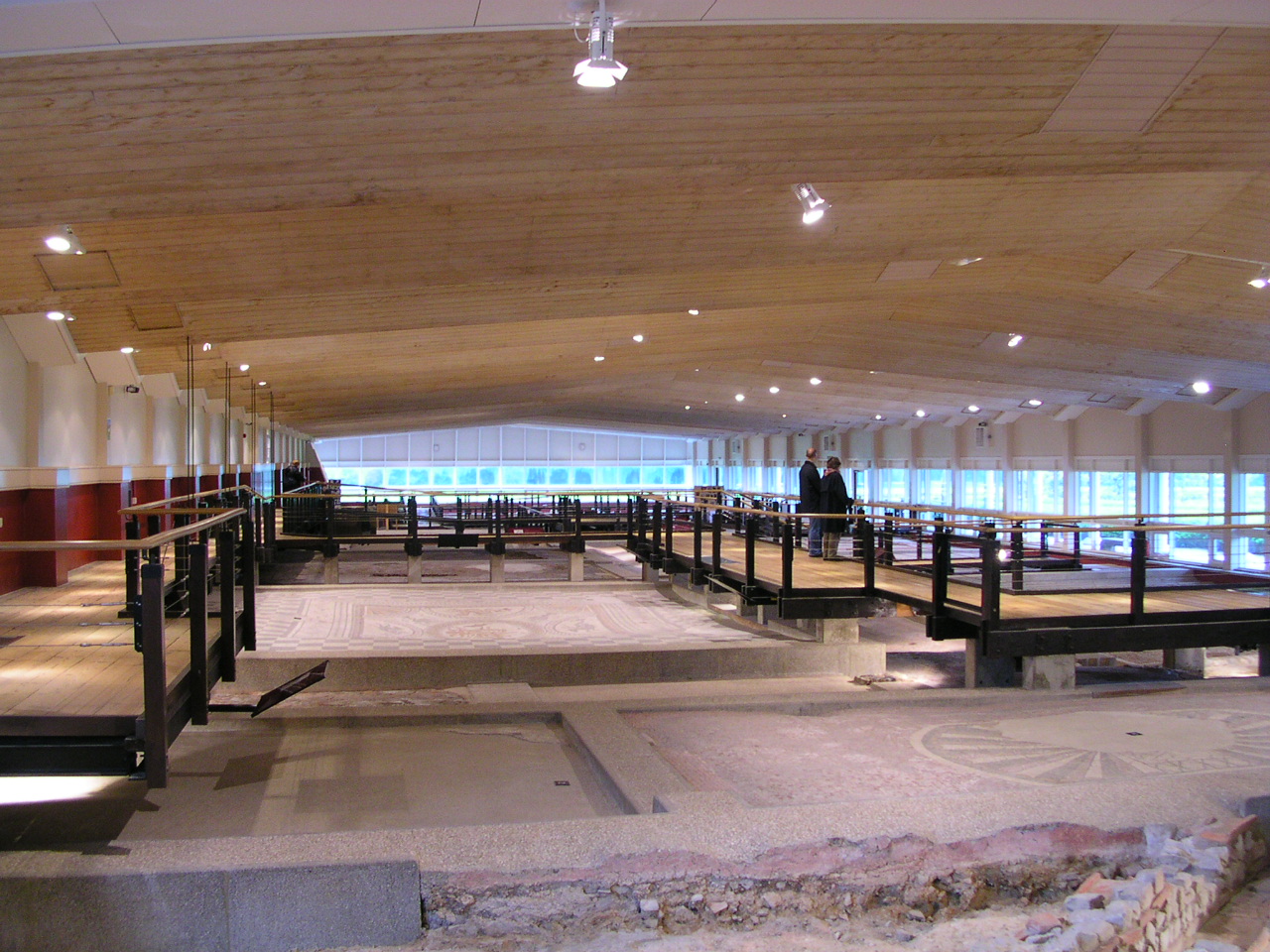
Listen to your footsteps for a moment. Inside this long modern hall you walk on raised walkways, and beneath you lie floors laid nearly two thousand years ago. Small cubes of stone, black, white, red and cream, are fitted together by hand. The light falls softly across them. The air smells faintly of cool earth and old mortar. You are standing above the remains of the largest Roman house yet found in Britain.
For most of the last two thousand years, nobody knew it was here. This was farmland and quiet village ground on the edge of Chichester. Then, in 1960, a workman digging a trench for a new water main struck something unexpected. It was rubble, then building material, then clearly Roman. That ordinary trench changed what historians believed about Roman Britain. Something very large had been sleeping under the fields.
Excavations began soon after. They were led by a young archaeologist named Barry Cunliffe, who later became one of Britain's best-known scholars of the ancient world. Season after season, the team traced walls, floors and drains. Slowly a plan appeared. This was not a farmhouse or a modest villa. It was a great complex of four wings arranged around a vast central garden, built on a scale more familiar from Italy than from a far province.
To understand why such a building stood here, picture the coast as it once was. The sea came closer to this spot than it does today, and a sheltered harbour lay nearby. When the Romans invaded Britain in AD 43, this stretch of shore was useful. Archaeologists believe the site was first used by the military, possibly as a supply base. Only later did the great residence rise on the same ground.
The palace itself was built in the later first century AD. Who lived in it? That is the question every visitor asks, and the honest answer is that nobody knows for certain. One popular theory links it to Togidubnus, a local British ruler who allied himself with Rome. He was rewarded with power and status. A house this grand would suit such a man. But no inscription here names him, so treat the idea as an educated guess, not a proven fact.
Whoever owned it, the ambition is clear. Craftsmen and materials appear to have come from across the Roman world. There was decorated marble, painted plaster and carefully worked stone. The rooms were heated, decorated and arranged to impress. A visitor arriving here would have passed into a formal entrance and looked across a planted garden toward an audience hall. Everything was designed to say one thing. This household belonged to the Roman order.
Now look down at the floors again. The earliest mosaics here are geometric, mostly black and white, with crisp patterns of squares, lines and repeated shapes. They are calm and precise. Later owners laid new floors on top of older ones, sometimes leaving earlier work beneath. Here is something many visitors miss. In places you can see one layer of floor sitting directly above another. It is like reading pages of a book stacked on top of each other.
The best known floor shows Cupid riding a dolphin. A winged boy sits in the centre, surrounded by sea creatures and decorative borders. The colours are softer than the early black and white designs, and the figures have movement. Take a moment to look closely at the individual cubes. Each one was cut and placed by a person working on their knees. Some areas show repair, uneven patches and dips where the ground below has sunk over the centuries.
Those dips are worth noticing. The floors are not flat like a modern kitchen. They rise and fall gently because the soil underneath settled long after the house was abandoned. The cover building protects them from rain and frost, which would otherwise break them apart within years. Opened in the late 1960s, the shelter itself is now part of the story. It shows how people of that era chose to display a fragile ancient site.
Step outside and the scale of the place becomes easier to feel. The formal garden has been replanted along the lines that excavators uncovered. This is the second surprise. Archaeologists found the actual trenches where Roman gardeners had dug bedding for hedges, and those lines were used to guide the replanting. So the shapes you see in the green are not invention. They follow marks left in the soil by people who tended this ground long ago.
Near the garden, there are plants of the kinds the Romans grew and used, for food, for medicine, and for scent. On a warm day you may catch the smell of herbs in the air. Bees move between the flowers. Much of the original palace now lies under the nearby road and modern houses, so what you see is only part of it. Imagine the remaining wings stretching far beyond the fences.
The great house did not last forever. In the later third century a fire swept through the building. After that, the site was not rebuilt as a grand home. Its stone was taken away for other uses, and the land returned to fields. The details of that fire, whether accident or something else, remain unclear. What survives are the floors, the foundations, and scorched traces that excavators recorded as they worked.
Before you leave, stand for a moment at the edge of the garden and look back toward the hall that shelters the mosaics. Behind you is a modern road, and around you are ordinary houses and the sound of passing cars. Under some of those streets the palace still lies hidden. As you walk away, notice how flat and quiet the ground looks. It once held a house built to impress an empire.
Key facts
What to look for
Practical tips
Common questions
Is there a free audio guide to Fishbourne Roman Palace?
Yes — the Lokali app narrates Fishbourne Roman Palace free of charge in 50+ languages. The guide runs about 6 minutes, covers the history, what to look for on site and practical tips, and works offline once downloaded.
Where is Fishbourne Roman Palace?
Fishbourne Roman Palace is in Chichester, United Kingdom, at 50.8366, -0.8103. Tap the map link on this page for directions from where you are.
What is Fishbourne Roman Palace known for?
Discovered in 1960 during digging for a water main. Largest Roman residence yet found in Britain.
What should you look for at Fishbourne Roman Palace?
Cupid riding a dolphin at the centre of one floor. Early black and white geometric mosaic patterns. Places where one mosaic floor sits above another.
What should you know before visiting Fishbourne Roman Palace?
Start inside the cover building before exploring the garden. Visit the garden on a dry day for easier walking.
On the map
Opens directions to Fishbourne Roman Palace from your location.
More to see near Fishbourne Roman Palace


Hear Fishbourne Roman Palace in your language
The full story, narrated, in 50+ languages. Download it before you go and it plays offline, at your own pace, with no ticket and no tour group.