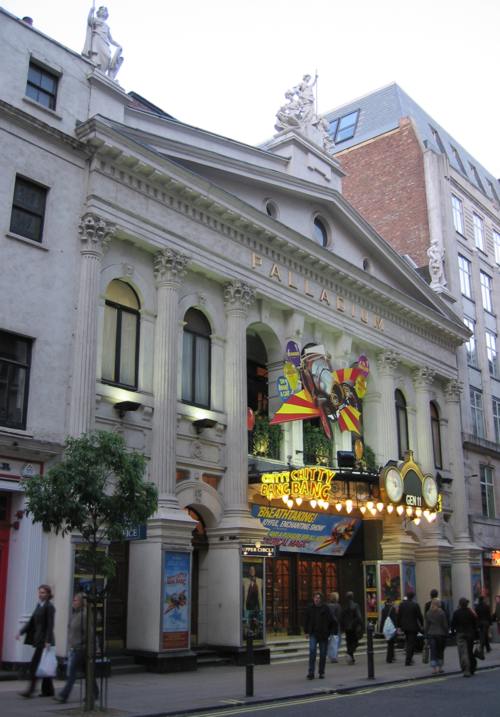
Photo: The original uploader was MykReeve at English Wikipedia. · CC BY-SA 3.0 · Wikimedia Commons
London Palladium is the West End theatre in London. It is in Westminster, United Kingdom. Opened in 1910 to designs by Frank Matcham. The free Lokali audio guide runs 6 minutes.
✓ Published October 2026 · how we write these guides
Visitor facts
| Lokali audio guide | 6 min · free |
|---|---|
| Type | Theatre |
| Location | Westminster, United Kingdom |
| Coordinates | 51.5146, -0.1405 |
| Official website | lwtheatres.co.uk |
| Languages | 50+, in the Lokali app |
The story
Stand on Argyll Street for a moment. Behind you, the crowds of Oxford Street push past with shopping bags and phones. In front of you, the street narrows and quietens. Then a tall white facade rises up, lined with columns. Its name is spelled out in lights above the doors. The noise of the city seems to fall back here, as if the street itself is waiting for the curtain to rise.
This is the London Palladium. For more than a century, the people of this country have treated it as the home of variety entertainment. Variety means a show of many different acts in one evening: comedians, singers, dancers, magicians and jugglers, one after another. Other theatres in the West End are known for long-running musicals. The Palladium is known for the people who walked onto its stage.
The theatre opened in 1910. Its designer was Frank Matcham, the busiest theatre architect of his era. He gave Britain dozens of music halls and playhouses, and many of them still stand. Matcham was a master of sightlines. He knew how to place thousands of seats so that each one felt close to the stage. The Palladium was among the largest theatres he ever built, with room for well over two thousand people.
Here is the first surprise. The grand front you are looking at is older than the theatre behind it. This site has a long history. A great townhouse once stood here, the London home of the Dukes of Argyll — which is why the street carries their name. Later the site became a shopping bazaar, and then a circus building, where horses and acrobats performed. Matcham kept the old classical frontage and built his new auditorium behind it.
So when you look at the columns and the pediment, the triangular gable above them, you are seeing the outer shell of an earlier age. Behind that shell sits a theatre designed for electric light, large audiences and quick changes of scene. Take a moment to look up at the roofline. The facade is much more formal than most theatre fronts in the West End. It looks closer to a bank or a gallery than to a playhouse.
In its first decades, the Palladium became the flagship of British variety. In the 1930s, a troupe of comedians called the Crazy Gang made the theatre their own. Their shows were loud and chaotic. Performers ran into the audience, and the jokes were often aimed at the people in the seats. Londoners came back again and again. The theatre's reputation for fun, rather than for serious drama, dates largely from these years.
After the Second World War, the Palladium began to bring over the biggest names from America. The comedian Danny Kaye played here in 1948, and audiences reportedly queued in huge numbers for tickets. Over the following years, many of the most famous entertainers of the twentieth century appeared on this stage. For an American star, a season at the Palladium became a sign that you had truly arrived in Britain.
Then television arrived — and the theatre entered every living room in the country. From 1955, a programme called Sunday Night at the London Palladium was broadcast live from this auditorium. Families across Britain gathered around their sets to watch it. The show made household names of its hosts and its guests. For many people who never travelled to London, this was what the West End looked like.
One feature of that show is still remembered. At the end of each broadcast, the performers stood on a revolving section of the stage. It turned slowly, and the cast waved goodbye to the cameras as they passed. The image became so familiar that it passed into British popular culture. It is a small piece of stage machinery, but for a generation it meant the weekend was over.
Here is the second surprise. In October 1963, the Beatles appeared on that Sunday night programme. The scenes outside the theatre were wild. Crowds of young fans filled the streets around Argyll Street. The next day, newspapers wrote about the frenzy, and the word Beatlemania soon entered common use. Many people link the start of that word to the night the band played here. So the narrow street under your feet was part of a turning point in music history.
The Palladium also hosts one of Britain's longest royal traditions, the Royal Variety Performance. It is a charity gala, attended by members of the royal family, with a line-up of popular acts. The event has moved between several theatres over the years, but the Palladium has staged it more often than any other. In 1964, Judy Garland performed here in concert with her young daughter, Liza Minnelli. Recordings of that night are still treasured by fans.
Today the theatre belongs to the group run by the composer Andrew Lloyd Webber. It stages big musicals, concerts and one-night events. In recent years it has also brought back a great British winter tradition, the pantomime. Pantomime is a family Christmas show built on fairy tales, with songs, slapstick comedy, and audiences shouting back at the actors. It fits the old spirit of this place well. Variety never truly left the Palladium.
If you have a ticket, notice the inside as you take your seat. Matcham's auditorium is rich with gilding, red upholstery and curved balconies. Even from the upper levels, the stage feels within reach. That was his talent. If you do not have a ticket, stay out here a little longer. Watch the doors, the posters, the people stopping to take a photograph. Then turn back toward Oxford Street. As the traffic noise returns, remember that every comedian, singer and band who stood behind those columns walked out into this same small street.
Key facts
What to look for
Practical tips
Common questions
Is there a free audio guide to London Palladium?
Yes — the Lokali app narrates London Palladium free of charge in 50+ languages. The guide runs about 6 minutes, covers the history, what to look for on site and practical tips, and works offline once downloaded.
Where is London Palladium?
London Palladium is in Westminster, United Kingdom, at 51.5146, -0.1405. Tap the map link on this page for directions from where you are.
What is London Palladium known for?
Opened in 1910 to designs by Frank Matcham. Site was once the London home of the Dukes of Argyll.
What should you look for at London Palladium?
Tall classical columns across the white main facade. Triangular pediment above the central entrance. Theatre name spelled out in lights over the doors.
What should you know before visiting London Palladium?
Use Oxford Circus Underground station, a short walk away. Cross to the far side of Argyll Street for photos.
When is the best time to visit London Palladium?
Book ahead for the Christmas pantomime season.
On the map
Opens directions to London Palladium from your location.
More to see in Westminster


Hear London Palladium in your language
The full story, narrated, in 50+ languages. Download it before you go and it plays offline, at your own pace, with no ticket and no tour group.