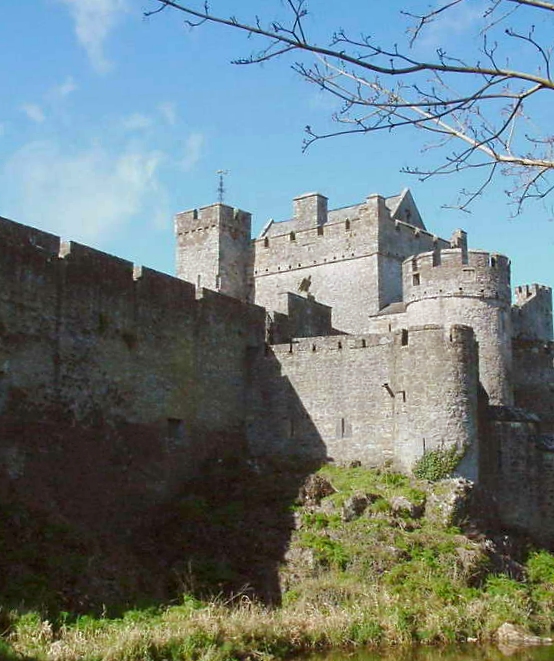
Photo: Chmouel Boudjnah Original uploader was Chmouel at fr.wikipedia · CC BY-SA 3.0 · Wikimedia Commons
Cahir Castle is a castle in Ireland. Built on a rocky island in the River Suir. The free Lokali audio guide runs 7 minutes.
✓ Published October 2026 · how we write these guides
Visitor facts
| Lokali audio guide | 7 min · free |
|---|---|
| Type | Castle |
| Location | Clonmel, Ireland |
| Coordinates | 52.3745, -7.9272 |
| Official website | heritageireland.ie |
| Languages | 50+, in the Lokali app |
The story
Listen first to the water. The River Suir runs fast and shallow around the rock beneath these walls, and on most days you can hear it before you notice the castle at all. The stone underfoot is grey limestone, worn smooth by centuries of boots. Above you, the towers rise straight out of the riverbed. It is easy to see the idea at once: whoever held this rock could control the crossing, and whoever controlled the crossing could control the valley.
You are standing in the town of Cahir, a short drive west of Clonmel in County Tipperary. The name Cahir comes from the Irish word for a stone fort, and the town grew up around this one. The castle sits on a small rocky island in the Suir, joined to the land by the ground you just crossed. That island is the whole reason the castle is here. Water on the sides, solid rock below — there was no easier place to defend a river crossing in this part of Ireland.
The history of the site goes back a long way. A fortification is said to have stood here from the twelfth century, and tradition links the earliest castle to the O'Brien family, the powerful rulers of Thomond in the west. Very little of that early building survives in a form you can easily point to. What you see today is mostly later work, rebuilt and extended over several centuries. The castle grew outward from its core, layer by layer, like the rings of a tree.
In the late fourteenth century the castle came into the hands of the Butler family. The Butlers were one of the great Anglo-Norman families of Ireland, descendants of knights who arrived in the wake of the Norman invasion. A branch of the family later took the title Barons of Cahir. For most of the next five centuries, this castle and the Butler name were bound together. Much of the stone around you — the keep, the walls, the towers — was shaped under their ownership.
Now look at the layout. The castle is built in a series of enclosed courtyards, called wards, each one inside the next. An attacker who broke through the outer wall would find himself in an open yard, exposed to archers on every side. Then he would face another wall, and another gate. At the centre stands the keep, the tall square tower that was the last refuge. This nested design was a common idea in medieval castles, but here it is unusually easy to read.
Here is something many visitors walk straight past. Look up as you pass through the gateway into the inner part of the castle. Cahir still has a portcullis — the heavy iron-shod gate that drops from above to seal an entrance. Many Irish castles lost theirs long ago. This one is often described as one of the best surviving examples in the country, and the lifting machinery sits in the chamber above the gate. Stand under it for a moment and picture it falling.
The castle's most dramatic moment came in 1599. That year, Robert Devereux, the Earl of Essex, marched into Ireland with a large English army for Queen Elizabeth the First. Cahir was held against him. Essex brought heavy guns and bombarded the walls for several days. The castle had a reputation for being impregnable, but cannon changed the rules of warfare. After the bombardment, the defenders slipped away and the castle fell. For Essex, it was one of the few clear victories of a campaign that ended badly for him.
And now a detail worth hunting for. Embedded in the masonry of one of the towers there is a cannonball, still lodged in the stone. It is commonly said to date from that siege of 1599, though it is hard to prove which shot left it there. Either way, it is a small, round, very physical reminder that these walls were built to be attacked. Ask a guide on site to point it out if you cannot find it.
The seventeenth century brought more war. During the conflicts of the 1640s and 1650s, the castle changed hands again. When Oliver Cromwell's army came through Tipperary, Cahir surrendered without a long fight. By then, the lesson of 1599 was clear: stone walls could not stand for long against artillery. Because the castle gave in rather than resisting to the end, it avoided the heavy destruction that ruined many other Irish strongholds. That surrender is one reason so much survives today.
In the nineteenth century, the Butlers of Cahir restored parts of the castle. The great hall, the large room where the household gathered and ate, was rebuilt during this period. So as you walk through, keep in mind that you are seeing a mix — medieval stone alongside Victorian repair. Look at the edges of the windows and the colour of the mortar. Newer stonework is often sharper and cleaner, while the older walls are rougher and darker. The castle is a record of many hands.
In the twentieth century, the castle passed into the care of the Irish state. Today it is looked after by the Office of Public Works, the government body that manages many of Ireland's heritage sites. Because it is so complete, Cahir has also caught the eye of filmmakers. Scenes for the film Excalibur were shot here, and the castle has appeared in several other historical productions over the years. When you see it from the riverbank, you can understand why a director would want this outline on screen.
If you have time, walk along the river path that leads south from the castle. It follows the Suir through quiet parkland. Further along, you will find the Swiss Cottage, a thatched ornamental cottage built for the Butler family in the early nineteenth century. Its design is usually credited to the architect John Nash, who also worked for the British royal family. The walk is flat and gentle, and it gives you some of the best views back toward the castle walls.
Before you go, find a spot near the water and look back at the castle one more time. Notice how the walls seem to grow straight out of the rock, with no clear line where nature stops and building begins. Listen again to the river. It was running here long before the first stone was laid, and it shaped every decision the builders made. As you walk back into the town square, the sound of the water will follow you for a while... and then fade behind the houses.
Key facts
What to look for
Practical tips
Common questions
Is there a free audio guide to Cahir Castle?
Yes — the Lokali app narrates Cahir Castle free of charge in 50+ languages. The guide runs about 7 minutes, covers the history, what to look for on site and practical tips, and works offline once downloaded.
Where is Cahir Castle?
Cahir Castle is near Clonmel, Ireland, at 52.3745, -7.9272. Tap the map link on this page for directions from where you are.
What is Cahir Castle known for?
Built on a rocky island in the River Suir. Held by the Butler family for centuries.
What should you look for at Cahir Castle?
The surviving portcullis above the inner gateway. A cannonball still lodged in a tower wall. Nested courtyards leading inward to the central keep.
What should you know before visiting Cahir Castle?
Allow time for the riverside walk to the Swiss Cottage. Ask staff to point out the embedded cannonball.
On the map
Opens directions to Cahir Castle from your location.
More to see near Cahir Castle


Hear Cahir Castle in your language
The full story, narrated, in 50+ languages. Download it before you go and it plays offline, at your own pace, with no ticket and no tour group.