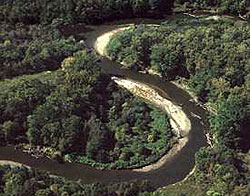
Cuyahoga Valley National Park
41.2417° N · 81.5497° W · National Park
Photo: Wikimedia Commons contributor · Public domain · Wikimedia Commons
Cuyahoga Valley National Park is a national park in Ohio, United States. Became a national recreation area in 1974. The free Lokali audio guide runs 8 minutes.
✓ Published October 2026 · how we write these guides
Visitor facts
| Lokali audio guide | 8 min · free |
|---|---|
| Type | National Park |
| Location | Cuyahoga County, United States |
| Coordinates | 41.2417, -81.5497 |
| Official website | nps.gov |
| Languages | 50+, in the Lokali app |
The story
Listen for a moment. Somewhere below the trees, water moves slowly over stone. A woodpecker knocks on a dead trunk. Then, from far down the valley, a train whistle carries through the morning air. The ground under your boots is soft with fallen leaves and damp earth. You are standing between two cities, yet the green closes in around you on every side. This is Cuyahoga Valley National Park, and that mix of wild quiet and human sound is what this place is about.
The park follows the Cuyahoga River as it winds between Cleveland to the north and Akron to the south. It covers land in both Cuyahoga County and Summit County in northeast Ohio. The name Cuyahoga is often said to mean crooked river, from an Indigenous language of the region. Look at a map and you will see why. The river runs south, then turns sharply, then heads north toward Lake Erie in a long, bending U.
Here is the first surprise. Most national parks protect places that people never settled. This one is different. The valley holds farms, small villages, old roads, and a working railway. People have lived and worked here for a very long time. The protection came in stages. In 1974, Congress created a national recreation area here. In 2000, that area became a full national park. So the park is young as a title, but the landscape inside it is full of old stories.
The second surprise is the river itself. For much of the twentieth century, the lower Cuyahoga, closer to Cleveland's industry, was badly polluted. Oil and debris on the water caught fire more than once. A fire in 1969 drew national attention. Many people point to that moment as one push behind new American environmental laws in the early 1970s. Today the river is far cleaner, and fish and birds have returned. Standing beside it now, it is hard to imagine flames on its surface.
Long before the parkland, there was the canal. In the 1820s and early 1830s, workers dug the Ohio and Erie Canal through this valley. It linked Lake Erie with the Ohio River far to the south. Boats pulled by mules carried grain, coal, and passengers. Small towns grew up along the route to serve the traffic. Railroads later took the business away, and floods damaged what was left. But traces of the canal still lie in the woods, if you know where to look.
The easiest way to meet that history is on the Towpath Trail. This flat, wide path follows the old route where mules once walked beside the water, towing the boats. Today walkers, runners, and cyclists use it. You may pass the remains of stone locks, the chambers that raised and lowered boats between water levels. Some lock walls are still sturdy. Others are slowly breaking under roots and moss. At the Canal Exploration Center, exhibits explain how the system worked.
Now to one of the quiet wonders of the park... the Beaver Marsh. This wetland did not always look this way. For years, part of the land here was used as a junkyard for old cars. Local volunteers cleaned it up. Then beavers moved in and built dams. Water spread across the ground, and a marsh formed. Today a boardwalk crosses it. In the early morning or at dusk, you may see herons, turtles, and, with luck, a beaver cutting a line across the water.
If you want height and texture, go to the Ledges. Here, tall walls of rough, pale rock rise among the trees. The stone is a sandstone full of small, rounded pebbles. It feels like coarse sandpaper under your fingers. Over a very long time, water and frost cut cracks and narrow passages into it. Moss grows in the shade, and the air between the walls stays cool even on warm days. Some people come here at sunset, when the view opens to the west.
Water shapes much of this valley, and the clearest example is Brandywine Falls. Here a stream drops over a ledge of layered rock and spreads into a white veil. A boardwalk and stairs lead to viewing points. Notice how the rock is stacked in thin bands of different hardness. The softer layers wear away faster, and the harder ones form the lip of the fall. After heavy rain, the sound fills the gorge. In a dry summer, the falls can thin to a gentle trickle.
The human side of the valley appears again in its villages. Peninsula, near the middle of the park, has old houses, a few shops, and a quiet main street. Nearby, the Boston area holds a visitor center, a good first stop for maps and advice from rangers. Across the park you will also find old farmhouses, barns, and a restored covered bridge. Some farmland is still worked today, so fields of crops can sit right beside protected forest.
Remember that train whistle from the start? It belongs to the Cuyahoga Valley Scenic Railroad, which runs through the park along the river. The train lets people see the valley from a different angle, sitting by large windows as forest and marsh roll past. Some visitors combine it with the Towpath Trail, cycling one way and riding the train back. Check the current schedule before you plan this, because service changes by season and booking may be needed.
The seasons change this place dramatically. In spring, wildflowers cover the forest floor before the leaves fill in overhead. Summer brings deep green shade and the steady buzz of insects. Autumn is a favourite for many visitors, when maples and oaks turn red, orange, and gold. In winter, snow quiets the valley, and frozen waterfalls can form thick columns of ice. Each season gives you a different park, so even a familiar trail can feel new on a second visit.
What makes this park unusual is not one single view. It is the way wild land and human history sit side by side. A canal lock sits beside a beaver dam. A farm field lies next to deep forest. A river that once burned now carries herons. Millions of people live within a short drive, yet here you can find silence. That closeness is part of the point. Nature here did not survive by being far away. It survived because people chose to protect it.
So take a moment before you move on. Look at the trees around you, at the light coming through the leaves. Listen for the river, or the wind, or that distant train. Notice the smell of the soil and the feel of the path under your feet. As you walk away, watch for the small things... a stone from an old lock, a beaver-chewed stump, a bird lifting off the water. This valley holds all of its stories at once, and you are now part of them.
Key facts
What to look for
Practical tips
Common questions
Is there a free audio guide to Cuyahoga Valley National Park?
Yes — the Lokali app narrates Cuyahoga Valley National Park free of charge in 50+ languages. The guide runs about 8 minutes, covers the history, what to look for on site and practical tips, and works offline once downloaded.
Where is Cuyahoga Valley National Park?
Cuyahoga Valley National Park is near Cuyahoga County, United States, at 41.2417, -81.5497. Tap the map link on this page for directions from where you are.
What is Cuyahoga Valley National Park known for?
Became a national recreation area in 1974. Redesignated a full national park in 2000.
What should you look for at Cuyahoga Valley National Park?
Crumbling stone walls of old canal locks. Beaver-chewed stumps along the marsh boardwalk. Pebbles embedded in the sandstone walls at the Ledges.
What should you know before visiting Cuyahoga Valley National Park?
Start at the Boston Mill Visitor Center for maps. Visit Beaver Marsh at dawn or dusk for wildlife.
When is the best time to visit Cuyahoga Valley National Park?
Visit Beaver Marsh at dawn or dusk for wildlife.
On the map
Opens directions to Cuyahoga Valley National Park from your location.
More to see near Cuyahoga Valley National Park


Hear Cuyahoga Valley National Park in your language
The full story, narrated, in 50+ languages. Download it before you go and it plays offline, at your own pace, with no ticket and no tour group.