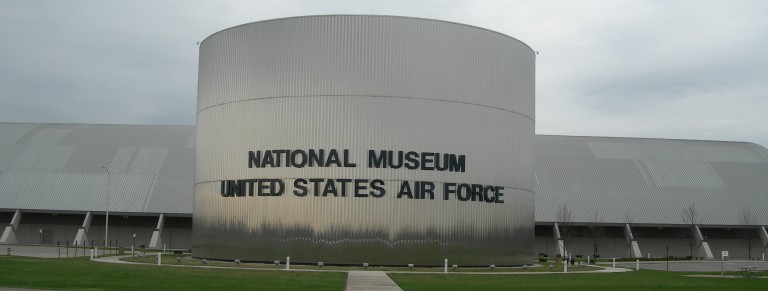
National Museum of the United States Air Force
39.7814° N · 84.1106° W · Museum
Photo: No machine-readable author provided. Rogerd assumed (based on copyright claims). · CC BY-SA 3.0 · Wikimedia Commons
National Museum of the United States Air Force is an aerospace museum at Wright-Patterson Air Force Base in Ohio, United States. Widely called the oldest and largest military aviation museum. The free Lokali audio guide runs 7 minutes.
✓ Published October 2026 · how we write these guides
Visitor facts
| Lokali audio guide | 7 min · free |
|---|---|
| Type | Museum |
| Location | Dayton, United States |
| Coordinates | 39.7814, -84.1106 |
| Official website | nationalmuseum.af.mil |
| Languages | 50+, in the Lokali app |
The story
Listen for a moment. Inside these vast hangar halls, sound behaves strangely. Footsteps on the polished concrete seem to drift upward and vanish into the steel roof high above. Voices soften. Children go quiet without being told. The air is cool and still. All around you, aircraft hang overhead or rest on the floor, their wingtips nearly touching. Some are the size of a family car. Others could shade a small house. Welcome to the National Museum of the United States Air Force.
This museum sits on Wright-Patterson Air Force Base, just outside Dayton, Ohio. It is widely described as the oldest and largest military aviation museum in the world. More than 350 aircraft and missiles are on display across its galleries. That number is hard to grasp until you start walking. Many visitors plan a quick look and are still here hours later. So take your time. Nobody sees all of it in one visit, and that is perfectly fine.
The location is not an accident. Dayton is the hometown of Wilbur and Orville Wright. The two brothers ran a bicycle shop in this city before they built the first successful powered aeroplane. After their famous flights in North Carolina in 1903, they came home and kept working. They refined their machines on a cow pasture called Huffman Prairie. That field is still preserved today, on this same air base, only a short drive from where you are standing.
The museum itself began in 1923, at a place called McCook Field in Dayton. In those early years it was a small engineering collection, kept for study rather than display. It grew slowly over the decades. In 1971 it moved to this site, and the first great hangar opened to the public. Since then, building after building has been added. The newest, the fourth building, opened in 2016. Together they form a long chain of halls that follows flight from canvas wings to spacecraft.
Start where the story starts, in the Early Years gallery. Here the aircraft look fragile, almost like furniture. You will see wood, wire, and fabric stretched tight over thin frames. There is a reproduction of the Wright Military Flyer from 1909, the type the brothers sold to the United States Army. Look closely at how little protects the pilot. There is no cockpit, no windshield, only a seat in the open air. Then imagine flying it over open country.
Walk on, and the machines grow heavier and darker. The Second World War gallery holds some of the most famous aircraft in American history. One of them is the Memphis Belle, a B-17 bomber. Its crew was among the first to complete twenty-five combat missions over Europe, in 1943. The plane became a symbol back home. After years of careful restoration, it went on display here in 2018. Its painted nose art still catches every passing eye.
Not far away stands a silver bomber with a much heavier story. This is Bockscar, a B-29 Superfortress. On the ninth of August, 1945, it dropped an atomic bomb on the Japanese city of Nagasaki. Days later, the war in the Pacific ended. The museum presents this aircraft plainly, without celebration. Many visitors stop here longer than anywhere else. It is a place to think about what technology makes possible, for better and for worse.
Here is something many people walk past. Somewhere in these galleries you may find a display connected to the Doolittle Raiders. In 1942, these airmen flew bombers off an aircraft carrier to strike Japan, a mission few expected them to survive. For decades the surviving Raiders gathered each year and toasted fallen comrades with a set of silver goblets. Each goblet carried one man's name. The museum became the home of that collection, a small and very personal memorial.
As you continue, the shapes change again. Propellers give way to jet engines, and wings sweep backward. The Korean War and Southeast Asia galleries follow the arrival of the jet age. Then comes the Cold War, with its long nervous decades of watching and waiting. Here the aircraft were built for speed and height. The black SR-71 Blackbird is one of them. It was designed for reconnaissance, which means spying from the sky, and it flew faster than any defence could follow.
Now for the second surprise. In the fourth building, look for a long white aircraft with a sharp nose and drooping wingtips. This is the XB-70 Valkyrie, an experimental bomber designed in the 1950s to fly at three times the speed of sound. Only two were ever built. One was lost in a mid-air collision in 1966. The one in front of you is the only survivor. It looks less like a plane than a creature from science fiction.
That same building holds the presidential aircraft. You can walk through several of them. The most famous is the plane known by its tail number, 26000. It carried President John F. Kennedy to Dallas in November 1963. Hours later, it carried his body home to Washington. Lyndon Johnson was sworn in as president on board, before the plane left the ground. Walking down its narrow aisle is a quiet and strange experience.
The fourth building also follows the story into space. Rockets and capsules stand beside the aircraft that tested their ideas first. There is a large space shuttle trainer, once used to prepare astronauts for their missions. Nearby, research aircraft show how engineers learned, step by step, what the human body and the machine could survive. It is a reminder that flight did not stop at the edge of the sky. The Wright brothers' pasture led, in time, to orbit.
Before you leave, consider stepping outside into the Memorial Park. Trees, stones, and plaques honour units and individuals who served. It is calmer out there, with birdsong instead of echoes. Then look back at the long, plain hangars behind you. From outside, they give almost nothing away. Somewhere inside them, a canvas flyer and a Mach three bomber rest under the same roof. As you walk back to your car, listen... you may hear a real aircraft crossing the sky above the base.
Key facts
What to look for
Practical tips
Common questions
Is there a free audio guide to National Museum of the United States Air Force?
Yes — the Lokali app narrates National Museum of the United States Air Force free of charge in 50+ languages. The guide runs about 7 minutes, covers the history, what to look for on site and practical tips, and works offline once downloaded.
Where is National Museum of the United States Air Force?
National Museum of the United States Air Force is near Dayton, United States, at 39.7814, -84.1106. Tap the map link on this page for directions from where you are.
What is National Museum of the United States Air Force known for?
Widely called the oldest and largest military aviation museum. Founded in 1923 at McCook Field in Dayton.
What should you look for at National Museum of the United States Air Force?
Painted nose art on the Memphis Belle B-17 bomber. Silver Doolittle Raiders goblets, each engraved with a name. Drooping wingtips on the white XB-70 Valkyrie.
What should you know before visiting National Museum of the United States Air Force?
Plan at least half a day; the galleries are enormous. Wear comfortable shoes for long walks on concrete floors.
When is the best time to visit National Museum of the United States Air Force?
Visit the fourth building early before it gets crowded.
On the map
Opens directions to National Museum of the United States Air Force from your location.
Hear National Museum of the United States Air Force in your language
The full story, narrated, in 50+ languages. Download it before you go and it plays offline, at your own pace, with no ticket and no tour group.