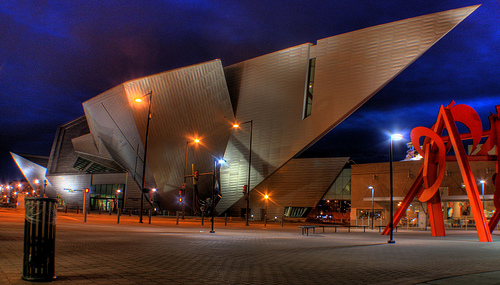
Denver Art Museum
39.7372° N · 104.9894° W · Museum
Photo: Archipreneur · CC BY-SA 3.0 · Wikimedia Commons
Denver Art Museum is a museum in Denver, Colorado, United States. The museum began in 1893 as the Denver Artists' Club. The free Lokali audio guide runs 7 minutes.
✓ Published October 2026 · how we write these guides
Visitor facts
| Lokali audio guide | 7 min · free |
|---|---|
| Type | Museum |
| Location | Denver, United States |
| Coordinates | 39.7372, -104.9894 |
| Official website | denverartmuseum.org |
| Languages | 50+, in the Lokali app |
The story
Stand still for a moment and listen. Traffic hums along the avenue. Footsteps echo across a wide stone plaza. Above you, sharp edges of silver metal catch the thin, bright light of a city that sits about a mile above sea level. The air here is dry, and the sun feels closer than it does in most places. Across the street, a grey tower rises like a castle wall. It glitters in a way that stone never could. Welcome to the Denver Art Museum.
This is not one building. It is a small campus of very different structures, and that is the first thing worth knowing. One building looks like a fortress. Another looks like a mountain range broken into pieces. A third is a curving shell of glass that joins them together. Each one comes from a different decade and a different idea of what a museum should be. Walking between them is part of the visit, so take it slowly.
The museum's story begins in 1893, with a modest group called the Denver Artists' Club. Denver was still a young frontier city then. It had grown quickly on mining money, railways, and ambition. A handful of local artists wanted a place to show and discuss their work. Over the following decades, that small club grew into a public institution. It moved between temporary homes for years, and it slowly built a collection far larger than its founders could have imagined.
Now look at the grey tower. This is the Martin Building, originally called the North Building, and it opened in 1971. Its designer was Gio Ponti, the Italian architect and designer from Milan. Here is a surprise for many visitors... this is the only completed building Ponti ever designed in the United States. He worked on it with a Denver firm, and the result looks like nothing else in the city. It has two linked towers and many folded sides, like a medieval keep.
Step closer and study the surface. The walls are covered in more than a million small grey glass tiles. On a cloudy day, they look soft and silvery. In full sun, they sparkle. Ponti wanted the building to change with the light and the weather. Notice the windows too. They are narrow, oddly shaped slits, placed in an irregular rhythm. They look almost like openings in a castle wall. Ponti designed them to frame small views of the city.
Now turn toward the sharp, silver structure. This is the Hamilton Building, designed by the architect Daniel Libeskind. It opened in 2006. Its walls are clad in titanium, and they lean out at sharp angles. Almost nothing inside or outside is a right angle. Libeskind drew inspiration from the jagged peaks of the Rocky Mountains to the west. He also looked at the geometry of rock crystals. Some people love its drama. Others find it disorienting. Both reactions are part of its story.
Inside the Hamilton Building, the walls tilt and the ceilings slope. Galleries open in unexpected directions. Hanging art on walls that lean is a real challenge, and curators have had to solve it again and again. Look up as you climb the central staircase. Light falls from above in narrow shafts. The stairs twist between floors, and the space feels more like a canyon than a corridor. Many visitors find that they slow down here without meaning to.
A bridge connects the two worlds. It crosses the street between the Hamilton Building and the older side of the campus. Walk across it and pay attention to the change. You move from sharp titanium angles toward Ponti's grey glass tower. Between them stands the newest piece, the Sie Welcome Center. It opened in 2021, when the Ponti building reopened after a major renovation. Its curved glass walls form a rounded shape that feels calm beside its two dramatic neighbours.
Now for something many visitors miss. The Denver Art Museum was one of the first major museums in the country to collect Native American objects as art. This happened in the 1920s, at a time when most institutions treated such objects as anthropology or curiosity. The museum chose to show them for their beauty, skill, and meaning. Today the collection of Indigenous arts of North America is one of the museum's great strengths. It includes historic works and contemporary pieces by living artists.
The collections reach far beyond the region, though. You will find art from Asia, Africa, Oceania, Europe, and Latin America. There are textiles, design objects, photography, and modern and contemporary works. The museum is also known for its art of the American West. That collection makes sense here. Denver sits where the Great Plains meet the mountains, and painters have tried to capture this landscape for generations. Look for scenes of open space, big skies, and rugged peaks.
Outside, on the plaza, look for something playful. A giant broom and dustpan seem to sweep the ground. The sculpture is called Big Sweep, by Claes Oldenburg and Coosje van Bruggen. This artistic couple was known for turning everyday objects into huge public sculptures. Here, a common household tool becomes a monument. Children often run straight to it. Adults usually smile. It is a reminder that art in this place does not always need to be serious to be meaningful.
The museum also anchors a wider neighbourhood called the Golden Triangle Creative District. Just nearby is the Clyfford Still Museum, devoted to one abstract painter. The central branch of the Denver Public Library stands close by, with its colourful, blocky shapes. History Colorado sits within walking distance as well. To the north lies Civic Center Park and the Colorado State Capitol, with its gold dome. If you have energy after your visit, this whole district rewards an unhurried walk.
Before you move on, find a spot on the plaza where you can see both main buildings at once. On one side, Ponti's grey glass catches the sky. On the other, Libeskind's titanium points toward the mountains. Feel the dry air and the high, clear light on your face. Listen to the city moving around you. These buildings do not agree with each other... and that is the point. Take one last look, then carry their contrast with you as you walk away.
Key facts
What to look for
Practical tips
Common questions
Is there a free audio guide to Denver Art Museum?
Yes — the Lokali app narrates Denver Art Museum free of charge in 50+ languages. The guide runs about 7 minutes, covers the history, what to look for on site and practical tips, and works offline once downloaded.
Where is Denver Art Museum?
Denver Art Museum is in Denver, United States, at 39.7372, -104.9894. Tap the map link on this page for directions from where you are.
What is Denver Art Museum known for?
The museum began in 1893 as the Denver Artists' Club. Gio Ponti's only completed building in the United States.
What should you look for at Denver Art Museum?
Narrow, irregular slit windows in Ponti's grey glass tower. Leaning titanium walls on the angular Hamilton Building. The giant Big Sweep broom and dustpan sculpture.
What should you know before visiting Denver Art Museum?
Plan time for both main buildings, connected by a bridge. Check whether special exhibitions need a separate ticket.
On the map
Opens directions to Denver Art Museum from your location.
Hear Denver Art Museum in your language
The full story, narrated, in 50+ languages. Download it before you go and it plays offline, at your own pace, with no ticket and no tour group.