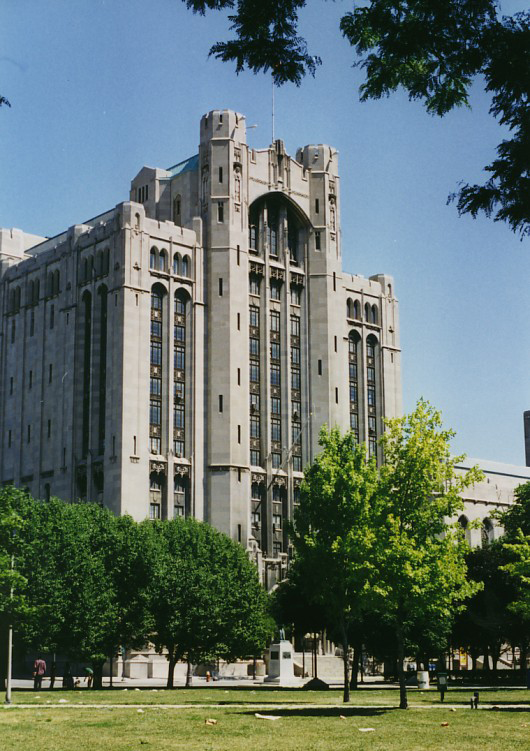
Detroit Masonic Temple
42.3414° N · 83.0602° W · Theatre
Photo: Einar Einarsson Kvaran aka Carptrash at en.wikipedia · CC BY-SA 3.0 · Wikimedia Commons
Detroit Masonic Temple is a masonic building in Detroit, Michigan. Often called the largest Masonic temple in the world. The free Lokali audio guide runs 7 minutes.
✓ Published October 2026 · how we write these guides
Visitor facts
| Lokali audio guide | 7 min · free |
|---|---|
| Type | Theatre |
| Location | Detroit, United States |
| Coordinates | 42.3414, -83.0602 |
| Official website | themasonic.com |
| Languages | 50+, in the Lokali app |
The story
Stand on the pavement and tilt your head back. The pale limestone rises in sheer, ribbed walls, and the narrow Gothic windows seem to go on forever. Across the street, the trees of Cass Park move in the wind, and traffic hums along the avenue. Up close, the stone feels cool and slightly rough under your palm. This is the Detroit Masonic Temple. It is often described as the largest Masonic building anywhere in the world.
That claim is easier to believe from the inside. The temple holds roughly a thousand rooms. There are theatres, ballrooms, lodge halls, dining rooms, offices, and long corridors that turn back on themselves. People who work here say it is easy to get lost, even after years. The building is less like one hall and more like a small vertical city, built in stone for one society and its many branches.
So who were the Freemasons, and why did they need this much space? Freemasonry is a fraternal society. It traces its symbols to the stonemasons of medieval Europe, the builders of cathedrals. Members meet in lodges, move through a series of degrees, and take part in rituals built around the tools of construction: the square, the compass, the level. In the early twentieth century, membership in America was enormous. Detroit, flush with automobile money, wanted a home to match.
And the city was growing at an extraordinary speed. In the first decades of the twentieth century, factories pulled in workers from across the United States and from abroad. New fortunes appeared almost overnight. Fraternal societies gave newcomers a network, a social life, and a sense of belonging. For many Detroit men, the lodge was where business contacts were made and friendships were sealed. A temple on this scale was a statement. It showed confidence that the boom would last.
The architect was George D. Mason, a Detroit designer who shaped much of the city's skyline in that era. Yes, his surname really was Mason, and he was a Freemason as well. He chose a Neo-Gothic style. That means a revival of the pointed arches, vertical lines, and stone tracery of medieval European churches. For a society that honoured cathedral builders, the choice made sense. Work began around 1920, and the building was dedicated in 1926.
Now look closely at the carved details around the entrances and higher up the walls. Much of the decorative sculpture in buildings of this period in Detroit came from Corrado Parducci, an Italian-born carver who worked with many of the city's leading architects. Watch for figures, shields, and symbols set into the stone. The square and compass, the emblem of Freemasonry, appears in more than one place. It is a building that announces its owners at every door.
Here is a story you will almost certainly hear. Legend has it that George Mason went bankrupt building the temple, lost everything, and threw himself from the roof. It is a dramatic tale... and it is not true. Mason lived on for more than two decades after the dedication and died of natural causes in old age. The rumour says more about the building than the man. A place this vast seems to demand a tragedy.
The temple has collected other tales too. Locals talk about hidden staircases, doors that lead nowhere, and passages tucked behind the walls. Some of this is simply the result of a building with many separate organisations inside it, each needing private routes and service corridors. Ghost stories circulate as well, as they do in almost every old theatre. Treat them as folklore. But walk the corridors once, and you will understand why people tell them.
The biggest room is the main theatre. It seats several thousand people, and it is one of the largest theatres in the city. Over the decades it has hosted touring Broadway shows, orchestras, comedians, and rock concerts. Musicians often mention the acoustics and the sheer height of the space. Look up at the ceiling if you get inside. The painted and moulded decoration is easy to miss when the house lights are down.
The theatre also carries a newer name. Around 2013, the temple faced serious financial trouble, including unpaid property taxes. Jack White, the Detroit-born musician known for the band The White Stripes, stepped in and covered the debt. In thanks, the main hall was renamed the Jack White Theatre. It is a very Detroit story. A local artist, raised a few miles away, helped keep a landmark open when the city's fortunes were low.
Those low fortunes are part of the picture too. As Detroit's population fell in the second half of the twentieth century, fraternal membership also shrank. Many grand lodge buildings across America were sold, emptied, or demolished. This one survived. Masonic groups still meet here, while the theatres and ballrooms are rented for concerts, weddings, film shoots, and conventions. The mix keeps the lights on and the corridors in use.
If you join a guided tour, you will see spaces that concert-goers never reach. Lodge rooms are decorated in different historical styles, from ancient Egyptian themes to medieval and classical designs. Each one was meant to set a mood for ritual. Notice the furniture placement, the raised chairs, and the symbols painted on ceilings and walls. Ask your guide which rooms are still used for meetings. The answer may surprise you.
Step back outside and look at the neighbourhood around you. This is the Cass Corridor, now often called Midtown. Its streets have known wealth, decline, artists, students, and new restaurants, sometimes all within one generation. The temple has stood through all of it. Cass Park, across the road, gives you the best place to see the whole building at once. From the grass, the tower and the long wings finally fit into a single view.
Before you leave, stand still for a moment. Listen to the traffic, the birds in the park, the doors of the temple opening and closing. Look at the limestone again. Notice the darker streaks where rain has run down the walls for a century. A society of builders made this place to honour the craft of building. As you walk away, turn around once more. The windows will catch the light differently every time.
Key facts
What to look for
Practical tips
Common questions
Is there a free audio guide to Detroit Masonic Temple?
Yes — the Lokali app narrates Detroit Masonic Temple free of charge in 50+ languages. The guide runs about 7 minutes, covers the history, what to look for on site and practical tips, and works offline once downloaded.
Where is Detroit Masonic Temple?
Detroit Masonic Temple is in Detroit, United States, at 42.3414, -83.0602. Tap the map link on this page for directions from where you are.
What is Detroit Masonic Temple known for?
Often called the largest Masonic temple in the world. Designed by Detroit architect George D. Mason.
What should you look for at Detroit Masonic Temple?
Square and compass emblems carved into the stone. Pointed Gothic arches framing the narrow upper windows. Rain streaks darkening the pale limestone walls.
What should you know before visiting Detroit Masonic Temple?
Book a guided tour to see the private lodge rooms. Cross into Cass Park for a full view of the facade.
When is the best time to visit Detroit Masonic Temple?
Arrive early for concerts to explore the lobby spaces.
On the map
Opens directions to Detroit Masonic Temple from your location.
More to see in Detroit


Hear Detroit Masonic Temple in your language
The full story, narrated, in 50+ languages. Download it before you go and it plays offline, at your own pace, with no ticket and no tour group.