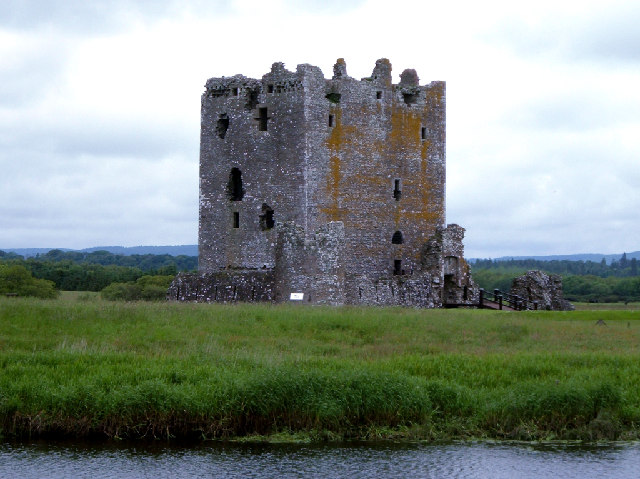
Photo: Alison Stamp · CC BY-SA 2.0 · Wikimedia Commons
Threave Castle is a 14th century tower house near Castle Douglas, Dumfries and Galloway, Scotland, UK. Built by Archibald the Grim in the late fourteenth century. The free Lokali audio guide runs 7 minutes.
✓ Published October 2026 · how we write these guides
Visitor facts
| Lokali audio guide | 7 min · free |
|---|---|
| Type | Castle |
| Location | Dumfries and Galloway, United Kingdom |
| Coordinates | 54.9392, -3.9697 |
| Official website | historicenvironment.scot |
| Languages | 50+, in the Lokali app |
The story
Listen first. The bell has rung, and somewhere across the water an oar dips into the River Dee. The boat is small and low, and the river slides past the hull with a soft, steady sound. Ahead of you, on a flat green island, a tall grey tower rises out of the grass. It has no roof and no glass in its windows. Swans drift along the reeds. This is how every visitor reaches Threave Castle, and it is how the castle was meant to be reached... by water, on someone else's terms.
The island sits in the River Dee, a short walk across farmland from the town of Castle Douglas, in the south-west of Scotland. Getting here takes some effort. You walk, then you wait at the jetty, then a boatman rows or motors you across. That small ritual is a good place to begin, because the river was the castle's first wall. Before any stone was laid, the water already kept strangers out and let friends arrive by boat.
The tower was built in the late fourteenth century by a man with one of the great nicknames of Scottish history: Archibald the Grim. He was Lord of Galloway and later the third Earl of Douglas. Galloway was a hard region to rule, with a strong local identity and a long memory of independence. Archibald needed a seat that showed power at a glance. The tower in front of you was his answer — and he died here, in the year 1400.
Look up at the tower itself. It is a tower house, a common Scottish form, where everything a lord needed was stacked vertically rather than spread out. It rises through several storeys. Near the bottom were storage and a grim pit prison. Above came the kitchen, then the great hall, then private rooms for the lord and his family. At the very top, a wooden gallery once projected from the walls, so defenders could watch the river and drop things on attackers below.
Now look for something small above the main doorway. A single stone sticks out from the wall, like a stubby finger. Local tradition calls it the gallows knob. The story goes that the Douglas lords used it to hang their enemies in full view of anyone arriving by boat. One well-known boast claims the knob was rarely without its "tassel" — meaning a hanged body. Whether it was used that often, nobody can say. But the message to visitors was clear.
The Douglases who held Threave became known as the Black Douglases. Over the fifteenth century they grew so powerful that they rivalled the Stewart kings of Scotland. They held vast lands, raised armies, and made alliances that worried the crown. Their story is full of violence. In 1452, King James the Second killed the eighth Earl of Douglas with his own hands, at Stirling Castle. After that, open war between the king and the family was only a matter of time.
The Douglases prepared Threave for that war. Around the tower they built a strong outer wall with round towers at the corners. Look closely at this wall and you will see narrow slits and openings shaped for guns, not bows. This is one of the earliest artillery defences in Britain. Cannon were the new weapon of the age, and the builders were trying to protect the castle against them and to fire back with them.
In 1455 the king came. James the Second besieged Threave for weeks, with heavy guns brought at great cost. A popular tale says the giant cannon Mons Meg, now kept at Edinburgh Castle, was cast nearby for this siege. Historians doubt this story, because the gun seems to have reached Scotland later. In the end, the garrison surrendered. Many believe bribes and promises did more work than cannonballs. With Threave gone, the power of the Black Douglases was finished.
After that, the castle belonged to the crown, and its keepers changed over the generations. Its last great test came in 1640, during the religious wars of the seventeenth century. The Covenanters — Scottish Presbyterians who opposed the king's church policies — besieged the castle while it was held for King Charles the First. The defenders held out for around three months before they gave up. Afterwards, the Covenanters made the castle useless as a fortress. The roof and floors were stripped out.
Here is a detail many visitors miss. Threave had one more strange chapter. During the Napoleonic Wars, in the early nineteenth century, the empty shell was considered as a place to hold French prisoners of war, and records suggest some were briefly kept here. Picture soldiers from France, far from home, staring out of these same windows at the slow Scottish river. It is an odd footnote for a medieval tower, and a reminder that old buildings keep finding new uses.
Walk around the island and notice the ground. Archaeologists have found that this was never just a tower in a field. There were halls, workshops, stables and a small harbour for boats, all outside the tower walls. Today these survive mostly as low lines in the grass. If you look toward the water's edge, imagine boats unloading food, wine and building stone. The river was the castle's road as well as its moat.
Now turn away from the stone and toward the landscape. The marshes and meadows around Threave are now protected for wildlife. In winter, large flocks of wild geese feed on these fields. In summer, ospreys have nested nearby, and you may see one hunting over the river. As evening comes, bats leave the old walls and nearby trees. The fortress built to keep people out now gives shelter to birds and animals instead.
Before the boat comes back, stand still on the grass for a moment. Feel the wind come off the water. Look up at the empty windows where Archibald the Grim once looked out over his lands. Then look at the small stone above the door, and at the gun slits in the outer wall. As you cross the river again, watch the tower slowly shrink behind you... grey against the sky, quiet now, and still standing in the middle of the Dee.
Key facts
What to look for
Practical tips
Common questions
Is there a free audio guide to Threave Castle?
Yes — the Lokali app narrates Threave Castle free of charge in 50+ languages. The guide runs about 7 minutes, covers the history, what to look for on site and practical tips, and works offline once downloaded.
Where is Threave Castle?
Threave Castle is in Dumfries and Galloway, United Kingdom, at 54.9392, -3.9697. Tap the map link on this page for directions from where you are.
What is Threave Castle known for?
Built by Archibald the Grim in the late fourteenth century. Stronghold of the powerful Black Douglas family.
What should you look for at Threave Castle?
The projecting gallows knob stone above the tower doorway. Gun slits shaped for cannon in the outer wall. Empty window openings on the upper storeys of the tower.
What should you know before visiting Threave Castle?
Ring the bell at the jetty to call the boat. Wear sturdy footwear for the farmland walk and grassy island.
When is the best time to visit Threave Castle?
Bring binoculars for ospreys and winter geese along the Dee.
On the map
Opens directions to Threave Castle from your location.
More to see near Threave Castle


Hear Threave Castle in your language
The full story, narrated, in 50+ languages. Download it before you go and it plays offline, at your own pace, with no ticket and no tour group.