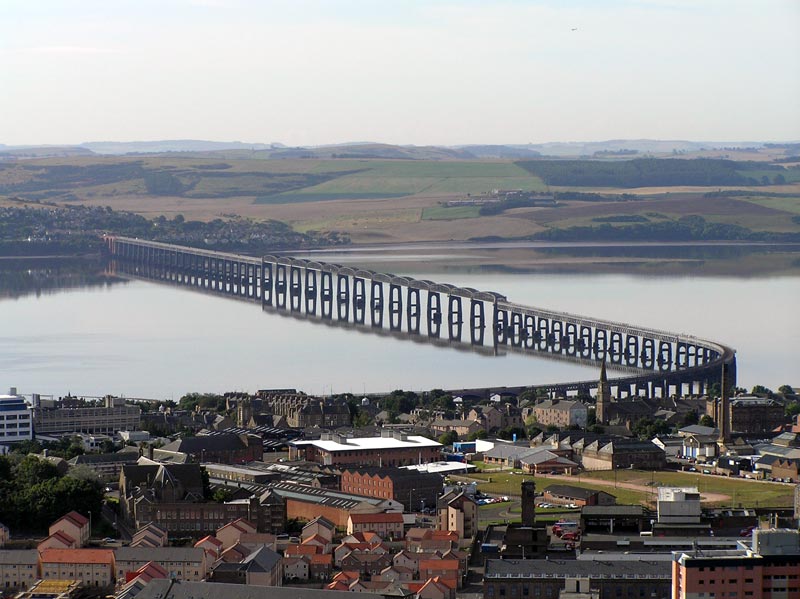
Photo: TheCreator · Public domain · Wikimedia Commons
Tay Bridge is a railway bridge across the River Tay, Scotland. It is near Dundee, United Kingdom. The first Tay Bridge opened in 1878. The free Lokali audio guide runs 7 minutes.
✓ Published October 2026 · how we write these guides
Visitor facts
| Lokali audio guide | 7 min · free |
|---|---|
| Type | Bridge |
| Location | Dundee, United Kingdom |
| Coordinates | 56.4389, -2.9886 |
| Languages | 50+, in the Lokali app |
The story
Stand at the water's edge and listen. The Tay moves fast here. It is wide and grey-brown, and a cold wind comes up the estuary from the North Sea. Then, far out over the water, you hear a low rumble. A train is crossing. It crawls along a line of iron and brick that seems to run on for ever, curving gently as it reaches the Dundee shore.
This is the Tay Bridge, the railway link between Dundee and the village of Wormit on the Fife side. It runs for a little over three kilometres, roughly two miles, and it is one of the longest railway bridges in Britain. From the riverbank it looks calm and steady. But the bridge you are looking at is the second one to stand here. The story of the first one is why people still come and stare.
Look carefully just beside the bridge, on the upstream side. In the water you can see a line of round, broken stumps. They sit low in the river like stepping stones that lead nowhere. Many visitors walk past without noticing them. These are the remains of the piers of the first Tay Bridge. They have stood in the river for well over a century, a quiet record of what happened here.
In the Victorian age, the Tay was a serious problem for travellers. Anyone going north along the east coast of Scotland had to cross two wide estuaries, the Forth and the Tay, often by ferry. Railway companies wanted a faster, unbroken route. The engineer Thomas Bouch offered a bold answer: a long, slender iron bridge across the Tay. It opened in 1878, and for a short time it was a great source of pride. Queen Victoria crossed it, and Bouch was knighted for the achievement.
The pride did not last. On the night of 28 December 1879, a violent storm swept down the estuary. A train was crossing from the south, carrying passengers towards Dundee. As it moved through the high central section of the bridge, the girders gave way. The whole central span fell into the river, and the train fell with it. In the darkness and the storm, no one on board survived.
For many years the number of dead was given as seventy-five. More recent research, working through records name by name, has identified around sixty victims. The exact figure may never be known, because there was no full passenger list. What is certain is the shock it caused. People in Dundee had watched the lights of the train move out over the water, and then the lights were gone.
An official inquiry followed. It found serious faults. The bridge had not been designed with enough allowance for the force of the wind. There were also problems with the quality of the iron castings and with how the bridge had been maintained. Much of the blame fell on Bouch himself. His reputation never recovered, and he died not long afterwards. His plans for a bridge over the Forth were abandoned, and a very different design was chosen instead.
Here is a detail that surprises many people. The locomotive that pulled the doomed train was later lifted out of the river. It was repaired and put back into service, and it ran for many more years. Railway workers gave it a dark nickname: The Diver. It is said that some drivers did not like to take it across the new bridge.
The disaster also entered literature, in two very different ways. In Germany, the writer Theodor Fontane wrote a serious, haunting ballad about the collapse. In Dundee, a local poet named William McGonagall wrote his own poem. It begins: "Beautiful Railway Bridge of the Silv'ry Tay! Alas! I am very sorry to say." McGonagall is often called the worst poet in the English language. Yet his poem is still read aloud today, and it has kept the memory of that night alive.
Now look again at the bridge in front of you. After the disaster, the railway still needed its crossing. A new bridge was designed by the engineer William Henry Barlow, working with his son, and built by the firm of William Arrol. It opened in 1887. This time the engineers were careful. The new bridge is wider and heavier, with paired iron spans on thick piers. It was built to resist exactly the kind of wind that destroyed its predecessor.
There is a quiet link between the two bridges. Some of the girders from the first bridge, the ones that did not fall, were reused in the new one. So when a train crosses today, part of it may roll over iron that was standing on the night of the storm. The old and the new are joined in the same line across the river.
The best places to take in the whole view are along the Dundee waterfront and the grassy slope of Magdalen Green, a park just to the west of the city centre. From there you can see the full curve of the bridge and the old pier stumps beside it. Across the river, Wormit gives a view back towards the city. Near both ends of the bridge there are memorials to the victims, with the names of those who are known to have died that night.
Notice the light while you are here. On a clear day the river turns silver, and the bridge looks thin and delicate against the hills of Fife. In grey weather it becomes a dark line drawn across the water. Further downstream you can see the road bridge, a much later structure that carries cars between Dundee and Fife. Together they show how this wide river has shaped the life of the city.
As you walk away, take one last look at those low stumps in the water. They are easy to miss, and that is part of their power. Above them, a modern train may be moving steadily across the river, its passengers looking at their phones or out at the view. Every day the bridge does its quiet work. And beside it, the old piers stay where they have always been, holding the memory of one stormy winter night.
Key facts
What to look for
Practical tips
Common questions
Is there a free audio guide to Tay Bridge?
Yes — the Lokali app narrates Tay Bridge free of charge in 50+ languages. The guide runs about 7 minutes, covers the history, what to look for on site and practical tips, and works offline once downloaded.
Where is Tay Bridge?
Tay Bridge is near Dundee, United Kingdom, at 56.4389, -2.9886. Tap the map link on this page for directions from where you are.
What is Tay Bridge known for?
The first Tay Bridge opened in 1878. Central spans collapsed in a storm on 28 December 1879.
What should you look for at Tay Bridge?
Broken stumps of the original piers beside the bridge. Paired iron spans resting on heavy piers. The gentle curve as the bridge meets Dundee.
What should you know before visiting Tay Bridge?
Walk to Magdalen Green for the full curve of the bridge. Visit the victims' memorial on the Dundee riverside.
On the map
Opens directions to Tay Bridge from your location.
More to see near Tay Bridge


Hear Tay Bridge in your language
The full story, narrated, in 50+ languages. Download it before you go and it plays offline, at your own pace, with no ticket and no tour group.