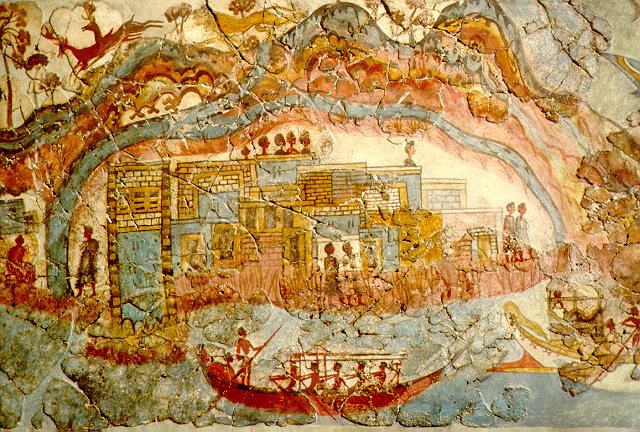
Photo: unknown minoan artist · Public domain · Wikimedia Commons
Akrotiri is a Bronze Age settlement on the volcanic Greek island of Santorini (Thera). Buried by the Thera eruption in the Bronze Age. The free Lokali audio guide runs 6 minutes.
✓ Published October 2026 · how we write these guides
Visitor facts
| Lokali audio guide | 6 min · free |
|---|---|
| Type | Archaeological Site |
| Location | Fira, Greece |
| Coordinates | 36.3514, 25.4036 |
| Languages | 50+, in the Lokali app |
The story
Step under the great roof and the light changes at once. The hard Aegean sun turns soft and grey, filtered through panels high above your head. The air is cooler here. Underfoot, the walkway rings a little with each step, and below it, in the shadows, you can see walls, doorways and staircases. They are made of rough volcanic stone. This is a town that went to sleep under ash more than three and a half thousand years ago.
The name Akrotiri belongs to the modern village nearby, not to the ancient town. Nobody knows what its own people called it. The settlement thrived in the Bronze Age, the era before iron tools, when copper and tin were the metals that mattered. Santorini looked very different then. It was a rounder island, with a volcano at its heart. The people here traded across the sea, and they were closely linked to the Minoan civilisation of Crete, the island to the south.
Then the volcano woke. Archaeologists believe a series of earthquakes came first. You can still see the damage — cracked walls, fallen stairs, rubble pushed aside as if someone had started to clean up. After that, the eruption buried everything under thick layers of pumice and ash. It was one of the largest volcanic eruptions in human history. The cliffs you may have seen at Fira are the broken rim of that ancient volcano.
Here is the first surprise. Almost no human remains have been found at Akrotiri. Very few valuables have been found either — little gold, few precious objects. This is very different from Pompeii, the Roman town in Italy where many people died where they stood. The evidence here suggests the people of Akrotiri had warning. They seem to have packed what they could carry and left. Where they went, and whether they survived, remains a mystery.
Look down at the streets as you walk. They are narrow, paved and winding, and they open into small squares. Some buildings rose two or even three storeys high. Stone staircases still climb toward floors that no longer exist. Beneath the streets ran a drainage system, with clay pipes carrying waste water away from the houses. For a town of this age, that is a remarkable level of planning.
Now find the large clay storage jars, called pithoi. Many still stand in the rooms where they were left. They held oil, grain, wine and other food. Some sit in neat rows, like a storeroom waiting for the next delivery. Others are cracked open, their curved walls lying in pieces. Standing above them, you are looking at a household pantry that nobody came back to empty.
The second surprise involves furniture made of nothing. Wooden beds, tables and stools rotted away inside the ash long ago. But they left hollow spaces in the exact shape of the original objects. Excavators poured plaster into these hollows. When the plaster set, they had perfect casts of furniture from the Bronze Age. It is a clever technique, also used at Pompeii, and it lets us see the shape of everyday life.
The walls of Akrotiri were once covered in paintings. These are frescoes, painted onto wet plaster so the colour soaked into the surface. They show swallows flying over red lilies, two young boys boxing, a fisherman holding his catch, and a long procession of ships sailing between coastal towns. Most of the originals are no longer here. Some are displayed in the Museum of Prehistoric Thera in Fira, and others are in the National Archaeological Museum in Athens.
One large building, known as Xeste 3, held paintings of women and girls gathering crocus flowers. The crocus produces saffron, a precious spice and dye. Scholars think the building may have had a ceremonial purpose, perhaps connected to coming-of-age rituals. That is an interpretation, not a certainty. But the images show how much this island valued colour, nature and the sea.
Serious excavation here began in 1967, led by the Greek archaeologist Spyridon Marinatos. He had long believed that the eruption of Thera, the ancient name for Santorini, played a part in the decline of Minoan Crete. He worked on this site until his death in 1974, which happened during excavation work. He is buried here, within the ancient town he spent his final years uncovering. Look for his grave as you walk the route.
You may hear people link Akrotiri to Atlantis. The Greek philosopher Plato wrote about a powerful island civilisation that sank beneath the sea. Some writers have suggested that the eruption of Thera inspired the story. It is an appealing idea, but it is speculation, not proven history. What is real is impressive enough: a working town, frozen at the moment its people walked away.
The roof above you protects the ruins from sun, rain and wind. It has its own story. In the mid-2000s, part of an earlier roof collapsed, and the site closed for several years. The current structure allowed the excavation to reopen to visitors. Only a part of the ancient town has been uncovered. Archaeologists believe much more still lies under the surrounding fields and hills.
Before you leave, stop for a moment at the edge of the walkway. Listen to the quiet. Look at a single doorway, its stone frame still standing, and imagine someone stepping through it for the last time, with a bundle in their arms. Then walk back out into the bright sunlight. Notice the pale pumice in the soil and the cliffs on the horizon. That ash is the same ash that kept this town hidden — and kept it safe — for thousands of years.
Key facts
What to look for
Practical tips
Common questions
Is there a free audio guide to Akrotiri?
Yes — the Lokali app narrates Akrotiri free of charge in 50+ languages. The guide runs about 6 minutes, covers the history, what to look for on site and practical tips, and works offline once downloaded.
Where is Akrotiri?
Akrotiri is near Fira, Greece, at 36.3514, 25.4036. Tap the map link on this page for directions from where you are.
What is Akrotiri known for?
Buried by the Thera eruption in the Bronze Age. Very few human remains or valuables were ever found.
What should you look for at Akrotiri?
Clay storage jars still standing in their original rooms. Stone staircases climbing toward vanished upper floors. Cracked walls left by earthquakes before the eruption.
What should you know before visiting Akrotiri?
Visit the Museum of Prehistoric Thera to see original frescoes. Arrive early to beat the cruise and tour bus crowds.
When is the best time to visit Akrotiri?
Arrive early to beat the cruise and tour bus crowds.
On the map
Opens directions to Akrotiri from your location.
Hear Akrotiri in your language
The full story, narrated, in 50+ languages. Download it before you go and it plays offline, at your own pace, with no ticket and no tour group.