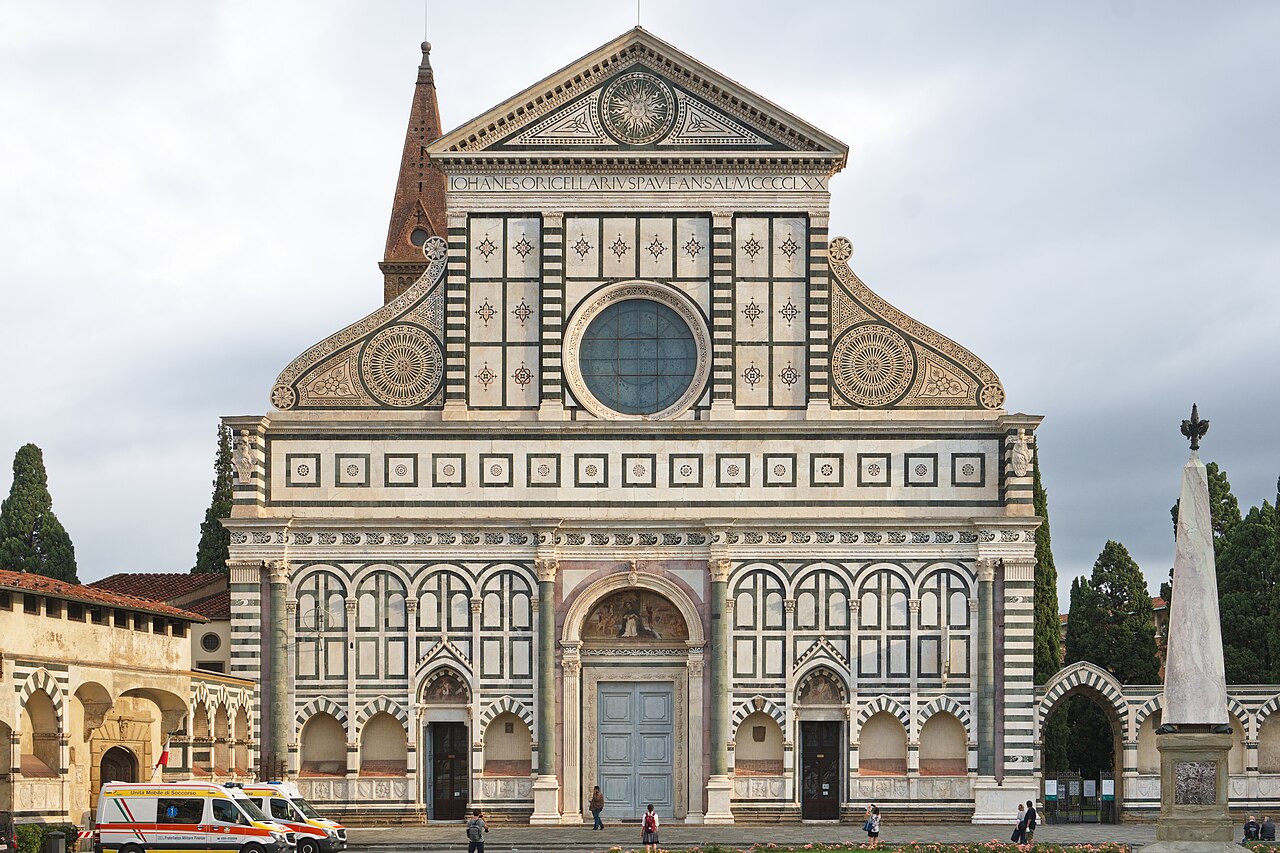
Basilica di Santa Maria Novella
43.7761° N · 11.2457° E · Church
Basilica di Santa Maria Novella is a Dominican church begun in the 13th century, featuring Masaccio's Trinity fresco and one of Florence's finest marble façades. It is in Florence, Italy. Most visitors spend 1–1.5 hours here. The free Lokali audio guide runs 6 minutes.
✓ Verified August 2026 · how we write these guides
Visitor facts
| Time needed | 1–1.5 hours |
|---|---|
| Lokali audio guide | 6 min · free |
| Type | Church |
| Best for | History |
| Location | Florence, Italy |
| Coordinates | 43.7761, 11.2457 |
| Languages | 45, in the Lokali app |
The story
You come out of the train station, pulling your bag behind you. The platforms and crowds are at your back. You turn a corner into a wide open square, and there it is across the space. A church front of green and white marble. The patterns are clean and sharp, circles and squares drawn in stone, almost like a piece of geometry. This is the Basilica of Santa Maria Novella.
Many travelers see this church as their very first sight of Florence, because the main railway station sits directly behind it. The station even borrows the church's name. Yet most people walk straight past, dragging their luggage, their eyes on their phones. They do not realize that this calm marble front is one of the most important works of the early Renaissance.
The church belongs to the Dominican order. The Dominicans were friars who lived by study, teaching, and preaching. They began to build here around 1279, on the western edge of the medieval city. The main body of the church was finished by the middle of the next century. For a long while, though, the front remained bare brick, rough and plain, waiting for someone to complete it.
Then a wealthy merchant stepped forward. His name was Giovanni Rucellai, and he came from one of the richest families in the city. He paid for the marble front to be finished at last. And he did not hire just any builder. He chose one of the greatest minds of the age, the architect and scholar Leon Battista Alberti. Alberti completed his design around 1470.
Alberti faced a hard puzzle. The lower part of the front was already standing, built in the older Gothic style, full of pointed shapes. He could not tear it down. So he had to join it to a new design built on simple, harmonious forms, squares and circles in careful proportion. He used green and white marble to tie the old and the new together. The finished front feels balanced and quiet, even now.
Look along the upper part of the front. On each side you will see a large curved scroll, like a great stone wave. These scrolls were a brand new idea. They gently hide the sloping roof behind them and connect the wide lower level to the narrow upper one. The solution was so clever that architects all across Italy would copy it for the next several centuries.
Now look more closely at the stone, and you will find a sail. A billowing ship's sail, full of wind, carved again and again across the front. This was the personal emblem of the Rucellai family. The merchant who paid for the work made certain that everyone would know it. His name, in fact, is spelled out in large Latin letters running straight across the top of the facade.
Step inside, out of the light. The church stretches long and high before you, lined with tall arches. Hanging in the central space is a large painted cross by Giotto, made around 1290. The body of Christ sags with real weight, and the face shows real pain. At the time, this was a new and daring way to paint, full of human feeling, very unlike the stiff and distant images that came before.
Walk down the left side of the church and stop at a painting set into the wall. It shows a chapel with a rounded, coffered ceiling, and within it the figures of the Holy Trinity, with kneeling donors at the edges. This is the work of Masaccio, painted around 1427. The strange thing is how real it looks. The flat wall seems to open into a deep stone room that is not truly there.
That single painting helped change the course of art. Masaccio used the new rules of perspective, just then being worked out in Florence. Every line of the painted ceiling points toward one single vanishing point, drawing your eye into the depth. Younger artists came here to stand and study it. It is among the first paintings anywhere to use this method so completely and so well.
There is still more to find inside. Behind the high altar, the walls are covered with bright frescoes by Domenico Ghirlandaio, painted in the late fifteenth century. They tell stories from the Bible, but the figures wear the clothes of wealthy Florentines and stand in rooms like those of the city itself. By tradition, a young apprentice named Michelangelo may have helped to paint them.
When you are ready to leave, step back outside and turn for one last look at the front. The marble has stood through more than six centuries of sun, rain, and war. It has watched the city change around it again and again. Behind it, just out of sight, trains arrive and depart every few minutes, carrying thousands of people in and out of Florence. Most of those travelers will hurry past without a glance, the way you almost did. But you stopped. You looked. And the quiet geometry of Alberti's design looked back, as patient and as sure as it has been since the day the last marble panel was set in place.
Key facts
What to look for
Practical tips
Common questions
How long do you need at Basilica di Santa Maria Novella?
Plan 1–1.5 hours. That is the time most visitors spend at Basilica di Santa Maria Novella. The free Lokali audio guide adds about 6 minutes of narration you can listen to as you walk, so it fits inside your visit rather than adding to it.
Is there a free audio guide to Basilica di Santa Maria Novella?
Yes — the Lokali app narrates Basilica di Santa Maria Novella free of charge in 50+ languages. It covers the history, what to look for on site and practical tips, and it works offline once downloaded.
Where is Basilica di Santa Maria Novella?
Basilica di Santa Maria Novella is in Florence, Italy, at 43.7761, 11.2457. Tap the map link on this page for directions from where you are.
What should you know before visiting Basilica di Santa Maria Novella?
Enter from the square facing the station.
What is Basilica di Santa Maria Novella known for?
Florence's chief Dominican church, begun around 1279.
What is the best time to visit Basilica di Santa Maria Novella?
The cloister adjacent to the church—the Chiostro Verde—is often overlooked by visitors rushing between major sites.
On the map
Opens directions to Basilica di Santa Maria Novella from your location.
More to see in Florence


Hear Basilica di Santa Maria Novella in your language
The full story, narrated, in 50+ languages. Download it before you go and it plays offline, at your own pace, with no ticket and no tour group.