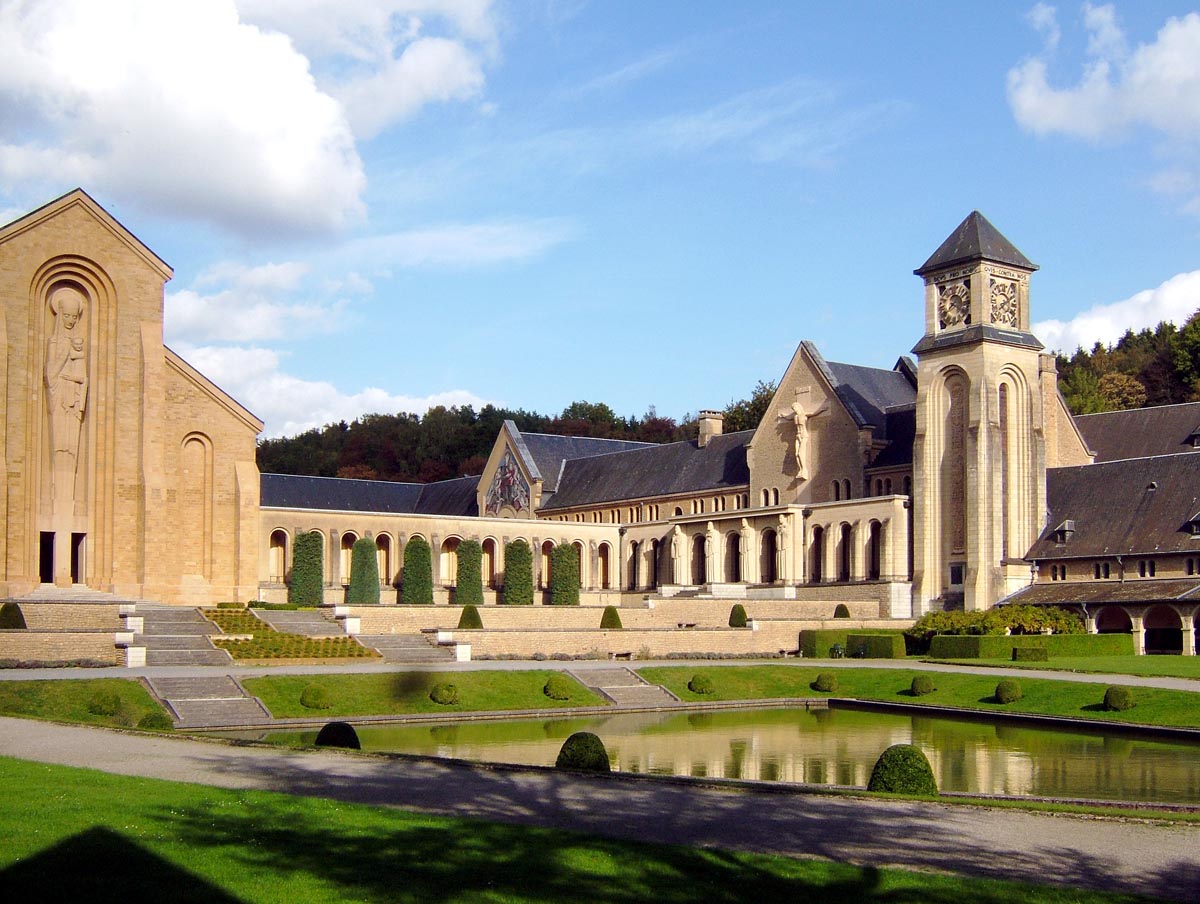
Photo: Danielbaise · CC BY-SA 4.0 · Wikimedia Commons
Orval Abbey is a monastery in Belgium. Monks first settled this valley in the late eleventh century. The free Lokali audio guide runs 8 minutes.
✓ Published October 2026 · how we write these guides
Visitor facts
| Lokali audio guide | 8 min · free |
|---|---|
| Type | Monastery |
| Location | Florenville, Belgium |
| Coordinates | 49.6397, 5.3489 |
| Official website | orval.be |
| Languages | 50+, in the Lokali app |
The story
Listen first. Beneath the birdsong and the crunch of gravel, there is the sound of running water. A spring rises here, close to the old stones. It has run through this valley for as long as anyone can remember. The air carries damp moss and cut grass from the gardens. On some days it also carries something warmer and sweeter, the smell of malt drifting from the brewery. You are standing in one of Belgium's quietest corners, deep in the forests of the Gaume.
Welcome to Orval Abbey. The Gaume is the southernmost tip of Belgium, close to the French border, with milder weather and softer light than the rest of the country. Here the Ardennes forest opens into a narrow wooded valley. The town of Florenville lies a short drive away. Orval is two places at once. One is a field of medieval ruins, open to visitors. The other is a living monastery, where a community of monks still prays, works and keeps silence.
Start with the story everyone tells here, and remember that it is a legend. Locals say that Matilda, a powerful countess of Tuscany in the eleventh century, came to this valley as a widow. While she sat by the spring, her wedding ring slipped from her finger into the water. She prayed for its return. A moment later, a trout rose to the surface with the ring in its mouth. Grateful, she is said to have cried out that this was truly a valley of gold.
In French, a golden valley is Val d'Or, and Orval comes from those words. Whether the story happened or not, the abbey took it to heart. The trout with a ring in its mouth became Orval's emblem. You will see it carved, painted and printed everywhere — on signs, on gates, and on every bottle of the famous beer. The spring itself is still here. It is called the Matilda Fountain, and you can stand beside the same water from the tale.
Now for the history we can trust. Monks first came to this valley in the late eleventh century. According to the abbey's own account, the first group were Benedictines from Calabria, in the far south of Italy. That is a long journey to reach a remote Belgian forest. In the twelfth century, the community joined the Cistercians. The Cistercians were a reforming order of monks who valued simple buildings, hard manual work and isolated valleys with good water.
That choice shaped what you see in the ruins. Cistercian churches were plain on purpose. They avoided rich decoration so that nothing would distract from prayer. Walk through the remains of the medieval church and you will see the style: long lines, tall pointed arches and pale, honey-coloured stone. The local stone takes on a golden tone in late afternoon. The great rose window in the west wall is now open to the sky. Its round frame still holds the outline of the tracery.
The abbey did not have an easy life. Fire damaged it in the thirteenth century, and wars crossed this border region many times. Each time, the monks rebuilt. Over the centuries Orval grew wealthy. It ran farms and forges, because this part of the Gaume had iron ore. By the eighteenth century the abbey was large and grand. Then came the French Revolution. In the 1790s, French revolutionary troops burned Orval. The monks scattered, and the buildings were left to decay.
For more than a century, Orval was only a ruin. Local people took stones away to build houses and barns. Trees grew through the cloister. Here is a detail many visitors miss. Some of the medieval stone you see in nearby villages may have come from these walls. The abbey did not simply disappear. Parts of it spread across the valley and became the homes of the people who lived around it.
The revival began in the twentieth century. In the 1920s, monks returned, and a vast rebuilding project started beside the old ruins. Rather than restore the medieval church, the builders chose to leave the ruins as they were. They raised a completely new abbey next to them. The new church was consecrated after the Second World War. Look at the two side by side. The modern buildings echo the old Cistercian simplicity, but in clean, smooth, almost geometric forms.
That rebuilding was expensive, and here is the second surprise. The famous Orval beer exists because of this construction work. The brewery was founded in the early 1930s to help pay for the new abbey. Today Orval is one of the Trappist beers. Trappist is the name for a strict branch of the Cistercians, and only beers brewed under the supervision of these monks may carry the label. The profits support the community and its charitable work, not private shareholders.
The beer has an unusual character. It is dry and bitter, with a slightly wild, earthy edge that changes as the bottle ages. Its bottle is easy to spot, short and rounded like a skittle, with the trout and ring on the label. The brewery itself is usually closed to the public. But the café just outside the abbey gates traditionally serves Orval. It also serves a lighter version brewed mostly for the monks and local tables. The abbey also makes cheese, sold in the shop.
Before you leave the ruins, look for the smaller corners. In the old cellars there is a museum with stonework, models and objects from the abbey's past. Nearby is a garden of medicinal plants, set out in neat beds. It recalls the monks' long work as healers. There is also a reconstruction of an old monastic pharmacy, with its jars and wooden shelves. These quiet rooms show daily monastic life, not only grand architecture.
Remember that this is still a home for prayer. The monks follow a daily rhythm of services, from before dawn until night. Visitors do not enter the private parts of the monastery. Sometimes you may hear bells mark the hours. If you sit quietly at the edge of the ruins, you may catch something hard to find elsewhere — the same sound of bells and water that monks have heard in this valley for nearly a thousand years.
So take a last moment here. Look up through the empty rose window, where clouds now fill the space that once held glass. Look across at the newer walls, and down to the spring that started the story. Ruin and rebuilding stand side by side, and both are part of Orval. As you walk back toward the gate, listen again for the water. It will still be running after you have gone.
Key facts
What to look for
Practical tips
Common questions
Is there a free audio guide to Orval Abbey?
Yes — the Lokali app narrates Orval Abbey free of charge in 50+ languages. The guide runs about 8 minutes, covers the history, what to look for on site and practical tips, and works offline once downloaded.
Where is Orval Abbey?
Orval Abbey is near Florenville, Belgium, at 49.6397, 5.3489. Tap the map link on this page for directions from where you are.
What is Orval Abbey known for?
Monks first settled this valley in the late eleventh century. The community joined the Cistercian order in the twelfth century.
What should you look for at Orval Abbey?
The trout with a ring carved into the abbey emblem. The empty rose window framing the sky in the ruins. The Matilda Fountain spring beside the medieval walls.
What should you know before visiting Orval Abbey?
Visit in late afternoon for warm light on the ruins. Taste Orval at the café just outside the abbey gates.
When is the best time to visit Orval Abbey?
Visit in late afternoon for warm light on the ruins.
On the map
Opens directions to Orval Abbey from your location.
More to see near Orval Abbey


Hear Orval Abbey in your language
The full story, narrated, in 50+ languages. Download it before you go and it plays offline, at your own pace, with no ticket and no tour group.