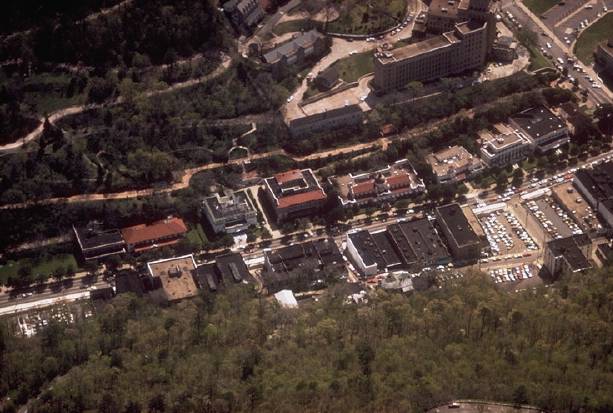
Hot Springs National Park
34.5136° N · 93.0536° W · National Park
Photo: Wikimedia Commons contributor · Public domain · Wikimedia Commons
Hot Springs National Park is a United States National Park in central Arkansas. It is near Garland County, United States. Congress protected the springs as a reservation in 1832. The free Lokali audio guide runs 7 minutes.
✓ Published October 2026 · how we write these guides
Visitor facts
| Lokali audio guide | 7 min · free |
|---|---|
| Type | National Park |
| Location | Garland County, United States |
| Coordinates | 34.5136, -93.0536 |
| Official website | nps.gov |
| Languages | 50+, in the Lokali app |
The story
Put your hand near one of the open springs and you will feel it first, before you see anything at all. A soft warmth rises off the stone. On a cool morning a thin mist drifts up from the rock and hangs in the air. The water here comes out of the ground hot, hot enough that you should not touch it at the source. Behind you, cars pass slowly along Central Avenue. In front of you, water that fell as rain thousands of years ago is coming back to the surface.
Welcome to Hot Springs National Park, in Garland County, Arkansas. It is one of the smallest parks in the American national park system. It is also one of the strangest. Most national parks protect wilderness, with canyons, glaciers or forests. This one protects water, and it sits right inside a working city. Here, the national park and the town grow into each other. A bathhouse built for wealthy visitors stands next to a modern street with diners and souvenir shops.
Here is the first surprise. This place was protected long before Yellowstone. In 1832, the United States Congress set aside the hot springs as a federal reservation. That was forty years before Yellowstone became the first national park. So Hot Springs has a fair claim to being the oldest protected area in the federal system. It became a national park in name much later, in 1921. The idea of protecting a special place for the public was tested here first.
Where does the heat come from? The answer is slow and patient. Rain falls on the surrounding hills and soaks deep into cracks in the rock. Far underground, the earth warms it. The heated water then rises back up along faults and comes out on the lower slope of Hot Springs Mountain. Scientists who have studied the water estimate that the whole journey takes thousands of years. When you touch it, you are touching very old rain.
The water arrives at roughly 143 degrees Fahrenheit, or about 62 degrees Celsius. It has almost no smell, unlike many hot springs around the world. Most of it is now collected and piped away before you ever see it. This system was built to keep the water clean and to send it to the bathhouses. A few springs are left open for display, so visitors can see the water as it leaves the hillside. Look for the pale, crusty rock around them.
That pale rock is called tufa. It is a mineral deposit that forms as the hot water cools and leaves dissolved minerals behind. Over long periods, tufa builds up in layers, almost like a slow stone waterfall. Some of the hillside behind the bathhouses is made of it. It looks rough and porous, a little like dried sponge. It is a quiet record of how long this water has been flowing out of the mountain.
People came here for the water long before the bathhouses. Native American peoples knew these springs well. Locals often tell a popular story that the Spanish explorer Hernando de Soto visited in the sixteenth century. Historians are not certain about that. Treat it as legend rather than confirmed history. What is certain is that by the nineteenth century, visitors arrived in growing numbers. They believed that soaking in hot water could cure almost anything.
That belief built Bathhouse Row. Walk along the line of grand buildings beside Central Avenue. There are eight historic bathhouses, and most date from the early twentieth century, the peak of the bathing era. Each one tried to look more elegant than its neighbour. You will see Spanish-style tiled roofs, classical columns and Renaissance-style details. Bathhouse Row is now a National Historic Landmark. It is one of the best-preserved groups of bathhouse architecture in the country.
The Fordyce Bathhouse is the place to go inside. Today it serves as the park's visitor centre and museum. It is set up to show how a visit worked in the bathhouse years. You will see tubs, steam cabinets, massage rooms and a gymnasium. Some of the equipment looks a little alarming to modern eyes. In the men's bath hall, look up. A stained-glass ceiling fills the room with soft, coloured light. Bathing here was meant to feel like a ritual.
Here is the second surprise. You can still take a traditional bath on Bathhouse Row. The Buckstaff Bathhouse has offered baths for more than a century and still runs them in the old style. The Quapaw Bathhouse offers a more modern spa experience with thermal pools. These services are run separately from the park, so check their own details before you plan a soak.
The springs drew more than invalids. In the early twentieth century, Major League Baseball teams came here for spring training. Players soaked in the baths and trained in the warm hills. Babe Ruth is among the famous names connected with the town in those years. Hot Springs also had a lively, and sometimes illegal, side, with gambling halls and nightlife. Locals still tell stories about well-known gangsters who came to relax here. Many of those tales grew bigger over time.
For a calmer view, walk up behind the bathhouses to the Grand Promenade. This wide brick path runs along the hillside above Bathhouse Row. From here you look down on the tiled roofs and across to the town. Trails climb from the promenade into the wooded hills, under oaks and hickories. At the top of Hot Springs Mountain, an observation tower gives a wide view over the low Ouachita Mountains. They are the old, rounded hills that feed these springs.
Back on the street, watch the public fountains. People arrive with empty jugs and plastic bottles and fill them with spring water to take home. It is free to collect, and many locals do it every week. It is a small habit, but it says a lot about this town. The water is not only history here. It is part of daily life, carried home in the back seat of a car.
Before you leave, stand still for a moment near one of the open springs again. Feel the warmth on your face and watch the steam drift into the trees. The bathhouses behind you will keep changing with the times. The town will keep changing too. But the water will keep arriving, as it has for thousands of years. It is the same slow rain, returning, warm, to the surface.
Key facts
What to look for
Practical tips
Common questions
Is there a free audio guide to Hot Springs National Park?
Yes — the Lokali app narrates Hot Springs National Park free of charge in 50+ languages. The guide runs about 7 minutes, covers the history, what to look for on site and practical tips, and works offline once downloaded.
Where is Hot Springs National Park?
Hot Springs National Park is near Garland County, United States, at 34.5136, -93.0536. Tap the map link on this page for directions from where you are.
What is Hot Springs National Park known for?
Congress protected the springs as a reservation in 1832. Protected forty years before Yellowstone became a national park.
What should you look for at Hot Springs National Park?
Pale, porous tufa rock around the open display springs. Stained-glass ceiling in the Fordyce men's bath hall. Red-tiled roofs and columns along Bathhouse Row.
What should you know before visiting Hot Springs National Park?
Start inside the Fordyce Bathhouse visitor centre for context. Bring an empty bottle to fill at the thermal fountains.
When is the best time to visit Hot Springs National Park?
Visit on a cool morning to see steam rising.
On the map
Opens directions to Hot Springs National Park from your location.
Hear Hot Springs National Park in your language
The full story, narrated, in 50+ languages. Download it before you go and it plays offline, at your own pace, with no ticket and no tour group.