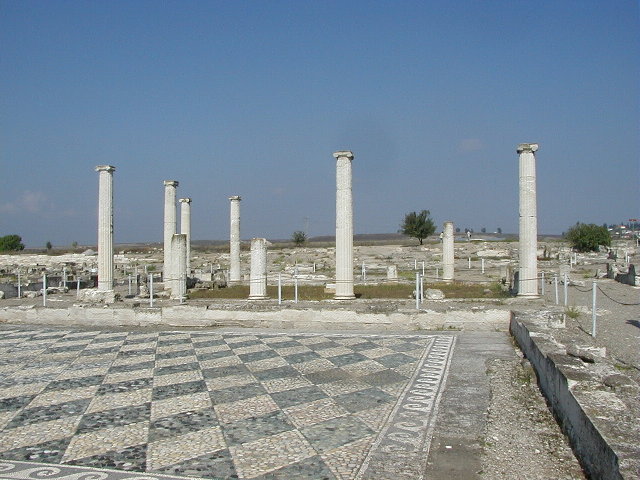
Photo: Brian Donovan · Public domain · Wikimedia Commons
Pella is a capital of the ancient kingdom of Macedon. King Archelaus moved the Macedonian capital here from Aigai. The free Lokali audio guide runs 7 minutes.
✓ Published October 2026 · how we write these guides
Visitor facts
| Lokali audio guide | 7 min · free |
|---|---|
| Type | Archaeological Site |
| Location | Giannitsa, Greece |
| Coordinates | 40.7600, 22.5256 |
| Official website | pella-museum.gr |
| Languages | 50+, in the Lokali app |
The story
Listen for a moment. The wind moves across flat green fields. A tractor hums somewhere in the distance. Under your feet the gravel crunches, pale and dusty. Around you, low walls of stone and brick rise only to knee height or waist height. It looks quiet, almost modest. But you are standing in the streets of a royal capital. This is Pella, once the heart of the kingdom of Macedon, and the city where Alexander the Great was born.
The ancient city lies just outside modern Giannitsa, beside a small village that still carries the old name. The plain around you is wide and fertile. Today it is farmland, criss-crossed by roads and irrigation channels. In ancient times, the landscape looked very different. Pella sat close to a large lagoon that connected to the sea. Boats could reach the city. Over many centuries, rivers carried silt into the lagoon and slowly filled it. The water retreated, and the harbour disappeared.
So why did Macedonian kings build their capital here? The older royal seat was Aigai, further south, in the foothills near the mountains. Around the end of the fifth century before Christ, King Archelaus moved the court to Pella. Historians usually explain the move through trade and power. A city near the water could reach the wider Greek world more easily. Archelaus wanted Macedon to look outward, not only toward its mountain past.
Archelaus also wanted culture. He invited artists and writers from southern Greece to his court. The playwright Euripides, one of the great tragic poets of Athens, spent his final years in Macedon. Ancient writers also say the famous painter Zeuxis worked on the royal palace. For the Greeks of Athens, Macedonians were often seen as rough outsiders. Archelaus used art and literature to answer that view. Pella was meant to be a statement.
The most famous child of this city came a few decades later. In 356 BC, Alexander was born here, son of King Philip the Second and Queen Olympias. He grew up in these streets and in the palace on the hill to the north. Here is a detail many visitors miss. His famous teacher, the philosopher Aristotle, did not teach him in Pella itself. The lessons took place at a quieter sanctuary called Mieza, some distance to the west.
Now look at the layout around you. The streets run in straight lines and cross at right angles. This grid pattern was a mark of careful planning in the Greek world. Wide avenues divided the city into regular blocks. Houses filled those blocks, and many of them were large. Some wealthy homes covered a whole block on their own, with courtyards, columns, and many rooms. Walking here, you can still follow the old streets with your feet.
At the centre of the city lay the agora, the great public marketplace. It was enormous, one of the largest known in the Greek world. Shops and workshops lined its sides. Archaeologists found traces of potters, metalworkers, and sellers of perfume and food. Imagine the noise. Traders calling out prices. Carts on stone. Voices in many dialects, because Pella drew merchants from across the Mediterranean. Today, only the outlines remain, and the silence makes the space feel even larger.
Now for the real treasure of Pella — the mosaics. These are not made of cut tiles, like later Roman mosaics. They are made of small natural river pebbles, chosen for their colour and set by hand. Artists used thin strips of lead or clay to sharpen the outlines of figures. The results are full of movement and depth. In the late fourth century before Christ, this was some of the finest floor art in the Greek world.
One mosaic shows two young men hunting a lion. One raises a sword, the other a spear. Some scholars suggest the figures could be Alexander and his companion Krateros, because ancient sources mention a lion hunt they shared. This is an interpretation, not a certainty. Another floor shows a stag hunt. Here is a second surprise. The artist signed it. The Greek inscription reads, in effect, Gnosis made this. It is one of the earliest signed mosaics we know.
Other floors show the god Dionysus, the god of wine and theatre, riding on the back of a panther. One house is now called the House of Dionysus because of this scene. Another is known as the House of the Abduction of Helen, after a mosaic showing the myth that started the Trojan War. Some of these floors remain on site. Others are protected in the archaeological museum nearby, where the light and the closer view show every pebble clearly.
Pella did not stay a capital forever. After Alexander, his empire broke apart, but Macedon remained a strong kingdom. Then Rome arrived. In 168 BC, the Romans defeated the last Macedonian king at the Battle of Pydna. Ancient accounts describe Roman soldiers carrying away great wealth from Pella. Later, an earthquake damaged the city badly. Life moved elsewhere. Slowly, soil and fields covered the ruins, and the royal capital became farmland.
The ancient city came back into view in the twentieth century. Discoveries in the fields led to systematic excavations, and work has continued for decades. Large parts of the city still lie unexcavated under the surrounding land. The palace on the hill is still being studied. In other words, Pella is not a finished story. Each season of digging can add new detail. The modern museum nearby holds many of the finds, from jewellery to painted plaster and those famous pebble floors.
Before you leave, stand still for a moment in one of the old streets. Look north toward the low hill where the palace stood. Look south across the flat plain, where the lagoon once shone in the sun. Notice how small the walls are now, and how wide the sky feels. Kings, poets, merchants, and a boy who would reach India all walked on this same ground. As you walk back, listen to the gravel under your shoes. It is the same sound, more or less, that filled these streets long ago.
Key facts
What to look for
Practical tips
Common questions
Is there a free audio guide to Pella?
Yes — the Lokali app narrates Pella free of charge in 50+ languages. The guide runs about 7 minutes, covers the history, what to look for on site and practical tips, and works offline once downloaded.
Where is Pella?
Pella is near Giannitsa, Greece, at 40.7600, 22.5256. Tap the map link on this page for directions from where you are.
What is Pella known for?
King Archelaus moved the Macedonian capital here from Aigai. Alexander the Great was born in Pella in 356 BCE.
What should you look for at Pella?
Straight streets crossing at right angles in a regular grid. Pebble mosaics with thin strips outlining each figure. The low hill to the north where the palace stood.
What should you know before visiting Pella?
Visit the nearby archaeological museum to see the finest mosaics. Bring a hat and water; the site has little shade.
When is the best time to visit Pella?
Come early morning for cooler air and softer light.
On the map
Opens directions to Pella from your location.
More to see near Pella


Hear Pella in your language
The full story, narrated, in 50+ languages. Download it before you go and it plays offline, at your own pace, with no ticket and no tour group.