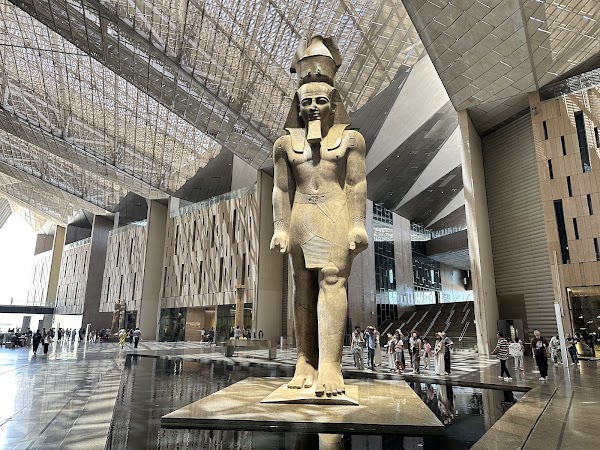
The Grand Egyptian Museum is a museum in Giza, Egypt. Egypt's largest museum, opened in 2021 near the Giza Plateau. Most visitors spend 3–5 hours here. The free Lokali audio guide runs 9 minutes.
✓ Verified August 2026 · how we write these guides
Visitor facts
| Time needed | 3–5 hours |
|---|---|
| Lokali audio guide | 9 min · free |
| Type | Museum |
| Best for | Editors' pick |
| Location | Giza, Egypt |
| Coordinates | 29.9759, 31.1346 |
| Languages | 45, in the Lokali app |
The story
Stand at the edge of the Giza Plateau and look toward the pyramids. Between you and those ancient monuments sits a building clad in translucent alabaster panels, its triangular silhouette echoing the geometry of the tombs behind it. This is the Grand Egyptian Museum, the largest archaeological museum in the world dedicated to a single civilization.
The structure covers roughly five hundred thousand square metres. Architects Heneghan Peng won the competition in 2002 with a design that aligns directly with the Pyramids of Khufu and Khafre — walk the Grand Staircase inside and you will see the monuments framed through floor-to-ceiling glass at the far end. The building itself becomes a kind of procession, a slow ascent toward the plateau, much like the ancient funeral routes that once led to these royal burials.
Inside, the museum holds over one hundred thousand objects. Many have never been displayed before. The collection spans five thousand years, from the Predynastic Period through the Greco-Roman era. You will find statues, jewelry, pottery, weapons, tools, textiles — the material residue of daily life and divine ritual. The galleries are organized chronologically, so you move through time as you move through space.
The headline attraction is the complete Tutankhamun collection, reunited under one roof for the first time. More than five thousand objects from the boy king's tomb, including the golden funerary mask, chariots, beds, and the nested coffins. Howard Carter spent a decade emptying that tomb in the Valley of the Kings, and the objects were scattered across Egyptian museums and storage facilities for nearly a century. Here, they are finally together.
Look for the Grand Staircase itself as an exhibit. Eighty-seven large-scale statues and artifacts line the steps, including a colossal statue of Ramesses II that once stood at the entrance of the ancient temple of Memphis. The statue weighs eighty-three tonnes. Moving it here required a custom-built trailer and a convoy that shut down roads across Cairo. It now greets visitors at the base of the staircase, a vertical axis connecting the modern city below to the ancient necropolis above.
The museum's conservation center is visible through glass walls in certain sections. You can watch restorers working on objects in real time — cleaning stone, stabilizing wood, piecing together fragments. This transparency is deliberate. The architects wanted visitors to see archaeology as an ongoing process, not a finished product. The past is still being assembled, still being interpreted.
One gallery focuses on the construction of the pyramids themselves. Models, tools, workers' graffiti, and administrative papyri show how the projects were organized. You learn that the builders were not enslaved labor but skilled workers paid in bread, beer, and onions. The papyri record crew names, shift rotations, and supply deliveries. The pyramids were not mysteries built by lost technology — they were state projects managed with bureaucratic precision.
The building's energy systems are worth noting. The alabaster facade is not solid stone but a composite panel system that filters daylight into the galleries. Solar panels on the roof provide part of the electrical load. Groundwater cooling reduces the demand on air conditioning in a desert climate. The museum was designed to last centuries, and the infrastructure reflects that ambition.
Walk to the western terrace if it is open. From there, you have an unobstructed view of all three Giza pyramids and the Sphinx. The museum does not compete with those monuments — it defers to them. The roofline stays low, the materials stay neutral. The message is clear: the ancient structures remain the stars. This building is their interpreter.
Outside, the landscaping includes native desert plants and a series of reflecting pools. The pools mirror the pyramids at certain times of day, creating a doubled image — the real monuments and their liquid reflections. It is a quiet effect, easy to miss if you are rushing. But if you pause, the water holds the geometry of the plateau in a way that feels both ancient and immediate.
As you leave, notice the way the museum positions you. You arrive facing the pyramids. You move through five millennia of objects. You exit with the monuments still in view. The experience is not about the building — it is about the long conversation between past and present, between the objects in the cases and the stones on the horizon. That conversation continues as you walk back toward the plateau, the museum's glass facade catching the afternoon light behind you.
Key facts
What to look for
Practical tips
Common questions
How long do you need at The Grand Egyptian Museum?
Plan 3–5 hours. That is the time most visitors spend at The Grand Egyptian Museum. The free Lokali audio guide adds about 9 minutes of narration you can listen to as you walk, so it fits inside your visit rather than adding to it.
Is there a free audio guide to The Grand Egyptian Museum?
Yes — the Lokali app narrates The Grand Egyptian Museum free of charge in 50+ languages. It covers the history, what to look for on site and practical tips, and it works offline once downloaded.
Where is The Grand Egyptian Museum?
The Grand Egyptian Museum is in Giza, Egypt, at 29.9759, 31.1346. Tap the map link on this page for directions from where you are.
What should you know before visiting The Grand Egyptian Museum?
Visit the western terrace for unobstructed pyramid views.
What is The Grand Egyptian Museum known for?
Largest archaeological museum dedicated to a single civilization.
What is the best time to visit The Grand Egyptian Museum?
Arrive early to avoid crowds.
On the map
Opens directions to The Grand Egyptian Museum from your location.
Hear The Grand Egyptian Museum in your language
The full story, narrated, in 50+ languages. Download it before you go and it plays offline, at your own pace, with no ticket and no tour group.